
Best Fujifilm Cameras
Right off the bat, here are my best Fujifilm cameras sorted by different categories. I also provide great lens recommendations for each camera.
You may want to check out my Ultimate Guide to Best FUJIFILM Lenses.
In addition, I’d encourage you to snap up the amazing deals on 2 Best Viltrox Fuji Lenses | What’s In My Bag?.
- Best All-Around/Bang For Your Buck: Fujifilm X-T30 III
- Best for Beginners: Fujifilm X-A7
- Best for Enthusiasts: Fujifilm X-E4
- Best for Professionals: Fujifilm X-T5
- Best for Travel Photography: Fujifilm X-T5
- Best for Wildlife and Sports: Fujifilm X-H2S
- Best for Landscape and Studio Work: Fujifilm X-H2
- Best for Street Photography: Fujifilm X100V
- Best Money-No-Object: Fujifilm GFX100 II
Fujifilm’s Camera Series Explained
Fujifilm offers a diverse range of digital cameras designed to meet the needs of various photographers, from beginners to professionals. Understanding the different series can help you choose the best Fujifilm camera for your needs.
Here’s a breakdown of each series, categorized by their purpose and standout qualities, At the end of the article you can find all of the current models and their prices.
| Series | Purpose | Standout Qualities | Target Audience |
|---|---|---|---|
| X-A Series | Beginner Series | Lightweight, user-friendly, built-in filters, easy sharing | Beginners, casual photographers |
| X-E Series | Rangefinder-Style for Enthusiasts | Compact, rangefinder-style, advanced controls, high-quality image sensor | Enthusiasts, advanced amateurs, street photographers |
| X-T Series | Traditional Style-Viewfinder for Enthusiasts and Professionals | Robust, weather-sealed, in-body stabilization, high-speed shooting | Enthusiasts to professionals |
| X-Pro Series | Rangefinder-Style for Professionals | Hybrid viewfinder, durable, rangefinder-style, manual controls | Professionals, photojournalists, street photographers |
| X-H Series | Traditional Style-Viewfinder for Professionals | High-end APS-C, in-body stabilization, advanced video, weather-sealed | Professionals, videographers |
| GFX Series | Medium Format for Ultimate Image Quality | Exceptional detail, dynamic range, superior color reproduction | Studio, high-end landscape, commercial photographers |
| X100 Series | Highly Portable Fixed Lens | Fixed lens, hybrid viewfinder, compact and discreet | Street, travel photographers, casual shooters |
| XF Series | Compact and Versatile for Enthusiasts | Portability, user-friendly, advanced manual controls | Enthusiasts, vloggers, casual photographers |
| XP Series | Basic Weatherproof Cameras | Waterproof, shockproof, freeze-proof, simple interface | Adventure photographers, outdoor enthusiasts, active families |
Best Value (Bang-For-Your-Buck) Fujifilm Camera
Fujifilm X-T30 III

The Fujifilm X-T30 III offers incredible value for its price, providing many features found in higher-end models without breaking the bank.
It’s known for its powerful performance, advanced autofocus, and compact, lightweight design, making it perfect for a variety of photography styles.
Why You’ll Love It:
- Versatile and powerful
- Advanced autofocus
- Compact and lightweight
Cons:
- Smaller grip may not be comfortable for all users.
- No weather sealing.
Expert Review
A lack of IBIS and video performance help keep the price of the Fujifilm X-T30 II down, meaning it falls short in many of the same areas as its predecessor.
– Peter Wolinski, Fujifilm Camera Reviewer
However, its image quality, range of creative features and gorgeous design make it a stellar mid-range choice for enthusiasts.
Fujifilm X-T30 III vs. X-S20
The Fujifilm X-T30 II offers excellent image quality and performance in a compact body, making it ideal for travel and street photography.
However, if you prefer a more substantial grip and additional features, the Fujifilm X-S20 might be a better choice. The X-S20 includes in-body image stabilization (IBIS), which is particularly useful for reducing camera shake in low light and handheld situations.
Additionally, the X-S20 has a deeper grip, providing better ergonomics, especially for those with larger hands or when using heavier lenses.
While both cameras share the same 26.1MP APS-C sensor, the X-S20’s added features, such as a higher resolution screen, advanced AI autofocus, and improved battery life, make it a compelling option for those looking for enhanced stability and handling at a similar price point.
Expert Review
I really liked the fusion of X-T series features in a smaller, cheaper, more accessible package when the X-S10 was launched. That continues to be the lane that X-S20 operates in, though it seems like Fuji is pushing the video side of things in the X-S20.
– Dustin Abbott, Fujifilm Camera Reviewer
That stands to reason, as there are more tangible improvements available on the video side of things in the X-S20, from the improved video options (resolutions, bitrates, formats) to accessories like the grip and cooling fan.
The main physical addition is a headphone monitoring jack, and while photographers will also benefit from the much larger battery, it will impact video shooters arguably even more.
Even the inclusion of the VLOG option on the mode dial and the options that it opens up are obvious attempts to market this camera to a new audience.
If you happen to be in this audience, the Fujifilm X-S20 should be a very compelling potential camera for you.
Best Fujifilm Camera for Enthusiasts
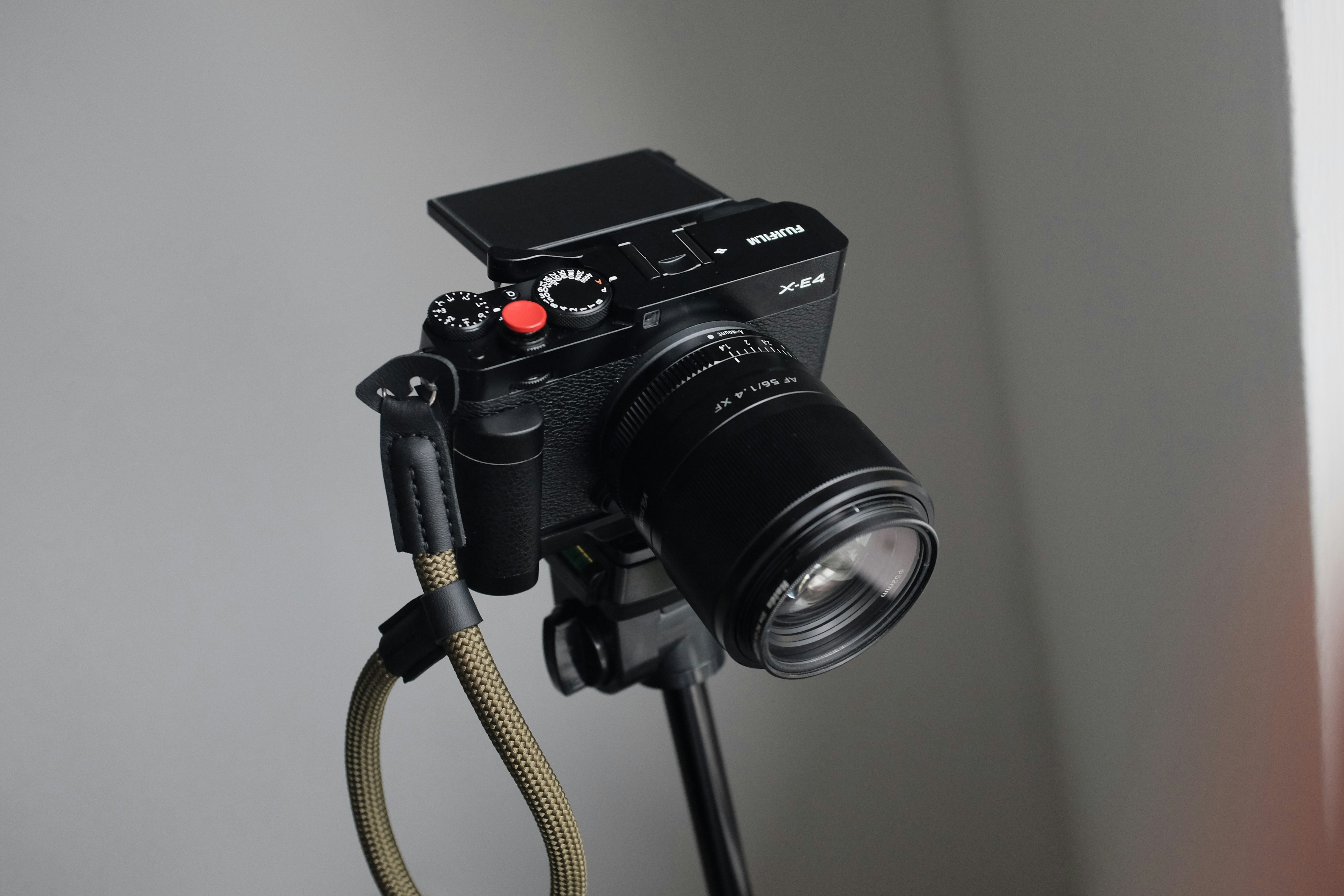
Fujifilm X-E4

If you’re an enthusiast, the Fujifilm X-E4 might be your dream camera. This rangefinder-style camera is compact and stylish, yet it doesn’t skimp on performance.
It has advanced manual controls and a superior image sensor, making it ideal for street photography and travel.
Why You’ll Love It:
- Rangefinder design
- Advanced manual controls
- Compact and portable
Cons:
- No in-body image stabilization.
- Limited battery life.
Expert Review
The Fujifilm X-E4 is the fourth camera in the X-E series, and no matter how long (or if) that line continues, it will always have limitations or lack features as it is the lowest-priced camera in the X lineup.
– Tom England, Fujifilm Camera Reviewer
The shortcomings or areas of improvement for the X-E4 may never be corrected as more features and conveniences could continue to be reserved for the more expensive X cameras.
But the X-E4 is an excellent evolution of the X-E line, and I’m pleased with the camera and still amazed by what the camera is capable of.
I can confidently say that the Fujifilm X-E4 is one of the best camera purchases I have ever made; it has allowed me to be more confident in public places with its small size and has allowed me to be more creative and experimental using film simulations and recipes.
Fujifilm X-E4 vs. Fujifilm X-T30 II
The X-E4 is praised for its compact, rangefinder-style design, making it a great companion for street photographers and travelers who need a lightweight, unobtrusive camera.
However, if you require more robust features, the X-T30 II is worth considering. The X-T30 II provides in-body image stabilization (IBIS), which the X-E4 lacks. This feature is particularly beneficial for handheld shooting in low light conditions.
Additionally, the X-T30 II offers a higher resolution electronic viewfinder (EVF), more customizable buttons, and better battery life.
The X-T30 II also includes more advanced video capabilities, making it a versatile option for both photography and videography enthusiasts.
Best Fujifilm Cameras for Professionals
Fujifilm X-T5

The Fujifilm X-T5 is a powerhouse, designed for professionals who need top-notch performance. It boasts a robust build, advanced features, and excellent image quality. Whether you’re shooting landscapes or portraits, this camera won’t let you down.
Why You’ll Love It:
- Robust and durable
- Excellent image quality
- Advanced features for professional use
Cons:
- Higher price point.
- Larger and heavier than some mirrorless options.
Expert Reviews
The X-T5’s greatest competition may just be in the form of Fujifilm’s own X-H2, which adds a number of features including: much deeper buffers, superior memory card technology, 8K video, fully articulating LCD screen, higher resolution viewfinder, has a full size HDMI port along with a native headphone jack, and can be gotten with a vertical grip and cooling fan.
– Dustin Abbott, Fujifilm Camera Review
The X-T5 is more compact and has the retro look and control scheme that some love, however. It would seem that the X-T5 is the generation where Fuji has worked to create more market separation between the two lines…which will either simplify or complicate your buying decision.
Fujifilm X-T5 vs. Fujifilm X-T4

The X-T5 is designed for professionals who need the utmost in performance and durability. It offers a robust build and top-notch image quality, making it perfect for demanding photography tasks.
However, if the X-T5’s higher price is a concern, the Fujifilm X-T4 provides a more affordable alternative with many similar features.
The X-T4 includes in-body image stabilization (IBIS), a high-resolution electronic viewfinder (EVF), and excellent 4K video capabilities, all of which make it a versatile option for both still photography and video work.
While the X-T5 may offer incremental improvements in durability and features, the X-T4 remains a powerful and cost-effective choice for professionals. The X-T4 is also only incrementally more affordable.
Best Money-No-Object Fujifilm Camera
Fujifilm GFX100 II

For ultimate image quality, look no further than the Fujifilm GFX100 II. This medium format camera offers exceptional detail and dynamic range, perfect for studio work, high-end commercial photography, and fine art.
Why You’ll Love It:
- Exceptional image quality
- Large medium format sensor
- Perfect for studio and commercial work
Cons:
- Very high price.
- Large and heavy, not ideal for casual or travel photography.
To be honest, the images below do not fully showcase the camera’s capabilities. The camera is still too new to have many sample images available.
Expert Review
The Fujifilm GFX100 II goes a long way towards fulfilling Fuji’s goal of making medium format as accessible as their smaller format cameras.
– Dustin Abbott, Fujifilm Camera Review
The GFX100 II is a beautiful camera with a truly gorgeous grip/wrap that makes me instantly wish all of my cameras had it.
There are still places where the ergonomics and autofocus don’t measure up to the best full frame cameras, but that is counterbalanced by image quality that those same cameras can’t measure up to.
Fujifilm GFX100 II vs. Fujifilm GFX50S II

The GFX100 II is the pinnacle of image quality, thanks to its 102MP medium format sensor that delivers stunning detail and dynamic range. It’s the absolute best Fujifilm camera in 2024.
It’s ideal for studio photographers and commercial work where the highest resolution is required.
However, if the price of the GFX100 II is beyond your budget, the Fujifilm GFX50S II offers a more accessible entry point into medium format photography.
The GFX50S II features a 51.4MP sensor, which still provides exceptional image quality and dynamic range, suitable for high-end commercial and fine art photography.
While it doesn’t match the GFX100 II in resolution, it’s a fantastic alternative for those looking to experience medium format at a lower price.
Best Fujifilm for Wildlife and Sports
Fujifilm X-H2S

The Fujifilm X-H2S is specifically designed to handle fast-paced photography, making it ideal for wildlife and sports. It features a stacked CMOS sensor that offers exceptional speed and performance.
Why You’ll Love It:
- Stacked CMOS Sensor: Provides faster readout speeds, reducing rolling shutter effects and enabling high-speed continuous shooting
- Advanced Autofocus: Superior autofocus capabilities with subject detection and tracking, crucial for capturing fast-moving wildlife
- High-Speed Performance: Capable of shooting up to 40 frames per second with the electronic shutter, ensuring you never miss a moment
Cons:
- Higher Price Point: It’s more expensive than the X-H2
- Battery Life: Intensive use of high-speed features can drain the battery faster
Expert Review
The Fujifilm X-H2S is the ultimate APS-C camera. Thanks to falling prices, though, it makes more sense than ever in 2024.
– Peter Wolinski, Fujifilm Camera Review
This camera still packs the latest and greatest Fuji has to offer, and will be more than enough camera for all but the most demanding pros for a long time to come.
Fujifilm X-H2S vs. Fujifilm X-H2
The X-H2S excels in scenarios requiring high-speed performance, such as wildlife and sports photography. Its stacked CMOS sensor allows for faster readout speeds and reduces rolling shutter effects, essential for capturing fast-moving subjects.
The camera’s advanced autofocus system includes subject detection and tracking, ensuring sharp images of unpredictable wildlife.
On the other hand, the Fujifilm X-H2 offers a higher resolution 40MP sensor, which is great for detailed landscapes and studio work.
However, it doesn’t match the X-H2S’s speed and autofocus capabilities, making the X-H2S a better choice for wildlife photography.
Best Fujifilm for Landscape and Studio Work
Fujifilm X-H2

The Fujifilm X-H2 is perfect for photographers who need high resolution and superb image quality, making it ideal for landscape and studio work. With its 40MP sensor, it delivers exceptional detail and dynamic range.
Why You’ll Love It:
- High-Resolution Sensor: 40MP sensor provides outstanding detail and image quality
- Advanced Features: Includes in-body image stabilization (IBIS) and a high-resolution electronic viewfinder (EVF)
- Robust Build: Weather-sealed and durable for various shooting conditions
Cons:
- Slower than the X-H2S: Not as fast in continuous shooting or autofocus performance
- Higher Price Point: Still expensive, though less than the X-H2S
Expert Review
The more I have used the X-H2S and now X-H2, the more I enjoy the overall experience.
Morten, 5050 Travelog
These cameras have Fujifilm DNA with a mix of features and design clues derived from the GFX series and the X-H1 and then spiced up with a new feature set and speed bumps which make them strong contenders, no matter which platform you come from.
The X-H2 could rightfully get the “photography first” stamp that Fujifilm otherwise gave to the X-T5 and add to this 8K video using the full sensor which makes it quite attractive to hybrid shooters as well….
The 40-megapixel sensor especially shines when it comes to landscape photography where you see a noticeable difference, even on your screen, from either the X-H2S or previous generation sensors from Fujifilm which are all 26 megapixels or lower.
Fujifilm X-H2 vs. Fujifilm GFX50S II

The X-H2 is tailored for photographers needing high resolution and advanced features for detailed landscape and studio photography.
However, if you’re looking for even higher image quality and are willing to invest more, the Fujifilm GFX50S II is an excellent medium format alternative.
The GFX50S II features a 51.4MP sensor, offering unparalleled detail and dynamic range, making it suitable for high-end commercial and fine art photography.
While the X-H2 provides versatility and a slightly lower price point, the GFX50S II delivers top-tier image quality for those who need it.
Best Fujifilm Camera for Beginners
Fujifilm X-A7

The Fujifilm X-A7 is perfect for those just starting out. It’s also the best affordable Fujifilm camera for those on a budget.
It’s got a user-friendly interface, a touchscreen, and excellent image quality thanks to its 24.2MP APS-C sensor. It’s also lightweight and compact, making it super easy to carry around for everyday use.
Why You’ll Love It:
- Simple controls
- Great for vlogging and selfies with its flip screen
- Affordable and packed with features
Cons:
- No viewfinder, which might be a deal-breaker for some.
- Limited 4K video capabilities compared to higher-end models.
Sample Images
Insert sample image showcasing the X-A7’s image quality.
Expert Review
The new X-A7 gives me hope. It’s way faster, has a more robust AF system, a fully articulating touchscreen, AF joystick, a USB-C port and oversampled 4K capture, all for under $700 with a lens.
– Jeff Keller
Fujifilm X-A7 vs. Fujifilm X-T200

The X-A7 is fantastic for beginners due to its intuitive interface and lightweight design, making it easy to carry and use. However, if you find the lack of a viewfinder limiting, the X-T200 might be a better option.
The X-T200 includes a built-in electronic viewfinder (EVF), which can be crucial for shooting in bright light conditions. It’s also much more stylish in my opinion.
Moreover, the X-T200 offers enhanced 4K video capabilities at 30fps compared to the X-A7’s 15fps, making it a better choice for those interested in higher-quality video recording.
While both cameras share the same 24.2MP APS-C sensor, the X-T200’s added features justify its higher price for those looking for more functionality.
Best Fujifilm Compact Camera
Fujifilm X100V

Compact and powerful, the Fujifilm X100V is ideal for street and travel photographers. It features a fixed lens and a hybrid viewfinder, combining portability with high image quality.
The lens offers a focal length of 23mm (135 equivalent: 35mm) and a widest aperture of F2.
Why You’ll Love It:
- Compact and discreet
- Fixed lens for simplicity
- Hybrid viewfinder
Cons:
- Fixed lens limits flexibility.
- No in-body image stabilization.
Fujifilm X100V vs. Fujifilm X-E4

The X100V is perfect for those who want a high-quality, all-in-one solution with a compact design. It’s ideal for street and travel photography, thanks to its fixed lens and hybrid viewfinder.
However, if you prefer the flexibility of interchangeable lenses, the X-E4 is a great alternative.
The X-E4 offers similar portability and image quality but allows you to switch lenses to suit different shooting situations. This makes the X-E4 a better choice for those who want more versatility in their photography.
Every Fujifilm Digital Camera Model
We’ve rounded up the last several models to come out from every Fujifilm series of digital cameras.
This way you can fully understand why and for who they were manufactured. It also allows you to see if you want to bump up or down for a slight difference in price.
1. X-A Series: Beginner Series
Purpose: Entry-level, affordable options for beginners and casual photographers.
Standout Qualities: Lightweight, user-friendly interface with touchscreen controls, built-in filters, and easy sharing options, making them perfect for social media enthusiasts and those new to photography.
Models: Fujifilm X-A7 ($700), Fujifilm X-A5 ($600), Fujifilm X-A3 ($550)
2. X-E Series: Rangefinder-Style for Enthusiasts
What is a Rangefinder-Style Camera?
A rangefinder-style camera has a viewfinder that is separate from the lens, typically placed on the side of the camera body.
This design allows photographers to compose their shots while simultaneously seeing their surroundings, providing a unique and discreet shooting experience popular among street photographers.
Purpose: Compact, stylish cameras for enthusiasts and street photographers.
Standout Qualities: Rangefinder-style design, advanced manual controls, and a high-quality image sensor, making them ideal for advanced amateurs.
Models: Fujifilm X-E4 ($850), Fujifilm X-E3 ($800), Fujifilm X-E2S ($650)
3. X-T Series: DSLR-Style for Enthusiasts and Professionals
Purpose: Versatile DSLR-style cameras for enthusiasts and professionals.
Standout Qualities: Robust build, weather-sealed bodies, advanced autofocus, and high-speed performance, making them versatile and durable for various shooting environments.
Models: Fujifilm X-T5 ($1,700), Fujifilm X-T4 ($1,500), Fujifilm X-T3 ($1,200), Fujifilm X-T30 II ($900), Fujifilm X-T30 ($800), Fujifilm X-T200 ($700)
4. X-Pro Series: Rangefinder-Style for Professionals
Purpose: High-quality, durable cameras for professional photographers.
Standout Qualities: Hybrid viewfinder (both optical and electronic), weather-sealed design, and emphasis on manual controls, providing a unique and professional shooting experience.
Models: Fujifilm X-Pro3 ($1,800), Fujifilm X-Pro2 ($1,500)
5. X-H Series: DSLR-Style for Professionals
Purpose: High-end APS-C cameras for professionals and videographers.
Standout Qualities: In-body image stabilization (IBIS), advanced video capabilities, and robust, weather-sealed bodies, making them suitable for demanding environments and professional use.
Models: Fujifilm X-H2 ($2,000), Fujifilm X-H2S ($2,500), Fujifilm X-H1 ($1,300)
6. GFX Series: Medium Format for Ultimate Image Quality
What are APS-C vs Full-Frame vs Medium Format Sensors?
APS-C Sensor: Measures approximately 22mm x 15mm. APS-C sensors provide very good image quality and are commonly used in consumer and enthusiast cameras, offering a balance between performance and portability.
Full-Frame Sensor: Measures 36mm x 24mm, the same size as a 35mm film frame. Full-frame sensors offer excellent image quality, superior low-light performance, and a wide field of view. They are popular among professional photographers for their versatility across various genres.
Medium Format Sensor: Larger than full-frame, typically around 43.8mm x 32.9mm or larger. Medium format sensors provide the highest image quality, with exceptional detail, dynamic range, and color depth, making them ideal for high-end professional applications like fashion, commercial, and fine art photography.
Purpose: To provide the highest image quality for high-end professionals.
Standout Qualities: Large medium format sensor, superior detail, dynamic range, and color reproduction, catering to studio photographers, high-end landscape photographers, and commercial photographers who require the best image quality possible.
Models: Fujifilm GFX100 II ($8,000), Fujifilm GFX100S ($6,000), Fujifilm GFX50S II ($4,000), Fujifilm GFX50R ($4,500)
7. X100 Series: Highly Portable Fixed Lens
Purpose: High-quality, portable camera for street and travel photographers.
Standout Qualities: Fixed lens and hybrid viewfinder, compact and discreet, offering an all-in-one solution with a high-quality APS-C sensor and manual controls.
Models: Fujifilm X100V ($1,400), Fujifilm X100F ($1,200)
8. XF Series: Compact and Versatile for Enthusiasts
Purpose: Compact, versatile fixed lens cameras for enthusiasts and casual photographers.
Standout Qualities: Portability, user-friendly interface, and advanced manual controls, making them great for everyday photography and vlogging.
Models: Fujifilm XF10 ($500), Fujifilm X70 ($700)
9. XP Series: Basic Weatherproof Cameras
Purpose: Durable, waterproof cameras for adventure and outdoor enthusiasts.
Standout Qualities: Waterproof, shockproof, freeze-proof, and dustproof design, making them suitable for extreme conditions. They feature a simple interface, ideal for beginners and casual shooters engaging in outdoor activities like hiking and swimming.
Models: Fujifilm XP140 ($200), Fujifilm XP130 ($180)
Fujifilm Cameras to Avoid Buying
| Model | Reason |
|---|---|
| Fujifilm X-A5 | Limited autofocus performance and older technology compared to the X-A7, which offers significant improvements in speed, usability, and image quality. |
| Fujifilm X-T100 | Slower autofocus and less refined user interface compared to newer models like the X-T200 or X-T30. The X-T100 lacks many features found in higher-end X-T series cameras, making it less competitive. |
| Fujifilm X-Pro2 | Outclassed by the X-Pro3, which offers better durability, improved autofocus, and a more advanced hybrid viewfinder. |
| Fujifilm X-H1 | Surpassed by the X-H2 and X-H2S, which offer better autofocus, higher resolution, and improved video capabilities. Additionally, the Sony A6600 provides strong competition with superior autofocus and battery life. |
| Fujifilm GFX50S | Largely replaced by the GFX50S II, which offers updated features and improved performance at a similar price point. |
| Fujifilm X70 | Older model with fewer features and slower performance compared to the XF10, which offers better image quality and faster processing at a similar price. |
| Fujifilm XP130 | Surpassed by the XP140, which offers improved durability, better waterproofing, and enhanced performance for outdoor use at a similar price. |




Leave a Reply