
A good inspection camera can save you a lot of guesswork. The 5 Best Endoscope/Boroscope Cameras below are the ones I would look at first if you need to check inside an engine bay, behind drywall, inside ducts, around plumbing, or in any tight space where your eyes cannot reach.
In practical terms, the right pick usually comes down to probe size, screen style, articulation, and whether you want a simple grab-and-go tool or something more advanced for mechanical work.
For anyone also dealing with hidden duct runs or hard-to-see HVAC spaces, the U.S. Department of Energy’s duct guidance is a useful companion read.
If you want the fast answer, the Anykit Dual Lens model with the 6-inch screen is the best overall fit for most readers. It gives you a larger built-in display, front and side viewing, split-screen support, and a 16.5-foot cable, which makes it more versatile than many basic snake cameras.
If you mainly work on engines, machinery, or other awkward angles, an articulating model is the better buy. That is where the Anykit Two-Way Articulating Borescope, Teslong USB-C articulating model, and Ralcam 4-way articulating option make more sense.
Related Articles
- 5 Best Ear Cameras (Top Otoscopes)
- 4 Best Fluke Thermal Cameras (#1 Budget Alternatives)
- 6 Best Camera Bags for Travel: Real-World Picks I’ve Tested
Quick comparison table
| Product | Best for | Screen style | Probe / cable highlights | Main strength |
|---|---|---|---|---|
| Anykit Dual Lens 6″ IPS Borescope | Best overall | Built-in 6″ IPS screen | Dual lens, 16.5 ft cable | Easiest all-around inspection |
| Anykit Two-Way Articulating Borescope | Automotive work | Phone-connected | 210° two-way articulation, 3.9 ft | Better angle control |
| Anykit 4.3″ Standalone Borescope | Beginners | Built-in 4.3″ screen | 0.3″ slim probe, 16.5 ft cable | Very simple setup |
| Teslong USB-C Two-Way Articulating Borescope | Home repair and mixed use | Phone/device-connected | 5 ft semi-rigid probe | Good balance of flexibility and convenience |
| Ralcam 4-Way 360° Articulating Borescope | Advanced inspections | Built-in 4.3″ screen | 6.2mm slim probe, 6.6 ft cable | Best steering control |
Buying fit table
| Product | Good for beginners | Recording support | Waterproof rating | Tradeoff |
|---|---|---|---|---|
| Anykit Dual Lens 6″ IPS Borescope | Yes | Yes | IP67 | Bulkier than phone-first options |
| Anykit Two-Way Articulating Borescope | Moderate | Yes, to phone | IP67 | Shorter cable |
| Anykit 4.3″ Standalone Borescope | Yes | No | IP67 | Simpler feature set |
| Teslong USB-C Two-Way Articulating Borescope | Moderate | Yes | [Unverified] | Requires compatible device |
| Ralcam 4-Way 360° Articulating Borescope | Moderate | [Unverified] | Waterproof listing claim | Higher complexity |
1. Anykit Dual Lens 6″ IPS Borescope
Best overall
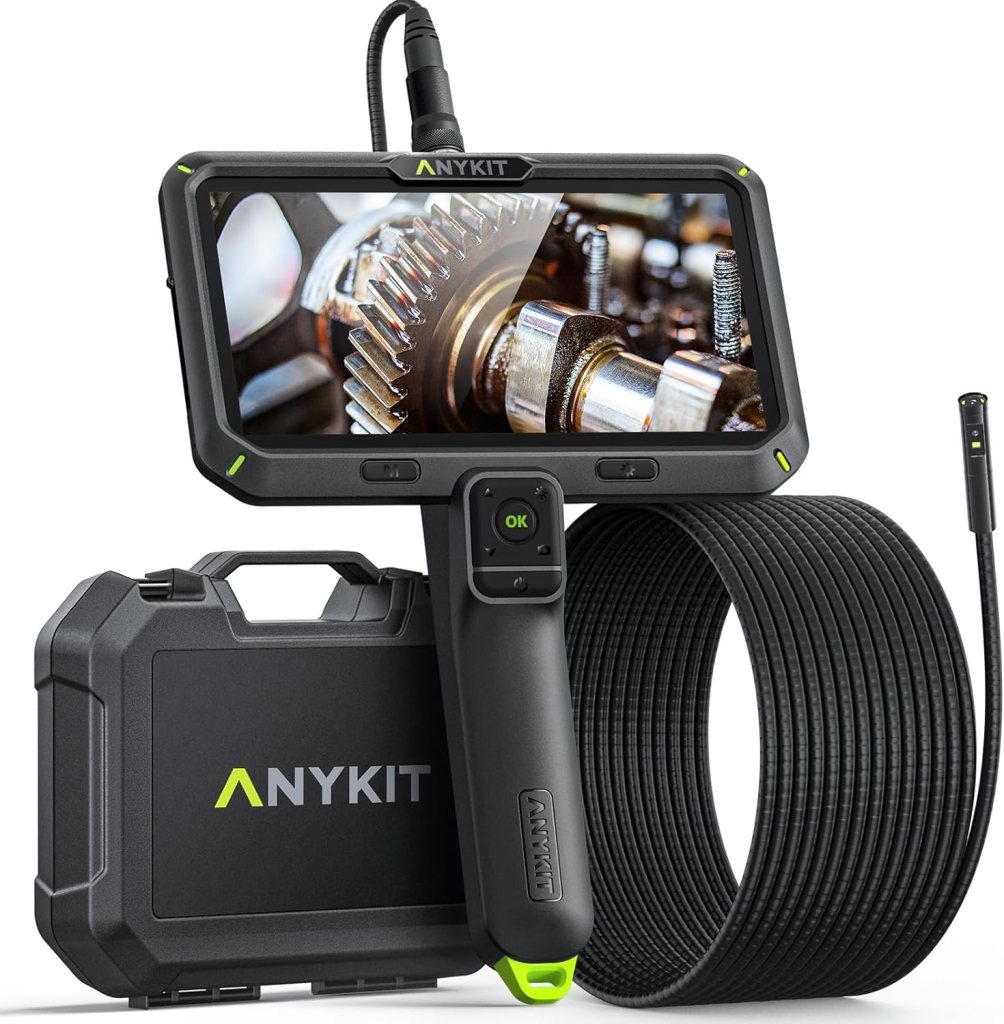
This is the model I would recommend to the widest group of buyers. It checks the main boxes that matter in real use: a large built-in 6-inch IPS screen, dual lenses, split-screen viewing, 1080P capture, IP67 waterproofing, and a 16.5-foot cable.
That combination makes it a strong fit for both household inspection work and light mechanical troubleshooting.
The biggest advantage here is convenience. You do not have to rely on your phone just to see what the camera sees, and the dual-lens setup gives you a better sense of what is happening around corners or along the side of a cavity. For many buyers, that is the sweet spot between basic and overkill.
Pros
- Large built-in screen
- Dual-lens view is more useful than most single-lens models
- Good cable length for home and garage use
- Split-screen support helps compare angles quickly
Cons
- Bigger unit than slim phone-connected options
- Likely more tool than you need for very occasional use
Real Testimonial
Was shopping for an older Jeep which are known to be rust buckets. The exterior part of the frame looked pretty good but just to be sure I ordered this endoscope and scoped the inside of the frame. The inside of the frame was so full of rust the scope almost wouldn’t penetrate it. The scope saved me thousands & a lot of grief.
2. Anykit Two-Way Articulating Borescope

Best for automotive and engine inspection
If your main goal is working around engine components, inside manifolds, around wiring paths, or through awkward mechanical openings, this one is a smarter choice than a fixed-lens model.
210° two-way articulation, 1080P video capture, a 3.9-foot semi-rigid cable, USB-C connectivity, and IP67 water and oil resistance. It is also positioned directly for engine, wall, and automotive inspection work.
This is the kind of tool that becomes much more valuable the first time you need to look slightly left or right instead of just straight ahead. That sounds minor until you are trying to find the exact source of a problem in a cramped area.
The short cable is not ideal for longer pipe runs, but for tight technical work it makes sense.
Pros
- Two-way articulation is genuinely useful
- Better fit for engines and machinery than a basic probe
- Records photos and video to your phone
- Water and oil resistant
Cons
- 3.9-foot cable limits long-run inspections
- Better for targeted jobs than broad household use
Real Testimonial
So far so good. I’ve used it a few times at work and it was a time saver every time. I ran this into a Ford 2.0L to check for coolant in the cylinder, used it to look under an intake manifold for a rodent damage and used it on a couple other things.
3. Anykit 4.3″ Standalone Borescope Inspection Camera
Best simple standalone option
Some people do not want app setup, adapters, or extra steps. They just want to turn on the screen and inspect the problem area. That is exactly why this model makes the list.
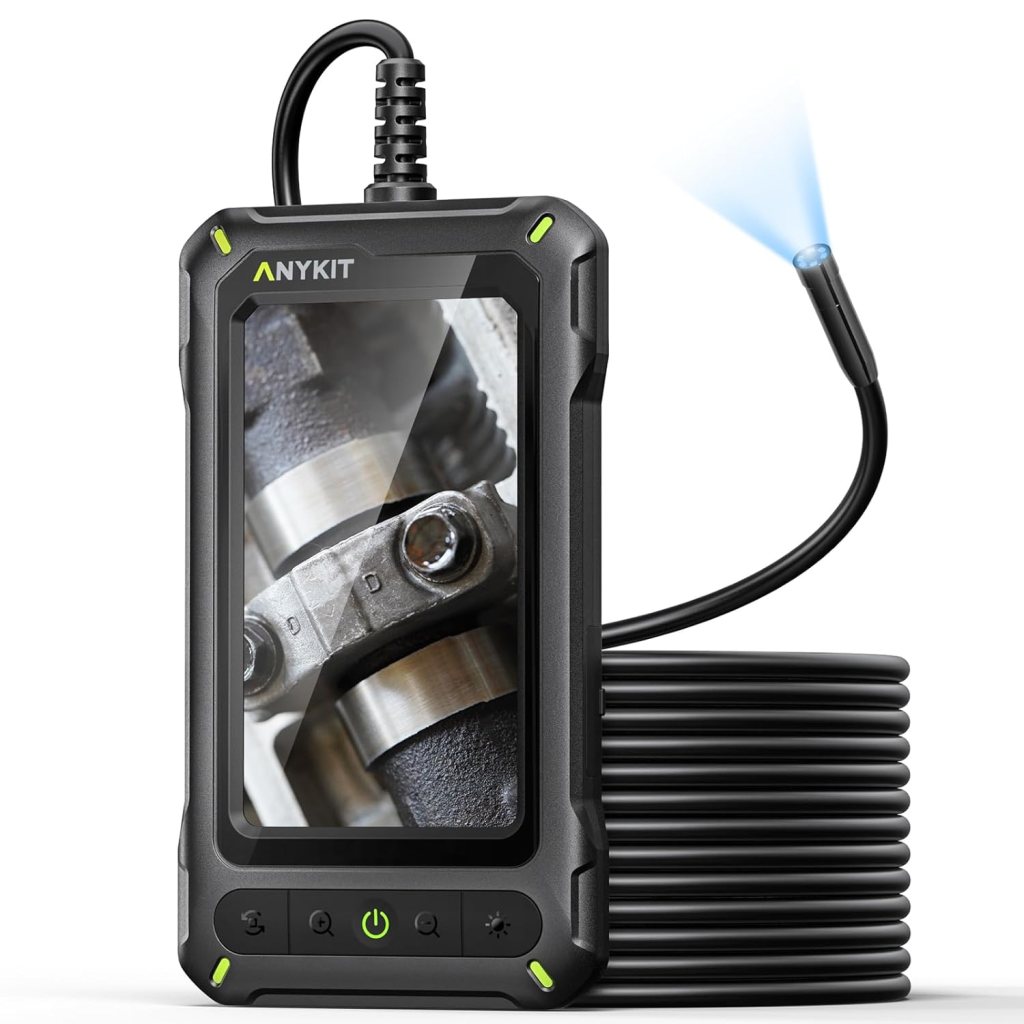
According to the listing, it is a standalone device with a 4.3-inch IPS screen, a 0.3-inch slim probe, a 16.5-foot semi-rigid cable, a 2000mAh rechargeable battery, IP67 waterproofing, and a stated 180° rotating function. The same listing also notes that this one does not take pictures or videos.
That last point will be a dealbreaker for some buyers, but it will not matter to everyone. If your only goal is to see inside a wall, under an appliance, or down into a tight mechanical space without fussing with a phone, this is a very practical pick. It is easy to understand and easy to hand to someone else.
Pros
- Very easy to use
- No app or Wi-Fi setup
- Long cable for general home use
- Slim probe for tighter access
Cons
Real Testimonial
Great camera! I used this taped to 3/4 pbc conduit to get the serial numbers of 52 Tigo optimizers. They were installed under the solar panels on an a-frame house ( no thanks to tigo and their lack of customer support). I was able to clearly read everything and snap a pic of the screen with my phone. Only took 2 hrs. The 33ft cord was perfect reach. This saved me from having to uninstall and reinstall every last panel. Thanks!!
4. Teslong USB-C Two-Way Articulating Borescope
Best balanced upgrade pick
Teslong has built a strong reputation in the inspection-camera category, and this model looks like a smart middle-ground option for buyers who want articulation without jumping straight to a more advanced four-way system.
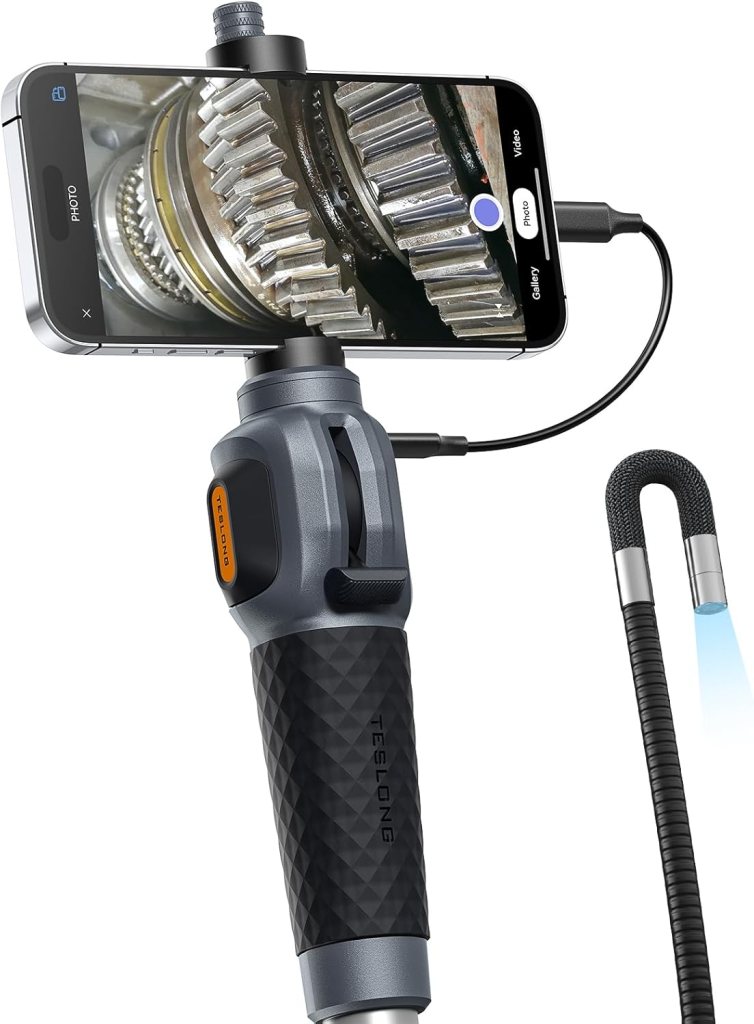
5-foot semi-rigid probe, USB-C connection, two-way articulation, and compatibility with newer iPhones and Android devices.
What I like about this pick is that it feels targeted. It is not trying to be a giant standalone inspection kit. It is for people who are comfortable using a connected device and want better directional control than a fixed camera can offer.
That makes it a strong fit for home repair, automotive work, and HVAC troubleshooting where you do not need a full-screen handheld unit.
Pros
- Two-way articulation adds real inspection value
- Solid brand presence in this category
- Easier to store than larger screen-based kits
- Good fit for mixed home and mechanical use
Cons
Real Testimonial
Highly recommend this if you are a car guy. Works great and pictures are super clear. Was able to scope engine cylinders and get great photos. Works right out the box.
5. Ralcam 4-Way 360° Articulating Borescope

Best for advanced steering control
If you already know you want deeper directional control, this is the step-up model.
4-way 360° articulating borescope with a 6.2mm ultra-slim waterproof inspection camera, a 4.3-inch HD screen, 4x zoom, and a 6.6-foot semi-rigid cable for engine, pipe, HVAC, and automotive inspection.
That kind of control is not necessary for every buyer. But when you are navigating tight internal spaces and need to inspect more than one angle from the same entry point, a four-way articulating probe can make the job much easier.
It is the kind of feature that feels excessive until you actually need it. Then it suddenly feels essential.
Pros
- Best steering flexibility in this roundup
- Built-in screen keeps the setup simple
- Slim probe is better for tighter access
- Good fit for complex inspections
Cons
Real Testimonial
Camera quality is good and the articulating feature works relatively well. Warranty was great I ended up damaging the camera inspecting a cylinder and they sent me a new one right away. Good overall product for the money.
Which type of endoscope/boroscope camera should you buy?
For most readers, the decision is simpler than it looks.
If you want the easiest all-around tool, buy a built-in screen model. It is faster to use, easier to hand off, and better for casual home inspection work. That is why the Anykit Dual Lens and Anykit 4.3-inch screen models make sense for the broadest audience.
If you care more about angle control than convenience, buy an articulating model. This is especially true for engine work, dense mechanical spaces, or any area where a straight-ahead camera keeps missing the real problem.
The Anykit articulating, Teslong articulating, and Ralcam articulating models all fit that role at different levels.
If you want a model for plumbing, think carefully about cable length and probe diameter first. A short articulating camera can be excellent for localized checks, but a longer semi-rigid cable may be more useful for broader household pipe inspection. That is one reason the 16.5-foot Anykit models stand out for general use.
What to look for before you buy
Probe size matters more than many buyers expect. A slimmer probe can fit through tighter openings, but it may come with more compromises in lighting, sturdiness, or price depending on the model.
Articulation is the premium feature worth paying for when you inspect engines, machinery, or hidden corners often. For simple straight-line checks behind walls or inside larger cavities, a fixed or rotating camera can be enough.
Screen style changes the user experience. Built-in displays are easier for quick work. Phone-connected systems are often lighter and more compact, but they depend on compatibility and setup.
Cable length should match the job. A shorter semi-rigid probe is often easier to control in mechanical work. A longer cable is better for general home use, duct inspection, and broader access points.
FAQ
What is the difference between an endoscope and a boroscope camera?
In everyday shopping language, most people use the terms almost interchangeably. In practice, both refer to small inspection cameras used to look inside tight or hidden spaces. The real buying differences are usually articulation, probe diameter, screen type, and cable length rather than the word on the box. [Inference]
What is the best endoscope camera for home use?
For most people, the Anykit Dual Lens 6-inch IPS model is the best all-around choice because it balances ease of use, screen size, cable length, and viewing flexibility. If you want something even simpler, the Anykit 4.3-inch standalone model is easier to pick up and use right away.
What is the best boroscope for automotive inspection?
The Anykit Two-Way Articulating Borescope is one of the strongest fits here because it is built around angle control and specifically marketed for automotive and engine inspection. The Teslong articulating model is also a strong option if you prefer that brand and a phone-connected workflow.
Do borescope cameras work for plumbing?
Yes, many do, especially IP67-rated models built for wet conditions. For plumbing checks, longer cable length and a waterproof probe matter more than fancy extras.
Is a dual-lens borescope better than a single-lens model?
It can be. A dual-lens design is especially helpful when you want to compare a straight-ahead view with a side view without repositioning the probe constantly. That makes inspections feel faster and more intuitive.
Do I need a 2-way or 4-way articulating borescope?
If you only need occasional angle correction, a two-way articulating model is usually enough. If you do regular engine, HVAC, or machinery work and want more complete directional control, four-way articulation is worth the upgrade.
Are built-in screen borescopes better than phone-connected ones?
Not always. Built-in screen models are easier and faster for many people. Phone-connected models are often more compact and can make saving media simpler. The better choice depends on how you like to work.
What probe size is best for tight spaces?
Smaller is usually better for access, but not always better overall. A very slim probe can help in tight mechanical spaces, while a slightly larger probe may feel sturdier and easier to manage for general household use.
Can endoscope cameras record photos and video?
Many can, but not all. The Anykit 4.3-inch standalone model specifically says it cannot take pictures or videos, while the articulating Anykit listing says photos and videos can be captured to your phone.
Are borescope cameras waterproof?
Many consumer inspection cameras are listed as IP67 waterproof, but you should always check the exact listing before buying. That is especially important if you plan to use one around wet pipes, drains, or oily mechanical areas.
Final verdict
If I were narrowing this down fast, I would choose the Anykit Dual Lens 6-inch IPS Borescope as the best overall pick, the Anykit Two-Way Articulating model as the best automotive choice, and the Ralcam 4-Way Articulating model as the best advanced option.
Those three cover the widest spread of real-world needs without forcing every buyer into the same style of tool. For readers who want a broader baseline on what a visual inspection is supposed to be, InterNACHI’s home inspection standards of practice are worth bookmarking.
Affiliate Disclaimer
This article contains affiliate links. We may earn a small commission if you purchase through these links, at no extra cost to you.






Leave a Reply