If you are shopping for the 5 best digital cameras under $200, the good news is that this price range still has a few genuinely useful options. The trick is knowing what matters. At this level, you are not buying the best low-light camera on the market.
You are buying a camera that is simple, portable, and more fun to use than your phone in the right situations. For beginners, casual travel, kids, and everyday snapshots, that can be more than enough.
DPReview’s beginner buying advice still lines up with that idea: the best starter camera is usually the one that is easy to carry, easy to understand, and suited to the kind of photos or video you actually plan to make.
[Inference] Based on current Amazon search results and category pages, the five cameras below appear in the sub-$200 shopping range at the time of research, though listings and bundle pricing can move around quickly.
Related Articles
- 6 Best Compact Cameras by Niche (Travel, Budget, Vlogs)
- 5 Best Digital Cameras for Teens (For Every Budget)
- 11 Best Cameras Under $300 (For Every Niche)
Comparison table
| Camera | Best for | Zoom | Video | Main strength |
|---|---|---|---|---|
| Kodak PIXPRO FZ55 | Overall value | 5x optical | 1080p | Better all-around balance |
| Kodak PIXPRO FZ45 | Beginners | 4x optical | 1080p | Simple, affordable, easy to use |
| Kodak PIXPRO AZ255 | Travel zoom | 25x optical | 1080p | Big reach for outdoor shooting |
| Kodak PIXPRO WPZ2 | Beach and outdoor use | 4x optical | 1080p | Waterproof and shockproof build |
| Minolta MND20 | Casual gift use | 16x digital | 2.7K | Lightweight and easy for basic use |
How I picked these cameras
For a list like this, I care less about inflated megapixel claims and more about whether the camera makes sense in real life. That means ease of use, portability, battery convenience, actual zoom performance, and whether the camera can do a decent job in daylight without constant frustration.
It also means giving extra credit to optical zoom. Nikon’s own support material notes that digital zoom does not add real detail the way optical zoom does, which is why cameras with true optical zoom usually make more sense when you are trying to stay under a tight budget.
1. Kodak PIXPRO FZ55
Best overall
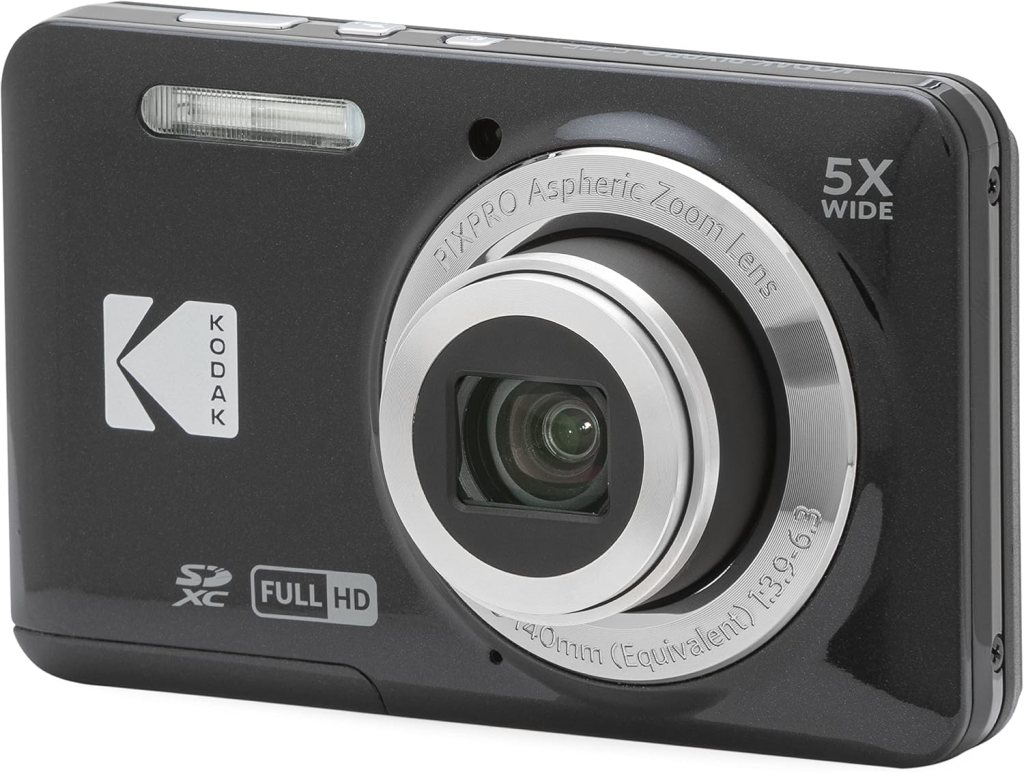
The Kodak PIXPRO FZ55 is the most balanced pick in this group. It gives you a 16MP sensor, a 5x optical zoom lens, a 28mm wide-angle view, and Full HD video in a body that stays small enough for everyday carry.
That combination makes it the easiest recommendation for most people. It is not flashy, but it covers the basics well enough that you can take it on trips, hand it to a beginner, or keep it around as a lightweight family camera without feeling like you bought a toy.
Why it stands out
- Good balance of size, zoom, and ease
- Optical zoom instead of digital-only zoom
- Better everyday fit than bulky bridge cameras
- Rechargeable battery is more convenient for frequent use
Pros
- 5x optical zoom is genuinely useful
- Wide-angle lens helps with travel and group shots
- Full HD video is enough for casual clips
- Small enough to toss into a bag or jacket pocket
Cons
- Still a budget camera, so low light is limited
- Small rear screen
- Not built for serious action or sports
Bottom line
This is the one I would suggest first for most buyers. If you want a simple point-and-shoot that feels like a real step up from random no-name budget cameras, the FZ55 makes the strongest case.
Real Testimonial
I ordered this for my college aged daughter to capture her memories at school. I am a professional photographer so I read the reviews carefully and saw that this was a wonderful starter camera. To say my daughter loves this camera is an understatement! It is easy to use, has a great battery life and takes beautiful photos. The image quality is superb. It adapt well in less than ideal light, has a good flash and takes sharp photos. At around $150, you certainly can’t beat this little camera!
2. Kodak PIXPRO FZ45

Best for beginners
The Kodak PIXPRO FZ45 is the camera for someone who wants the simplest path to taking photos without spending much. It trims things back to a 4x optical zoom, a 27mm wide-angle lens, a 16MP sensor, and 1080p video.
That sounds modest, and it is, but modest is not always bad. In this case, it makes the camera easier to understand and easier to recommend to someone buying their first camera, a younger user, or a family member who does not care about advanced features.
| Camera | Screen | Battery | Why buy it |
|---|---|---|---|
| Kodak PIXPRO FZ45 | 2.7-inch LCD | AA batteries | Lowest-stress beginner pick |
| Kodak PIXPRO FZ55 | 2.7-inch LCD | Li-ion rechargeable | Better all-around value |
AA batteries are also part of the FZ45’s appeal. Some people still prefer that because they can swap batteries anywhere without waiting for a recharge. That makes this camera especially easy to travel with on a budget or keep in a drawer for trips and family events.
Pros
- Easy menus and straightforward controls
- 4x optical zoom is still more useful than digital-only cameras
- AA power can be convenient
- Usually one of the more affordable real camera options
Cons
- Slightly less flexible than the FZ55
- Modest zoom range
- Budget image quality indoors
Bottom line
If you are buying for a true beginner and want the least complicated option, the FZ45 is hard to beat.
Real Testimonial
The KODAK PIXPRO FZ45 blew me away. I bought it as a budget-friendly alternative to the Canon GX7 and was genuinely surprised at how comparable the photo quality is. This camera delivers crisp, vibrant images with great color accuracy and sharpness, especially for casual use, travel, and everyday photography. The compact size and lightweight body make it ideal for tossing in your bag or carrying on the go. The 4X optical zoom and 27mm wide-angle lens give you flexibility for everything from portraits to landscapes.
3. Kodak PIXPRO AZ255
Best for zoom
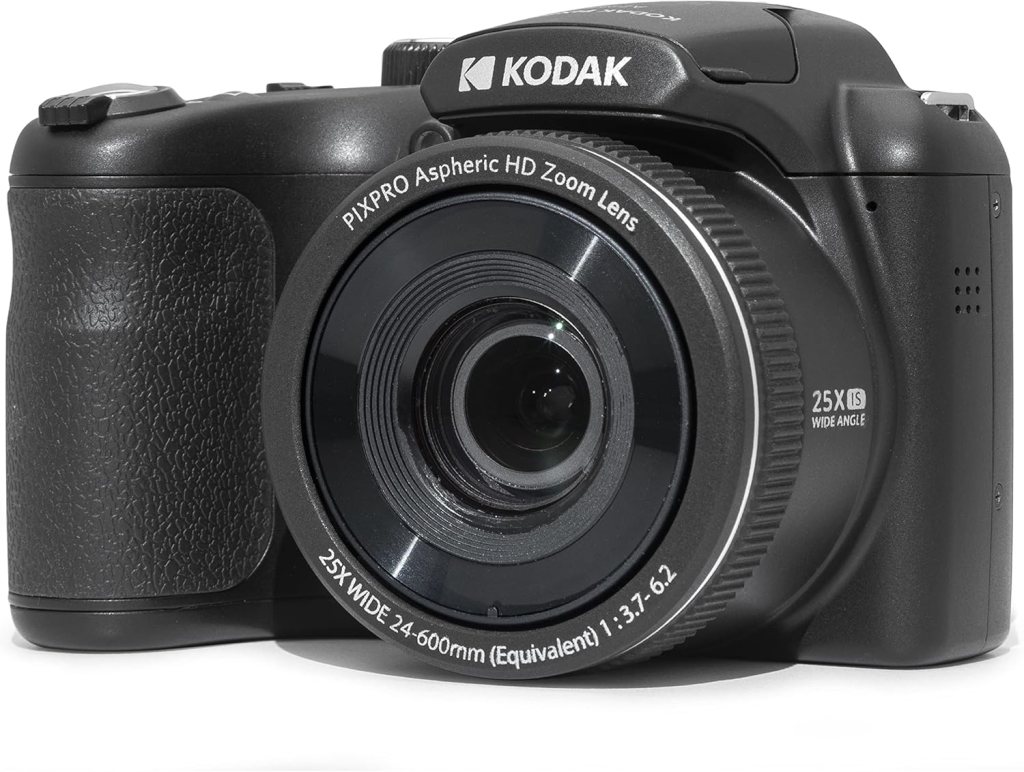
The Kodak PIXPRO AZ255 is the one to choose if reach matters more than pocketability. It gives you a 25x optical zoom lens, 24mm wide-angle coverage, optical image stabilization, a 16MP sensor, and 1080p video.
That is a very different job from the FZ45 or FZ55. This is the camera for outdoor school events, zoo trips, sightseeing, and casual wildlife shots where getting closer matters more than slipping the camera into a small pocket.
The tradeoff is size. A bridge-style camera like this is bulkier and not nearly as toss-in-your-pocket friendly. But if you have ever tried to photograph a far-off subject with a small compact, you already know why zoom changes the whole experience. For the right buyer, the AZ255 is the most useful camera on this list.
Pros
- 25x optical zoom is the real selling point
- Optical stabilization helps at longer reach
- Wide-angle start is handy for travel
- Better suited to outdoor distance shooting
Cons
- Bigger body than compact cameras
- Less appealing for everyday pocket carry
- Still not a high-end sports autofocus camera
Bottom line
If you mostly shoot outdoors and want a camera that can actually zoom in on distant subjects, this is the best choice in the group.
Real Testimonial
Very good quality for the price. Not a super high end camera but very decent on a budget. Has all the features that are marketed & lots of customization in terms of camera settings. Can zoom in on things with very nice quality, doesn’t distort or fry image.
Battery doesn’t last extremely long but since it runs on AA batteries you don’t have to stop to charge so that’s a definite plus for us.
Very easy to use & we definitely recommend for someone just starting out & not wanting to buy a super high end camera.
4. Kodak PIXPRO WPZ2
Best for beach trips, pool days, and rough travel
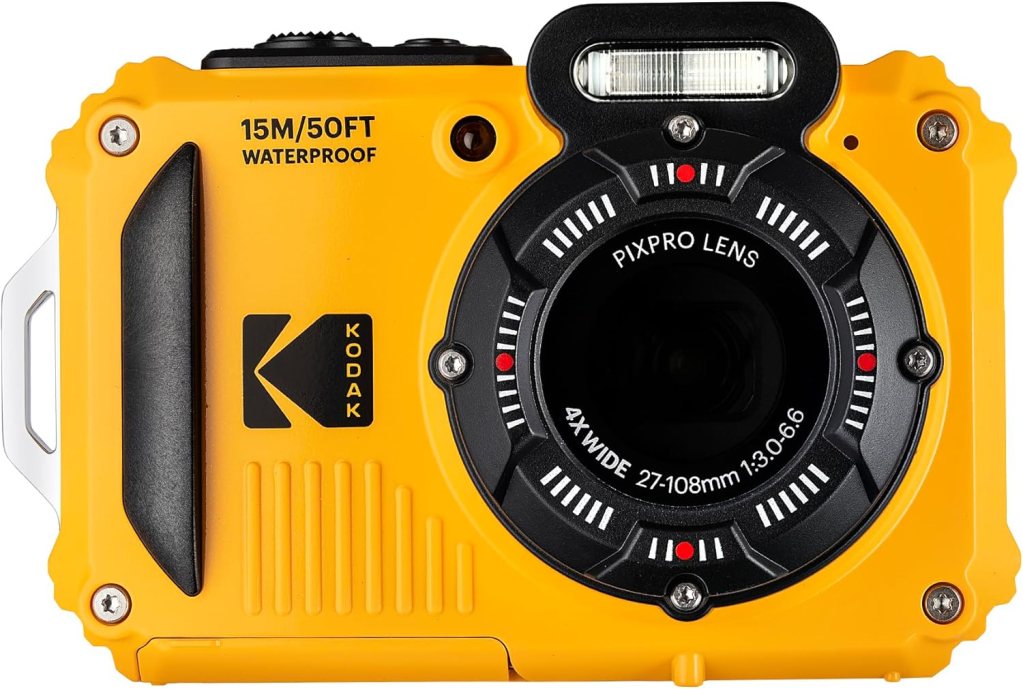
Most cheap cameras are not built for water, sand, drops, or rough handling. The Kodak PIXPRO WPZ2 is. It offers a 16MP BSI CMOS sensor, 4x optical zoom, 1080p video, Wi-Fi connectivity, and a body rated waterproof to 15 meters, plus shockproof and dustproof protection.
That makes it a completely different kind of value pick. You are buying it because it can go places the others should not.
This is not the camera with the best image quality here. It is the camera that survives the vacation. That matters. If your main use case is snorkeling, pool days, beach travel, hiking, or family outings where durability matters more than pure image quality, the WPZ2 has a real role.
Pros
- Waterproof, dustproof, and shockproof
- 4x optical zoom is better than expected for a rugged camera
- Great fit for beach and outdoor travel
- Rechargeable battery and easy operation
Cons
- Bulkier than a slim compact
- Image quality is more about convenience than polish
- Screen and controls are basic
Bottom line
Buy this for adventures, not for perfection. It is the best choice here if durability is your first priority.
5. Minolta MND20
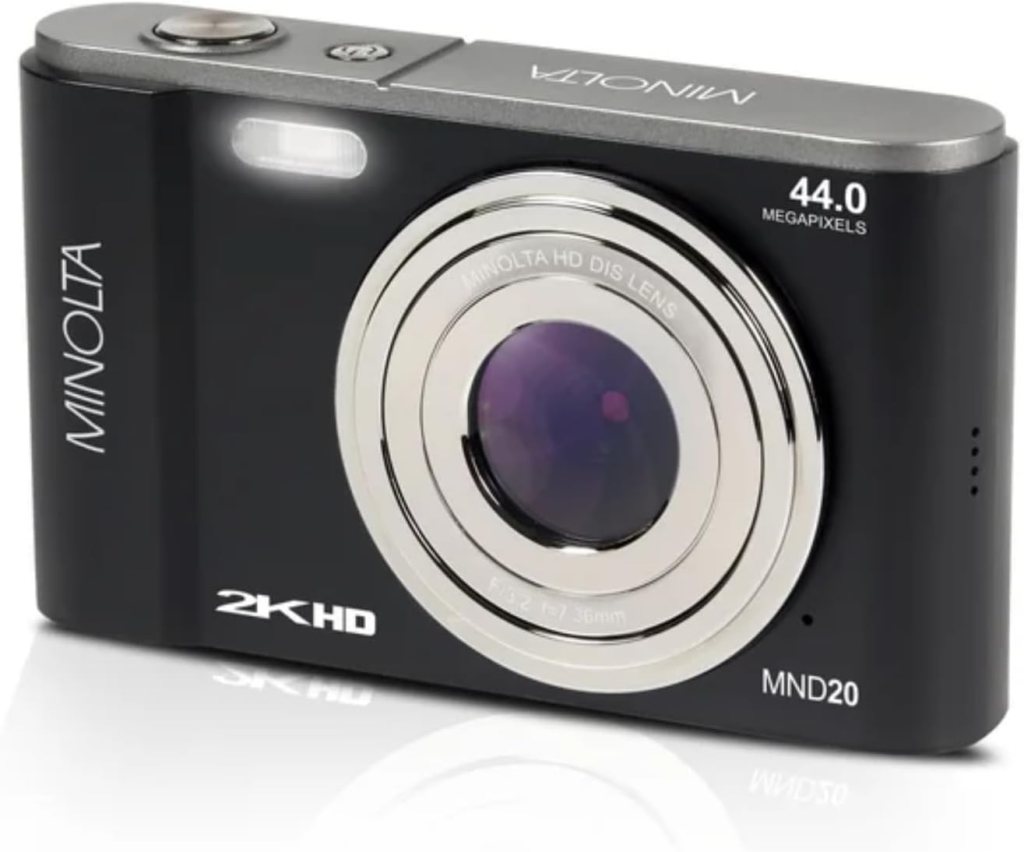
Best for kids, teens, or casual gifting
The Minolta MND20 is a very different kind of budget camera. It leans into high-resolution marketing, 2.7K video, anti-shake, time lapse, face detection, and a lightweight body.
It uses 16x digital zoom rather than optical zoom, which is why I would not call it the best value for serious photography. Still, for a casual user who wants a simple camera for fun, gifting, or very basic everyday shooting, it makes more sense than many generic off-brand models.
This is the camera I would look at for a younger user who wants something that feels modern and simple, and who is less likely to care about the difference between digital zoom and optical zoom. It is also a reasonable pick for casual video clips and social sharing in good light.
Pros
- Lightweight and easy to handle
- 2.7K video looks good on the spec sheet for the price
- Fun gift-style camera for casual use
- Simple feature set for non-enthusiasts
Cons
- Digital zoom is a real limitation
- Not the strongest value for photo quality
- Better for casual use than serious travel or zoom work
Bottom line
I would not choose this over the Kodak optical-zoom models for myself. But for a casual buyer, teen, or gift situation, it still earns a place on the list.
Real Testimonial
I picked up the Minolta MND20 hoping for a fun, compact camera I could use when I didn’t want to pull out my phone, and overall it’s a mixed bag—but fun to tinker with. On the plus side, it’s extremely pocketable and comes loaded with features like 44 MP stills (I’m a bit skeptical of the 44MP given its sensor size), 2.7K video, a 16× digital zoom, anti-shake stabilization, face detection, time lapse, and a 2.9-inch LCD display. I found the camera fairly easy to navigate, and the preset intelligent scene modes do help if you don’t want to mess with manual settings.
What to expect from a digital camera under 200
The best results in this price range usually happen outdoors or in strong daylight. That is true across almost all budget cameras. Indoors, you can still get usable photos, but you should expect more noise, softer detail, and slower performance once the light drops. That is not a dealbreaker. It is just the reality of small sensors and entry-level lenses.
You should also expect basic autofocus, basic screens, and modest video features. What you should not expect is flagship phone performance in dark rooms or high-end mirrorless image quality. In this tier, usability matters more than spec bragging.
A camera with honest 4x or 5x optical zoom can be more useful than one shouting about huge digital zoom or oversized megapixel numbers.
Who should buy one of these cameras
A camera under $200 makes sense for beginners, kids, teens, family travel, vacation backups, and anyone who wants a simple dedicated camera instead of using a phone for everything. It also makes sense if you want optical zoom without spending serious money.
It makes less sense for someone who cares a lot about low-light photography, fast sports autofocus, interchangeable lenses, or advanced video work. If that sounds like you, it is smarter to step up in budget rather than force a cheap camera to do a job it is not built for.
DPReview’s broader buying guides keep coming back to the same point: matching the camera to the use case matters more than buying a camera just because it is cheap.
Frequently asked questions
What is the best digital camera under 200 overall?
The Kodak PIXPRO FZ55 is the best overall pick because it gives you the cleanest balance of size, optical zoom, ease of use, and everyday practicality. It is simple enough for beginners but not so stripped down that it feels disposable.
Is a digital camera under 200 better than a phone?
Sometimes, yes. A budget camera usually will not beat a good phone in low light or processing. But it can beat a phone when you want optical zoom, a dedicated shooting experience, or a camera you can hand to a kid without also handing over your phone.
What matters more, megapixels or optical zoom?
Optical zoom matters more for most people in this price range. Extra megapixels can sound impressive, but if the lens is weak or the zoom is digital-only, that number does not help much in actual use. Nikon’s support explanation on zoom makes this pretty clear.
Is the Kodak PIXPRO FZ45 or FZ55 better?
The FZ55 is better if you want the stronger all-around pick. The FZ45 is better if you want the simplest beginner camera and like the convenience of AA batteries.
What is the best zoom camera under 200?
The Kodak PIXPRO AZ255 is the clear zoom pick here because it offers a 25x optical zoom with optical image stabilization. None of the smaller compact models come close to that reach.
Are cheap 4K or 2.7K cameras worth it?
They can be, but only if you understand what you are getting. Higher resolution labels do not automatically mean better overall quality. Lens quality, stabilization, autofocus, and low-light performance still matter. That is why a strong 1080p optical-zoom camera can often be the smarter buy.
What is the best waterproof digital camera under 200?
The Kodak PIXPRO WPZ2 is the best waterproof pick in this range because it is actually built for water, dust, and drops. That makes it far more practical for beach or pool use than a normal compact camera inside a cheap case.
Are these cameras good for YouTube or vlogging?
For casual clips, yes. For serious creator work, not really. The FZ55, FZ45, AZ255, and WPZ2 all offer 1080p video, which is fine for simple recordings, travel clips, and family content. But if video is your main goal, you will outgrow this class quickly.
Which one is best for a child or teen?
The Minolta MND20 and Kodak FZ45 are both reasonable answers. The Minolta feels gift-friendly and lightweight. The FZ45 is the better photography choice if you want optical zoom and a more dependable everyday camera design.
Should I buy a rugged camera or a normal compact?
Buy a rugged camera only if you truly need the protection. If your camera is going near water, sand, or rough travel, the WPZ2 makes sense. Otherwise, the FZ55 or FZ45 usually gives better everyday value.
Final thoughts
The camera under $200 is not trying to do everything. It is trying to solve specific problems at a low price. The FZ55 is the smartest all-around choice. The FZ45 is the easiest beginner pick. The AZ255 is the zoom option. The WPZ2 is the adventure camera. The MND20 is the casual gift-friendly pick. Pick based on how you shoot, not which spec sounds the biggest.
That is also why compact cameras still matter. CIPA’s 2025 shipment data and its 2026 outlook both show ongoing strength in the digital camera market, with built-in-lens cameras projected to keep growing. In other words, people still want dedicated cameras when the use case is right.
Affiliate Disclaimer
This article contains affiliate links. We may earn a small commission if you purchase through these links, at no extra cost to you.





Leave a Reply