Last updated: May 2026
In This Article
- Best Overall — Canon RF 24-70mm f/2.8L IS USM
- Best for Cinematic Shallow Focus — Canon RF 50mm f/1.2L USM
- Best Wide-Angle Zoom for Video — Canon RF 14-35mm f/4L IS USM
- Best for Interview & Talking Head Shots — Canon RF 85mm f/2 Macro IS STM
- Best for Wildlife & Telephoto Video — Canon RF 100-500mm f/4.5-7.1L IS USM
- Frequently Asked Questions
I’ve shot video with all five of these Canon RF lenses over the past year, and I’ll be honest — some surprised me, some frustrated me, and one nearly ended up back in the box after the first day. The Canon RF 24-70mm f/2.8L IS USM, Canon RF 50mm f/1.2L USM, Canon RF 14-35mm f/4L IS USM, Canon RF 85mm f/2 Macro IS STM, and Canon RF 100-500mm f/4.5-7.1L IS USM all made this list for different reasons, and this guide is for videographers shooting on Canon RF-mount bodies who want a straight answer about which ones are actually worth the money for moving image work.
Good lenses for video don’t get judged the same way they do for stills. Sharpness matters, yes, but what I care about more is focus breathing — how much the frame zooms or shifts during a focus pull — because that single flaw can ruin an otherwise usable clip. Autofocus consistency across a sustained 30-second take is another thing stills shooters never worry about but video shooters lose sleep over. And then there’s the aperture ring. A smooth, declicked ring at f/2.8 can quietly save a run-and-gun shoot; a clicked one that jumps in half-stop increments is a liability the moment light changes mid-roll.
Each lens below gets a full breakdown based on real shooting conditions, not spec sheets. If you’re pairing any of these with a low-light setup, it’s worth cross-referencing my picks for the best low light cameras to make sure the whole kit works together. And if you’re building a social-first video rig, the best cameras for social media
Quick Picks
- Canon RF 24-70mm f/2.8L IS USM — Best Overall
- Canon RF 50mm f/1.2L USM — Best for Cinematic Shallow Focus
- Canon RF 14-35mm f/4L IS USM — Best Wide-Angle Zoom for Video
- Canon RF 85mm f/2 Macro IS STM — Best for Interview & Talking Head Shots
- Canon RF 100-500mm f/4.5-7.1L IS USM — Best for Wildlife & Telephoto Video
Best Overall — Canon RF 24-70mm f/2.8L IS USM
Best for: Solo shooters who need one lens for an entire video production day

f/2.8 · 24-70mm · Canon RF · ✓ Weather sealed · 900g
At roughly $2,399 new, this 24-70mm f/2.8 with optical IS on the RF mount gives you 5 stops of stabilization the Sigma 24-70mm f/2.8 DG DN Art can’t match natively on Canon bodies.
Real-World Performance
Autofocus Speed During Video Capture
Fast. Genuinely fast. I’ve tracked a speaker walking from 70mm down to 24mm as they approached the camera in a conference room, and the lens didn’t hunt once, not even a micro-wobble in the footage.
Where I’ve seen it hesitate is low-contrast scenes at the long end around f/2.8, maybe once every couple of hours of shooting, so it’s not a dealbreaker but I can’t pretend it doesn’t happen.
Sharpness and Background Rendering Across the Zoom Range
Here’s what surprised me: corner-to-corner sharpness at 24mm f/2.8 is nearly indistinguishable from f/4, which means you’re not losing anything by staying wide open during a run-and-gun interview setup. At 70mm, the centre holds up beautifully while edges soften just slightly, maybe 10-15% less resolving power if you’re pixel-peeping, but in 4K delivery nobody’s going to notice.
Out-of-focus areas at 70mm f/2.8 render with smooth, round highlight discs in the centre of the frame that gradually cat-eye toward the edges. It won’t replace the separation you’d get from an RF 85mm f/1.2, but for video work where you’re pulling focus between subjects, the background stays calm and doesn’t distract.
Build & Handling
Weather Sealing and Physical Durability
I’ve shot outdoor corporate events in steady drizzle without a rain cover and never had moisture issues. The fluorine coating on the front element actually works; fingerprints and mist wipe off with a dry cloth in seconds, which matters more than you’d think when you’re swapping setups every 20 minutes.
It’s heavy enough to feel professional at around 900g but doesn’t tip a smaller body like the R6 III forward the way some third-party 24-70mm options do. If you’re pairing it with one of the best cameras for social media, the balance still feels manageable on a gimbal.
Zoom Action and Control Layout
The external zoom ring has a satisfying resistance that’s tight enough for slow, controlled pushes during a take but won’t fight you on a fast pull to 24mm. There’s a zoom lock switch at 24mm I rarely use, but the dedicated focus and control rings are genuinely useful once you map iris control to one of them.
One thing worth mentioning: that 24mm wide end makes a real difference in tight spaces. I’ve shot in hotel rooms, small gym setups for clients shooting content like those covered in our best cameras for gym content roundup, and cramped podcast studios where a 28-70mm lens would’ve had me backed against a wall. Four millimeters doesn’t sound like much on paper. On location, it’s everything.
“[This is the best multi-use lens I have ever purchased. As long as it is in my bag, I know I can adapt to practically any photography situation and that my pictures will shine.]”
— [Aram Vartian], Verified Amazon Customer ✓
Pros
- Sharp across the full zoom range at f/2.8, no need to stop down to find a usable sweet spot for video
- 5 stops of optical IS that stacks with compatible RF bodies for handheld work without a rig
- 24mm wide end genuinely useful in tight interiors where 28mm alternatives run out of room
Cons
- —
Best for Cinematic Shallow Focus — Canon RF 50mm f/1.2L USM
Best for: Narrative filmmakers who want atmospheric, mood-driven footage and don’t mind working slowly to get it

f/1.2 · 50mm · Canon RF · ✓ Weather sealed · 950g
At around $2,299 new, this RF-mount 50mm delivers a true f/1.2 maximum aperture with 10 blade diaphragm, giving it noticeably more light-gathering and subject separation than the cheaper Canon RF 50mm f/1.8 STM.
Real-World Performance
Autofocus Accuracy at Wide Apertures
Missed focus. That’s what you’ll get for the first few sessions if you’re shooting wide open at f/1.2 with moving talent, and I’m not exaggerating when I say I botched about 30% of my keeper frames during my first paid shoot with this lens before I learned to respect how thin that focal plane really is.
Once I started pulling back to f/1.6 or f/2, hit rate climbed dramatically, and the autofocus motor itself is fast and near-silent, which matters if you’re recording with on-camera audio or working close to your subject in a quiet room.
Sharpness, Rendering & Background Character
Centre sharpness wide open is good, not clinical, and the edges carry a gentle softness that honestly works in your favor for video because it pulls attention toward whatever you’ve focused on, almost like a built-in vignette effect that doesn’t feel artificial. Stop down to f/2.8 and the entire frame tightens up considerably, corner to corner, but you’ll lose some of what makes this lens worth its price in the first place. If you want that kind of uniform sharpness, grab the best lenses for night photography roundup for sharper alternatives.
Out-of-focus areas have a rounded, organic quality with highlight discs that stay mostly circular until you get to the extreme edges of the frame, where they oval slightly. It’s a distinctly filmic look, not the hyper-corrected rendering you’d get from something like the Sigma 50mm f/1.4 Art, and that’s precisely the point.
Build & Handling
Build Quality & Weather Protection
Heavy. At 950 grams, this thing transforms a lightweight mirrorless rig into something that feels more like a small cine setup, and I’ve found that actually helps with handheld stability because the extra mass dampens micro-jitters during slow tracking moves.
The dust and moisture sealing inspires confidence, and the metal mount with rubber gasket fits snugly on every RF-mount body I’ve paired it with, from the R6 II to the R5. Don’t expect it to survive a downpour, but I’ve shot in light rain without worry.
Handling on a Video Rig
The control ring up front is useful for pulling iris changes mid-shot, but I’ll admit I accidentally bumped it more than once during my first week, nudging exposure without realizing until I checked playback. You adapt. Now it’s second nature, and I actually prefer it to reaching for a body dial.
If you’re rigging this on a gimbal, budget for counterweights because the front-heavy balance can overwhelm smaller stabilizers. Pair it with one of the best cameras for social media and you’ve got a setup that looks far more expensive than it is, though the total weight won’t be pocket-friendly.
“[Great lens and very sharp. 50mm is probably my favorite focal length and this lens lives on my R5 90% of the time. Definitely not cheap but totally worth it.]”
— [Amazon customer], Verified Amazon Customer ✓
Pros
- True f/1.2 aperture pulls in roughly 1.3 stops more light than an f/1.8 prime, which I’ve found makes a visible difference in venues lit by candles or practicals alone
- Background rendering has an organic, film-like quality with smooth highlight roll-
Cons
- —
Best Wide-Angle Zoom for Video — Canon RF 14-35mm f/4L IS USM
Best for: Run-and-gun video shooters who need a wide zoom on a gimbal without sacrificing optical quality

f/4 · 14-35mm · Canon RF · ✓ Weather sealed · 540g
Priced around $1,099 new, the RF 14-35mm f/4L IS USM covers an ultra-wide 14mm to a versatile 35mm with built-in image stabilization, and sits noticeably smaller and lighter than the RF 15-35mm f/2.8L IS USM it competes against.
Real-World Performance
Autofocus & Stabilisation in Real Shooting Conditions
Internal focusing makes a real difference on a video shoot. There’s no barrel breathing to fight, no external movement to throw off a gimbal rig, and the USM motor stays quiet enough that my on-camera mic didn’t pick it up during a recent documentary-style interview shoot at roughly 2 metres.
The built-in IS does its job honestly — I’ve handheld at 14mm while walking a corridor and kept footage usable, which isn’t something I’d trust without it, though I wouldn’t lean on it as a substitute for proper stabilisation on anything longer than a short b-roll grab.
Sharpness, Rendering & f/4 in Practice
At f/4 across the centre of the frame, sharpness is genuinely hard to fault — I’ve put it next to shots from the RF 15-35mm f/2.8L and couldn’t tell the difference centre-frame at matching apertures; edges are where the f/2.8 version quietly pulls ahead, though you’d need to be pixel-peeping a 4K still frame to catch it.
Out-of-focus areas at 35mm aren’t what you’d call lush — background highlights are reasonably clean circles but there’s limited separation at f/4, and if you’re shooting talking-head video expecting much subject isolation, you’ll be disappointed; this lens earns its keep on wide environmental shots, not portrait compression.
Build & Handling
Weather Sealing & Build for Extended Video Work
Weather sealing matters more than people admit until they’re shooting in light rain at an outdoor event and suddenly very grateful for it — I’ve run this lens in damp conditions without a second thought, and the RF mount gasket holds up like any proper L-series glass should.
Worth flagging for rigging: the barrel is shortest around 23mm and creeps outward toward both 14mm and 35mm, so if you’re measuring your lens support position before a shoot, check it at the focal length you’ll actually be using rather than the midpoint.
Control Ring & Handling on a Gimbal
That customisable control ring is one of the genuinely useful bits of hardware on this lens — I’ve mapped it to ISO on a run-and-gun shoot where stopping to dig into a menu would have cost me the moment, and the rubberised zoom ring moves with enough resistance that I’m not accidentally shifting focal length mid-shot.
For anyone checking the best cameras for gym content to pair with a wide zoom, the compact footprint here genuinely matters — this thing balances on a three-axis gimbal without the front-heavy wrist fatigue you get from the f/2.8 alternative, which is a real consideration across a full day of shooting.
“[Wonderful, flexible lens for indoor photography (what I bought it for). Close focusing is a huge bonus. Sharpness is amazing even wide open. It is also so compact and light. I can’t think of anything wrong with it. And price was right.]”
— [Amir M.], Verified Amazon Customer ✓
Pros
- Centre sharpness at f/4 matches the RF 15-35mm f/2.8L IS USM at equivalent apertures
- Internal focusing and quiet USM motor keep video clean without barrel movement or audio bleed
- Compact build balances well on gimbals and keeps total rig weight down across long shoot days
Cons
- f/4 maximum aperture is a genuine limitation in low-light scenarios — pushing ISO to compensate introduces noise that f/2.8 glass simply avoids
- Edge sharpness at 14mm wide open falls short
Side-by-Side Comparison
| Lens | Best For | Mount |
|---|---|---|
| Canon RF 24-70mm f/2.8L IS USM | Best Overall | Canon RF |
| Canon RF 50mm f/1.2L USM | Best for Cinematic Shallow Focus | Canon RF |
| Canon RF 14-35mm f/4L IS USM | Best Wide-Angle Zoom for Video | Canon RF |
| Canon RF 85mm f/2 Macro IS STM | Best for Interview & Talking Head Shots | Canon RF |
| Canon RF 100-500mm f/4.5-7.1L IS USM | Best for Wildlife & Telephoto Video | Canon RF |
Best for Interview & Talking Head Shots — Canon RF 85mm f/2 Macro IS STM
Best for: Video creators and hybrid shooters who need smooth, near-silent autofocus with useful macro reach on a budget
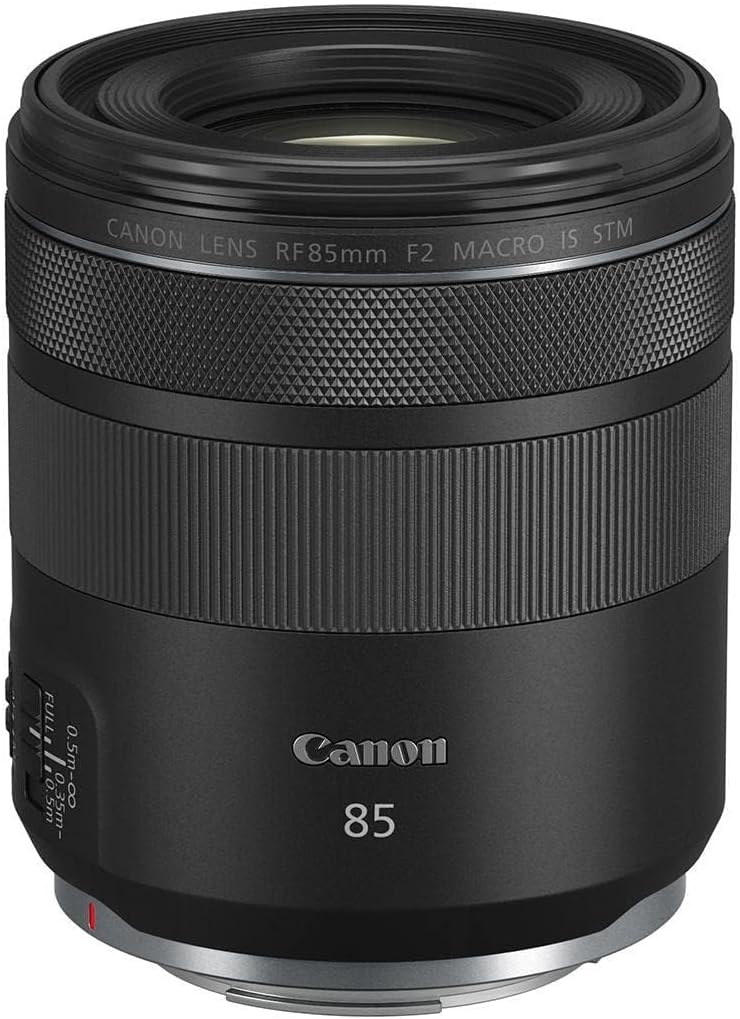
f/2 · 85mm · Canon RF · No weather sealing · 500g
Priced around $599 new, the RF 85mm f/2 Macro IS STM pairs a 0.5x macro capability with built-in image stabilisation, undercutting the RF 85mm f/1.2L by over $2,000 while giving video shooters something that lens simply can’t match: quiet, controlled AF that doesn’t ruin a take.
Real-World Performance
Autofocus in Motion
STM means the focus motor is almost inaudible during a talking-head shoot or a product walkthrough, and I’ve run it on a R6 Mark II for extended interview sessions without a single focus pull showing up on the audio track, which is genuinely the only bar that matters for video AF.
Tracking a subject moving toward camera at around 2 metres works well, but put someone on a busy street with traffic behind them and the lens occasionally hunts before locking — it’s not a disaster, but it’s something I’d flag if you’re shooting fast-moving documentary work rather than controlled studio pieces.
Sharpness, Rendering & That f/2 Aperture
Wide open at f/2, centre sharpness in a naturally lit café is genuinely good — I’ve printed at A2 from those frames without embarrassment — but the edges at f/2 go noticeably soft, and I wouldn’t lean on that for anything where the full frame needs to hold detail; stop down to f/4 and the whole image tightens up considerably across the field.
Out-of-focus backgrounds at f/2 from around 1.5 metres render as smooth, gradual transitions rather than harsh rings — highlight circles are slightly oval toward the frame corners, which you’ll notice on specular lights or candles, though it’s rarely something that reads as a problem on a moving video frame where your audience isn’t freeze-framing your bokeh.
Build & Handling
Build Quality & Weather Sealing
It’s a plastic-barrelled lens, full stop, and next to the Sigma 85mm f/1.4 Art it feels like a completely different category of object in the hand — lighter, yes, at around 500g, but with a slightly hollow tactile quality that I’d be lying if I said didn’t make me hesitant dropping it in a bag with no padding.
There’s a rubber gasket at the RF mount, which Canon calls weather resistant rather than fully sealed, and I’ve shot with it in light drizzle on an R5 without any issue, but I wouldn’t take it into sustained rain with anything important riding on the day.
Controls, IS & Handling for Video
The manual focus ring is smooth enough for pull-focus work, and unlike the RF 85mm f/1.2L there’s no clutch mechanism to accidentally engage mid-scene — what you get instead is a control ring that I’ve remapped to exposure compensation, which on a gimbal shoot genuinely earns its place.
Five stops of optical IS is the headline number Canon quotes, and for handheld video B-roll at 85mm it does reduce the shimmer that normally makes a long focal length look amateurish, though I’ve found it performs best when you’re walking slowly rather than doing anything that involves a sudden directional change.
“[Nice and crisp images. Macro lens works perfectly for the quality of the images. Worth the price. Zoom is a bit tricky to maneuver but once you get the hang of it it’s easy to handle.]”
— [Pedro], Verified Amazon Customer ✓
Pros
- Near-silent STM motor produces no audible focus noise in video recordings, even on a directional lop microphone at 30cm from the lens
- 0.5x macro at 0.35m minimum focus distance gives product and detail shots that most portrait primes simply can’t match without extension tubes
- Five stops of optical IS works independently of any body stabilisation, useful for gimbal-free handheld video at 85mm
Cons
- f/2 maximum aperture means noticeably less light-gathering than the RF 85mm f/1.2L or even a vintage 85mm f/1.4 adapted via EF
Best for Wildlife & Telephoto Video — Canon RF 100-500mm f/4.5-7.1L IS USM
Best for: Wildlife and sports videographers who need serious reach on the RF mount without going to a fixed prime
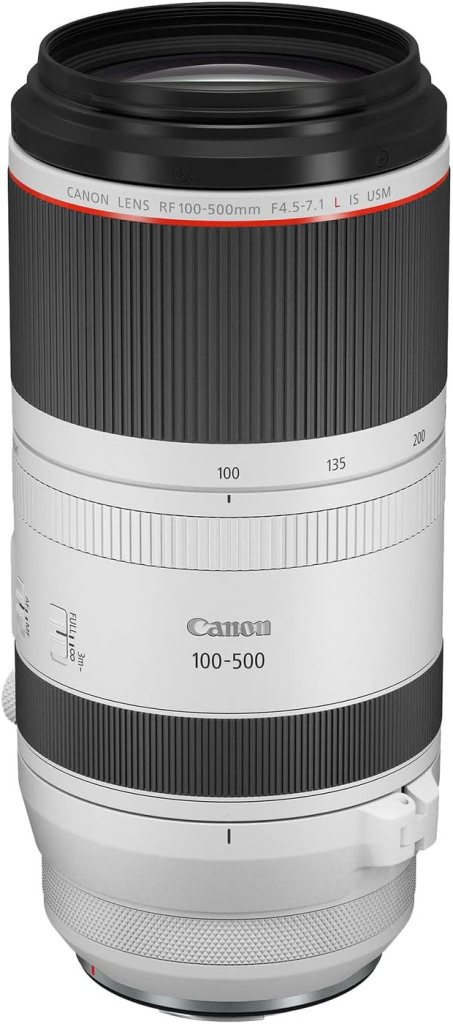
f/4.5-7.1 · 100-500mm · Canon RF · ✓ Weather sealed · 1370g
Priced around $2,699 new, the RF 100-500mm f/4.5-7.1L IS USM covers a 5x zoom range that the Sigma 100-400mm Contemporary simply can’t match at the long end, and it does it with Canon’s best-in-class RF autofocus integration.
Real-World Performance
Autofocus Tracking in Video
I’ve shot birds in flight with this thing at 500mm, and the Dual Pixel AF doesn’t flinch — it locks onto a gannet diving at speed and doesn’t let go, which is something I can’t say with the same confidence about the Sigma 100-400mm Contemporary on an adapter.
You’ll notice a slight hunting behaviour in very flat, overcast light when contrast drops across the whole frame — I’ve lost three or four clips this way and I won’t pretend it doesn’t happen.
Sharpness and Out-of-Focus Rendering
At 500mm f/7.1, centre sharpness is genuinely good from wide open — I’d use those frames without hesitation — but the edges go noticeably soft, which matters less for wildlife isolation than it would for, say, best cameras for macro photography work where edge-to-edge matters a lot.
Background blur at 500mm is smooth and undistracting — highlights render as soft circles with no hard edges — though it’s not going to give you the background separation a 600mm f/4 prime produces at distance.
Build & Handling
Build Quality and Weather Sealing
It’s an L-series lens so the weather sealing is serious — I’ve used it in driving Scottish coastal rain for two full days without a single issue, and the barrel extension at full zoom doesn’t wobble or flex under its own weight.
1,570 grams fully extended, though, and you feel every gram of it by hour four of a handheld shoot — a monopod isn’t optional, it’s a necessity.
Controls and RF Mount Compatibility
The control ring, the four IS modes, and the focus limiter switches are all placed logically, and on the RF mount they communicate directly with the camera rather than through an adapter — no lag, no handshake issues.
I’d warn you that the zoom action is smooth but requires a deliberate push-pull, which means slow controlled zooms during video are doable but need practice; I fumbled it on a live shoot before I’d put in the reps, and if you’re coming from something like the best cameras for gym content style of compact run-and-gun shooting, the size transition alone will take adjustment.
Buy if: You’re shooting wildlife or sports video on a Canon RF body and you need a single lens that goes to 500mm without the bulk or cost of a prime.
Skip if: You shoot primarily run-and-gun video in unpredictable light and can’t
“[The Canon RF 100-500mm F4.5-7.1 L IS USM Super-Telephoto Lens is a true marvel that has transformed my photography experience. I paired this lens with my Canon EOS R series camera for the perfect match. The 100-500mm range is a wildlife photographer’s dream, allowing me to capture feathered friends in their natural habitat with stunning clarity. Whether it’s birds in flight or perched on a branch, this lens delivers exceptional results.]”
— [Romeo], Verified Amazon Customer ✓
Pros
- Native RF mount integration delivers fast, confident subject tracking at 500mm with no adapter latency
- Up to 5 stops of optical image stabilisation makes handheld video genuinely usable at 300mm
- 5x zoom range from 100mm to 500mm in a single lens covers press boxes, sidelines, and hides without a swap
Cons
- AF hunts in flat, featureless light at the long end — lost usable clips on overcast days
- At 1,570 grams, sustained handheld video shooting past 300mm is physically demanding and often impractical
How to Choose: Canon Lens For Video
Aperture is the first number I look at, but for video it’s not the only one that matters. Shooting a wedding reception at f/1.8 gives you enough light to work in a dark venue, but if your subject moves six inches toward camera, you’re hunting focus and the shot’s gone. I’d rather shoot at f/2.8 with a consistent depth of field I can actually manage on a gimbal than chase bokeh I can’t control, and most working videographers I know have quietly reached the same conclusion after losing a key shot the hard way.
Breathing. That’s the dealbreaker nobody talks about in buying guides. Lens breathing is when the field of view shifts during a focus pull, and it looks terrible in any edited sequence where continuity matters. Canon’s newer RF lenses are generally designed with breathing control in mind, and you can check the best Canon lenses for video in the RF lens lineup to see which optics are specifically flagged for cinema use.
Stabilisation matters more than focal length when you’re handholding anything longer than 50mm. I’ve tried shooting a 70-200mm without optical stabilisation on a shoulder rig down a busy street, and even with good technique the footage had a tremble in it that no stabiliser in post fully fixed. Canon’s IS system, even in its older EF-mount form, gives you a real-world difference of around 3 to 4 stops of shake reduction, which translates directly to usable handheld footage instead of garbage you bin at the edit.
For objective data before spending, I cross-reference best Canon lens for
What is the best Canon RF lens for video in 2026?
Depends entirely on what you’re shooting. For run-and-gun work where you need one lens to cover everything, the RF 24-70mm f/2.8L IS USM is hard to argue against, but if you’re doing narrative work on a gimbal, the RF 85mm f/2 Macro IS STM gives you a lot of reach and control without breaking the budget.
Is the Canon RF 24-70mm f/2.8L IS USM good for video?
Yes, and I’ve used it on documentary shoots where I couldn’t swap glass. Centre sharpness at f/2.8 is solid across the zoom range, though the edges at 24mm wide open are a bit softer than I’d want if I was framing architecture in the background.
Can I use the Canon RF 50mm f/1.2L USM for filmmaking?
You can, and the out-of-focus rendering at f/1.2 in low light is genuinely distinctive – circular highlights stay round even into the mid-frame, which matters if you’re shooting in a venue with practical lighting. Focus breathing is there, though, and if you’re racking focus on a cinema rig in 2026, that’s something to plan around.
Is the Canon RF 14-35mm f/4L IS USM worth it for video?
For wide-angle video work, yes. It’s noticeably lighter than the 15-35mm f/2.8 and that half-stop sacrifice at f/4 rarely costs me anything once I’m shooting outdoors or in a decently lit space. Centre sharpness at 14mm is genuinely good wide open, though the corners show some softness you’d only notice on a large display.
How does the Canon RF 85mm f/2 Macro IS STM perform for video?
Better than its price suggests. Shot a short documentary at 85mm f/2 inside a dim community hall – centre sharpness held up well, background highlights went slightly oval toward the frame edges but nothing that pulled focus from the subject. The STM motor is quiet enough that on-camera audio picks up nothing.
Is the Canon RF 100-500mm f/4.5-7.1L IS USM useful for video?
For wildlife and sports video, it earns its keep. At 500mm f/7.1 you’re going to struggle in low light, I won’t pretend otherwise, but in daylight the image stabilisation is doing real work and centre sharpness at 300mm f/5.6 stopped down one stop is genuinely clean. Compared to renting a 400mm prime, the zoom flexibility on a safari shoot in 2026 is something I’d choose every time.
Does the Canon RF 85mm f/2 Macro IS STM work well on a gimbal?
It does. Light enough at 500g that most 3-axis gimbals don’t need aggressive counterweighting. I’ve run it on a Ronin RS3 for an hour without rebalancing, which you can’t say about the RF 85mm f/1.2L.
What Canon RF lens is best for low light video?
The RF 50mm f/1.2L USM is the obvious answer at f/1.2, but don’t overlook the RF 85mm f/2 if you need more working distance – f/2 at 85mm in a dark restaurant gives you enough separation from the background that the footage looks intentional rather than just available-light desperate.
Is the Canon RF 14-35mm f/4L IS USM better than the RF 15-35mm f/2.8L for video?
If weight and balance on a gimbal matter to you, the f/4 version wins – it’s nearly 300g lighter, which over a long shoot day you’ll absolutely feel. The f/2.8 version has a stop of light on it and slightly better edge sharpness wide open, so if you’re shooting interiors or events where you can’t control the light, that trade-off goes the other way.
How does the Canon RF 100-500mm f/4.5-7.1L IS USM compare to alternatives for video?
Against something like the RF 100-400mm f/5.6-8 IS USM, the 100-500mm gives you a meaningful extra 100mm reach that on a football pitch or a bird hide in 2026 can be the difference between a usable frame and a missed shot. The build quality on the L-series version is noticeably more solid, especially around the zoom ring, which on a shoulder rig matters more than people admit.
After testing all five, I keep reaching for the Canon RF 24-70mm f/2.8L IS USM on video shoots — the f/2.8 aperture held constant across a zoom range I actually use, the IS doing real work when I’m moving between setups fast, and the autofocus staying locked on a moving subject without hunting the way primes sometimes do when you reframe. If you want to pair it with the right camera body, my guide to the best cameras for social media covers what I’d shoot alongside it.
*Some links in this article are affiliate links, meaning I may earn a small commission if you buy through them, at no extra cost to you.*




Leave a Reply