
Hiking punishes bad gear choices fast. Weight gets annoying. Menus get old. Cheap build quality stops feeling cheap the first time wind picks up on an overlook or mist hits your pack. The best camera for hiking is not the same as the best cameras for a desk setup, a studio, or a travel influencer’s weekend bag.
It needs to be light enough to carry, quick enough to grab, and good enough to make you glad you brought them at all. For that kind of real-world camera buying, REI’s guidance on handling and controls still lines up with what actually matters outdoors.
Quick picks
- Best overall: Canon EOS R50
- Best for rough trails and bad weather: OM System Tough TG-7
- Best lightweight everyday carry: Sony ZV-1F
- Best for movement and trail video: DJI Osmo Action 5 Pro
- Best premium compact: Sony RX100 VII
Related articles
- 6 Best Camera Bags (Sling, Crossbody, Hiking)
- 9 Best Cameras for Landscape Photography (By Budget & Brand)
- 6 Best Compact Cameras by Niche (Travel, Budget, Vlogs)
Comparison table 1: trail use snapshot
The tables below are based on current manufacturer specs and current live listings for these camera models. Canon lists the EOS R50 as a 24.2 MP APS-C mirrorless body with oversampled 4K 30p. OM System lists the TG-7 as waterproof, shockproof, freezeproof, dustproof, and RAW-capable.
Sony lists the RX100 VII with a 24-200mm lens and 1-inch sensor. DJI lists the Osmo Action 5 Pro with a 1/1.3-inch sensor and up to 240 minutes of operating time in controlled conditions. Amazon listings also show current availability for the selected models.
| Camera | Best for | Carry feel | Main strength | Main compromise |
|---|---|---|---|---|
| Canon EOS R50 | Most hikers | Light mirrorless | Best balance of image quality, autofocus, and flexibility | Not pocketable |
| OM System Tough TG-7 | Wet, rough, no-fuss hiking | Jacket-pocket friendly | Can take abuse better than the others | Small sensor limits image quality |
| Sony ZV-1F | Casual day hikes | Very light compact | Easy to carry, simple to use | Wide fixed lens is limiting |
| DJI Osmo Action 5 Pro | Fast movement, POV video | Tiny | Stabilization and durability | Still photos are just okay |
| Sony RX100 VII | Serious hikers who want compact quality | Pocketable | Best compact zoom and autofocus mix | Price hurts |
Comparison table 2: buying factors
| Camera | Lens setup | Weather or ruggedness | Pocketable | Learning curve |
|---|---|---|---|---|
| Canon EOS R50 | Interchangeable lens | Mild caution advised | No | Easy to moderate |
| OM System Tough TG-7 | Built-in zoom | Proper rugged body | Yes | Easy |
| Sony ZV-1F | Fixed 20mm equivalent lens | No real rugged edge | Yes | Easy |
| DJI Osmo Action 5 Pro | Fixed ultra-wide lens | Built for abuse | Yes | Very easy |
| Sony RX100 VII | Built-in 24-200mm zoom | Travel-tough, not ruggedized | Yes | Moderate |
How I picked these
I cared about five things.
First, weight. A camera can be brilliant at home and miserable at mile six.
Second, speed. If it takes too long to wake up, pull out, flip open, or focus, you will miss the good light and start using your phone instead.
Third, durability. Hiking includes dirt, sweat, cold mornings, stray drops, and the occasional dumb moment.
Fourth, image quality in ugly light. Midday sun is easy. Forest shade and blue-hour trailheads are not.
Fifth, annoyance factor. This is real. Some cameras technically perform well and still make you not want to carry them.
1. Canon EOS R50
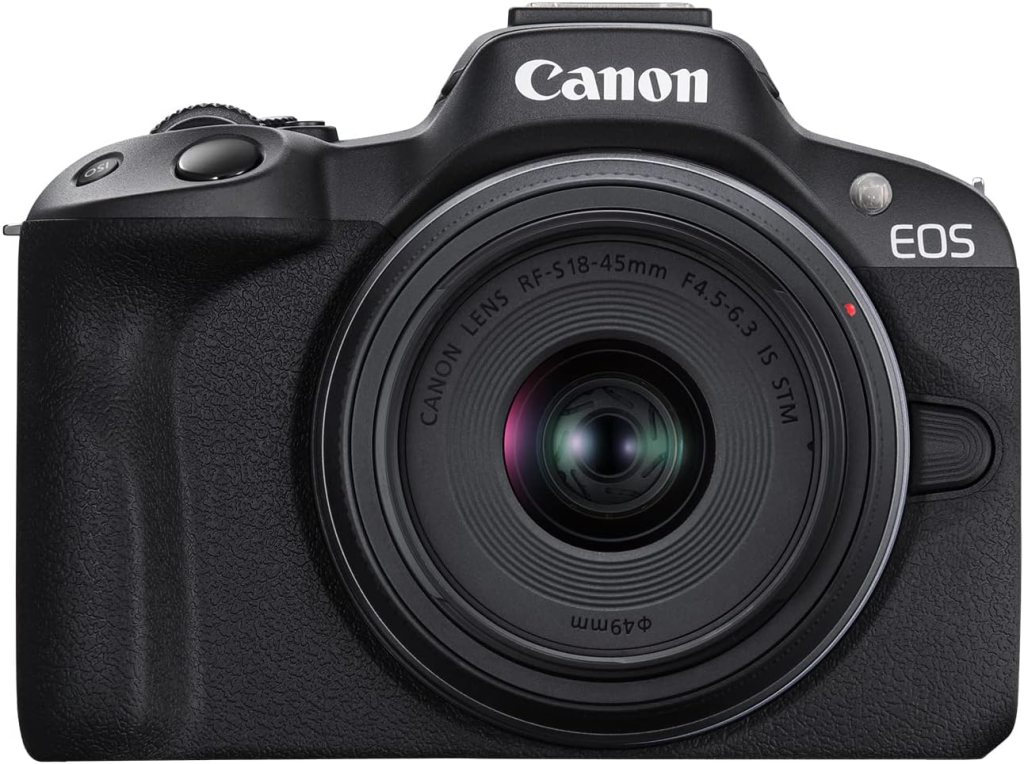
Best overall for most hikers
The Canon EOS R50 wins because it gets the basics right without turning the hike into a gear exercise. It is light for a mirrorless camera, autofocus is fast, and the files have enough headroom that you can come home with real photos instead of “good for a hike” photos. Canon’s official specs list a 24.2 MP APS-C sensor, Dual Pixel CMOS AF II, and uncropped 4K up to 30 fps oversampled from 6K. Current Amazon listings also show it as readily available in kit form.
This is the camera I’d hand to most people and feel done with the conversation.
It has enough image quality to justify carrying it. Enough autofocus intelligence to keep things easy. Enough lens flexibility that you can start simple and grow into it. Pair it with a small kit lens and it stays trail-friendly. Pair it with the wrong lens and you ruin the whole point.
That is the catch.
The R50 is only a hiking camera if you keep your own instincts in check. Don’t build a brick around it. Don’t hang a heavy zoom off the front and then complain that mirrorless cameras are annoying on hikes.
Review summary
The Canon EOS R50 is the most complete pick here. It shoots like a real camera, not a compromise camera. That matters if your hikes often end with photos you want to keep, print, or edit later.
Pros
- Strong image quality from an APS-C sensor
- Fast autofocus that feels modern
- Lightweight body
- Good entry point into interchangeable lenses
- 4K video is genuinely usable
Cons
- Not pocketable
- Battery life is fine, not magical
- Easy to make too heavy with the wrong lens choice
Best for
- Hikers who care about still photography first
- Beginners who want room to grow
- Anyone tired of phone files falling apart in bad light
Real Testimonial
The Canon EOS R50 is the easiest camera on this list to recommend without a long disclaimer. It gives you real image quality, fast autofocus, and enough flexibility to grow into, but it does not feel overly serious or punishing to carry. For hikers who want one camera that can handle landscapes, trail portraits, and general travel use, this is the cleanest all-around pick.
2. OM System Tough TG-7
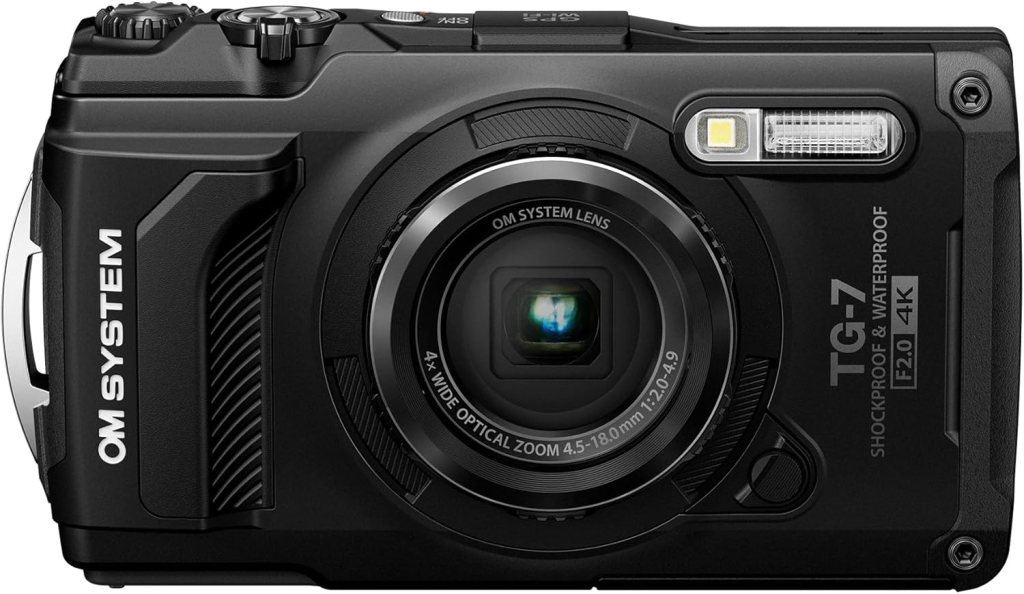
Best for rough trails, water, and no drama
The TG-7 is the camera for people who do not want to baby their gear. OM System says it is waterproof to 15 meters, shockproof to 2.1 meters, freezeproof to -10°C, crushproof to 100 kg, and built with RAW capture, macro modes, and 4K video. Amazon listings reflect the same rugged positioning.
That spec list sounds like marketing until you realize how useful it is on actual trails.
This is the camera you can clip to a pack, pull out with dirty hands, use near creeks, shove back in a pocket, and stop thinking about. For a lot of hikers, that freedom beats sensor size. You lose some low-light performance and some depth, sure. You gain a camera that shows up every time because carrying it never feels delicate.
I also like this one as the second pick because it solves a different problem than the R50. It is not trying to imitate a small mirrorless camera. It is trying to survive your day.
That honesty works.
Review summary
The OM System Tough TG-7 is the easiest camera here to live with outdoors. Not the prettiest files in the group, but maybe the most trail-appropriate object on the list.
Pros
- Actually rugged
- Waterproof and freezeproof
- Tiny and easy to stash
- Fun macro capability
- Fast to use with almost no fuss
Cons
- Smaller sensor shows its limits in low light
- Zoom range is modest
- Image quality is good, not special
Best for
- Wet trails
- Scrambles, creek crossings, and rough weather
- Hikers who want a camera, not a project
Real Testimonial
The TG-7 is the one you buy when convenience and durability matter more than chasing the prettiest files. It is built for bad weather, wet trails, drops, and rough handling, which makes it unusually easy to live with outside. It does give up some image quality compared to the larger-sensor models, but it earns that trade by being the least stressful camera here to actually carry on a hike.
3. Sony ZV-1F

Best lightweight everyday carry
The Sony ZV-1F is the light, simple, grab-and-go option. Sony positions it around a 1-inch sensor, an F2 lens, and a 20mm ultra-wide field of view. Amazon listings for the ZV-1F are current as well.
I have one hesitation here.
This is not the most flexible camera on the page. The fixed wide lens means it is better for environmental trail shots, people on hikes, trailhead videos, and “I want the whole scene” compositions than for compressing distant peaks or picking out details across a valley.
Still, that same limitation is part of why it works.
It is small. It is fast. It does not ask much from you. For a lot of casual hikers, especially people mixing photos with short spoken clips, that is enough. More than enough, really.
You carry it because it disappears.
Review summary
The ZV-1F is not a purist’s hiking camera, but it is a smart one for people who value light carry and easy use over technical flexibility.
Pros
- Small and light enough to carry without resentment
- 1-inch sensor is a real step above a phone in many conditions
- Simple, approachable shooting experience
- Strong option for mixed photo and casual video use
Cons
- Fixed 20mm-style wide view is limiting
- Not built for abuse
- Not the best pure stills specialist here
Best for
- Day hikers
- Casual creators
- People who hate carrying heavy gear
Real Testimonial
The Sony ZV-1F works best for hikers who want something light, simple, and genuinely portable. Its fixed wide lens is not ideal for every kind of photography, but it is good for trail scenes, casual photos, and quick video clips without adding bulk. This is the kind of camera that makes sense for people who know they will not carry a larger setup consistently.
4. DJI Osmo Action 5 Pro
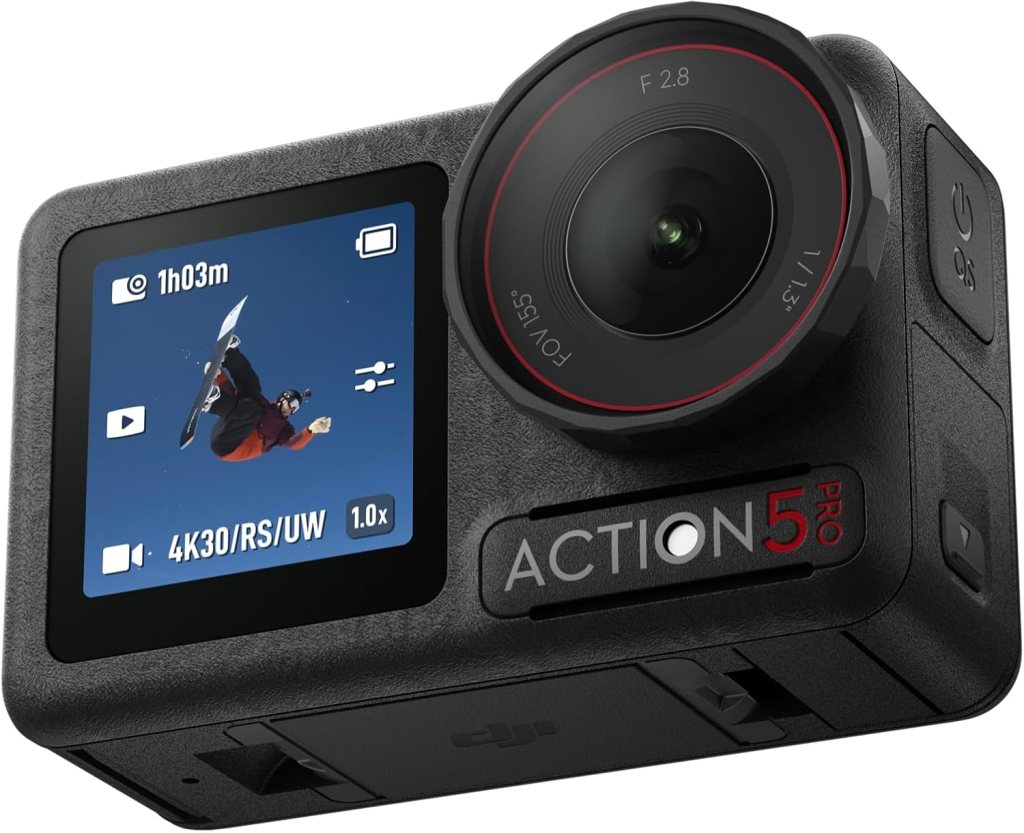
Best for movement, trail video, and POV footage
DJI’s Osmo Action 5 Pro is not pretending to be a landscape camera first. It is a movement camera. DJI lists a 1/1.3-inch sensor, 155° field of view, up to 240 minutes of operating time under specific test conditions, and water resistance to 20 meters without a case in its FAQ and product materials. Amazon-backed product results show current retail availability.
If your hikes include ridge scrambles, running, biking, trekking poles, chest mounts, or anything where one hand is busy, this thing makes more sense than a traditional camera.
The stabilization is the draw.
You can clip it, mount it, forget it, and still come back with footage that looks controlled instead of chaotic. The still photos are fine. Not moving. Not rich. Fine. That is the trade. But if your actual goal is capturing the feeling of the trail, not composing a careful still frame every few minutes, the Action 5 Pro earns its place.
This is the pick for momentum.
Review summary
The DJI Osmo Action 5 Pro is the most useful hiking camera here for people who shoot motion first. It is tiny, durable, and far better at making unstable situations look usable than most standard cameras.
Pros
- Tiny and easy to mount or stash
- Excellent stabilization
- Strong battery claims for an action cam
- Built for weather and movement
- Simple to operate on the go
Cons
- Still images are not the main event
- Ultra-wide look is not for everyone
- Less satisfying for deliberate scenic photography
Best for
- Hiking videos
- Trail runners and fast movers
- People who want first-person footage that looks clean
Real Testimonial
The Osmo Action 5 Pro is the most specialized option in the group, but it is excellent at what it does. If your hikes involve motion, first-person footage, scrambling, running, or anything where a normal camera feels awkward, this one makes a lot of sense. It is not the strongest choice for traditional scenic stills, but for trail video and stabilization, it is the clear standout.
5. Sony RX100 VII
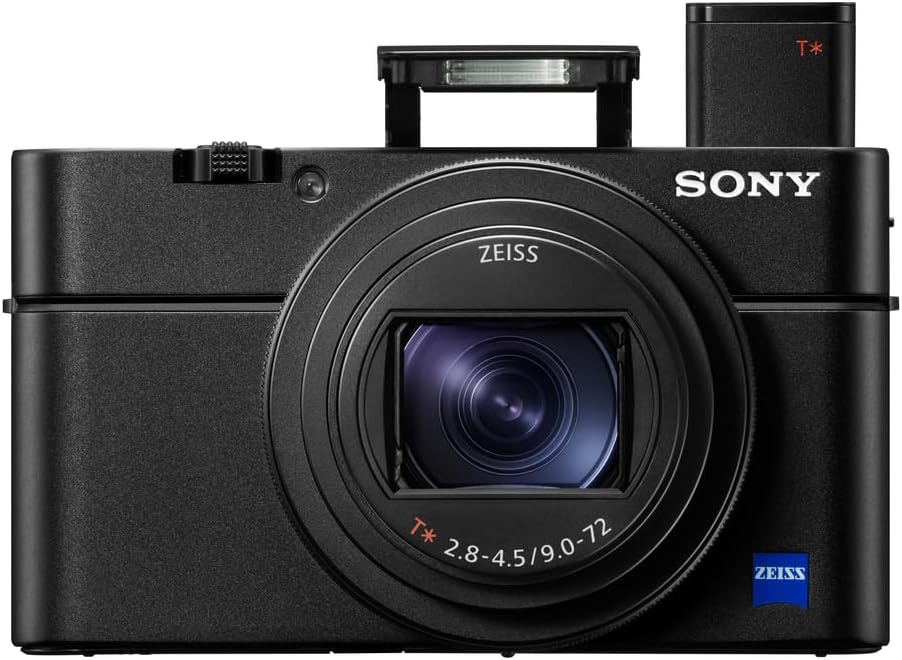
Best premium compact for serious hikers
The Sony RX100 VII is still the compact camera people bring up for a reason. Sony lists a 24-200mm F2.8-4.5 zoom, a 1-inch sensor, and very fast autofocus with 357 phase-detection and 425 contrast-detection points. Amazon Germany also shows the model live and sold directly by Amazon on at least one current listing.
This is the pocketable camera for people with standards.
You get real zoom reach. You get better flexibility than the ZV-1F. You get a body that can still fit in a jacket pocket. And you avoid the bulk jump that comes with interchangeable-lens systems.
The downside is obvious. Price.
The other downside is less obvious. Small premium cameras can feel a little fiddly on the trail if your hands are cold or you want big tactile controls. But if you know what you are buying and want the strongest compact here for mixed landscapes, wildlife-at-a-distance, and serious travel use, this one still has bite.
Review summary
The Sony RX100 VII is the expensive compact that actually earns the adjective “premium.” It is the best choice here for hikers who want quality and zoom without carrying a larger system.
Pros
- Excellent zoom range for a compact
- Strong autofocus
- Truly pocketable
- Good image quality from a 1-inch sensor
- Versatile enough for landscapes and distant details
Cons
- Expensive
- Smaller controls can feel cramped
- Not ruggedized like the TG-7
Best for
- Experienced hikers who want a compact without obvious compromises
- Travel-heavy shooters
- People who want zoom in a small body
Real Testimonial
The Sony RX100 VII is the premium compact for hikers who still care about zoom range and image quality. It costs more than most people want to spend on a small camera, but it offers a rare mix of pocketability, reach, and autofocus performance. For someone who wants serious capability without moving up to a bulkier interchangeable-lens setup, this is still one of the strongest compact choices around.
Review summary: the short version
If you want the safest recommendation, buy the Canon EOS R50.
If you want the easiest camera to carry through bad conditions, buy the OM System Tough TG-7.
If you want something tiny and simple, buy the Sony ZV-1F.
If your hikes are really about motion and video, buy the DJI Osmo Action 5 Pro.
If you want the best compact here and do not mind paying for it, buy the Sony RX100 VII.
What actually matters in a hiking camera
Weight beats theory
A lot of camera buying falls apart here. People imagine scenic overlooks. They forget the climb.
A camera you leave in the car is not better than a smaller camera in your hand.
Weather tolerance matters more than people admit
Dust, drizzle, cold air, damp straps, sunscreen on fingers. Hiking is not kind to electronics. Even light protection changes how relaxed you feel using a camera outdoors.
Fast access beats perfect specs
The best sensor in the world does nothing if the camera is buried under layers, snacks, and a rain shell.
Batteries feel smaller outside
Cold mornings chew through confidence. If you hike long, carry a spare. No drama. Just do it.
Phones are good until they are not
Phones are still excellent for quick snaps. But when the light gets flat, the subject gets far away, or you want files worth editing, the gap opens up.
Which camera should you buy?
Buy the Canon EOS R50 if you want the best all-around answer and care most about still photos.
Buy the OM System Tough TG-7 if your hikes are messy, wet, rough, or casual enough that convenience matters more than pure image quality.
Buy the Sony ZV-1F if you want something so light and simple that you never talk yourself out of bringing it.
Buy the DJI Osmo Action 5 Pro if motion matters more than stills and your hikes include movement, mounting options, or trail video.
Buy the Sony RX100 VII if you want serious compact performance and you know you will use the zoom.
Conclusion
The funny thing about the best cameras for hiking is that none of them are “best” in a vacuum. The right one depends on what kind of hiker you are. Slow scenic walker. Scrambler.
Casual day hiker. Video-first trail junkie. Photographer who hates carrying bulk but still wants control. That part matters. So does basic trail awareness. The National Park Service’s photography safety advice is still the right reminder: no shot is worth losing attention on the trail. Pick the camera that fits your hike, not your fantasy version of one.
FAQ
What is the best camera for hiking overall?
The Canon EOS R50 is the best overall pick in this group because it balances image quality, autofocus, size, and long-term flexibility better than the others.
Is a mirrorless camera better than a compact camera for hiking?
Usually for image quality, yes. Not always for convenience. A compact camera often wins if you care more about weight, pocketability, and quick access.
Are action cameras good enough for hiking photos?
They are good enough for casual stills. They are not the first choice for someone who really cares about scenic photography. Action cameras are better for movement and trail video.
What camera is best for hiking in rain or near waterfalls?
The OM System Tough TG-7 is the best fit here because it is built for water and rough use in a way the others are not.
Do I need weather sealing for hiking?
Not always. But it helps more than people think. Even mild dust and moisture protection can make outdoor use less stressful.
Is the Sony RX100 VII still worth it for hiking?
Yes, if you want compact size with better zoom range and better image quality than a basic small camera. The price is the real question, not the capability.
Is the OM System Tough TG-7 good for beginners?
Yes. It is one of the easiest cameras here to recommend to beginners because it is straightforward, durable, and hard to ruin with rough handling.
What lens is best for hiking photography?
For most hikers using an interchangeable-lens camera, a small general-purpose zoom is the right answer. You want range without turning the camera into dead weight.
Should I carry a camera or just use my phone on hikes?
Use your phone if you mostly want memories and convenience. Carry a camera if you care about image quality, zoom, editing latitude, or shooting in harder light.
How much should a hiking camera weigh?
As little as possible while still doing the job you need. That sounds vague because it is. But it is also true.
What is the best camera for mountain hikes?
For mountain hikes focused on photography, the Canon EOS R50 is the strongest all-around pick. For exposed, rough conditions, the TG-7 makes more sense.
What is the best camera for backpacking trips?
Usually the smallest camera you trust. The TG-7, ZV-1F, and RX100 VII all make more sense for many backpackers than a larger camera system.
What is the best camera for hiking videos?
The DJI Osmo Action 5 Pro is the best video-first hiking camera in this group because it is small, stabilized, and built for movement.
How do I protect a camera while hiking?
Keep it in a padded sling or hiking-friendly camera bag, use a lens cap when it makes sense, and do not let it ride loose next to metal water bottles and keys.
How many batteries do I need for a day hike?
For most day hikes, one spare is the smart minimum if you are using a dedicated camera a lot. More if it is cold or you shoot heavy video.
Can I use an interchangeable-lens camera for long hikes without regretting it?
Yes, if you keep the lens small and the setup simple. No, if you turn your hike into a gear haul.
Affiliate Disclaimer
This article contains affiliate links. We may earn a small commission if you purchase through these links, at no extra cost to you.



Leave a Reply