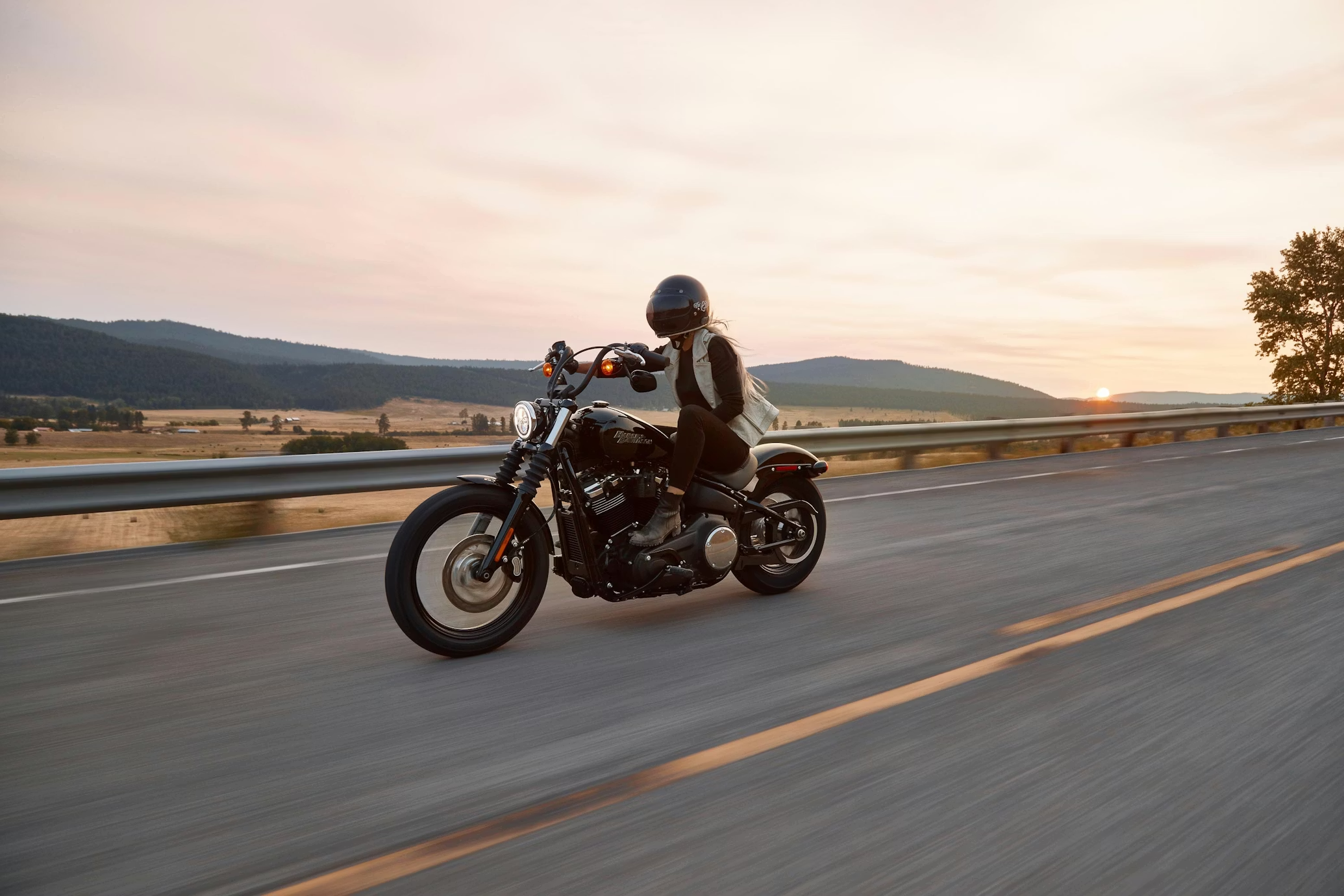
The best 360 cameras for motorcycle use are not the five cameras with the prettiest spec sheets. They are the ones that still make sense after wind buffeting, road grime, battery swaps, and one dumb lens scrape in a parking lot.
For riders, stabilization matters. So does lens protection. So does the simple fact that a camera has to be easy enough to use when you are wearing gloves and trying not to miss the light.
The Motorcycle Safety Foundation has long pushed riders to reduce distraction and keep setups simple, and that advice carries over to cameras too.
I kept the list tight. No filler picks. No relics that only look good because they are discounted somewhere. These five are the ones I would actually consider if the goal is clean, flexible motorcycle footage with fewer regrets later.
Related articles
The Short Version
- Insta360 X5
Best Overall - Insta360 X4
Best for riders who want proven performance and a smarter buy - DJI Osmo 360
Best for image quality and low-light rides - GoPro MAX2
Best for riders already in the GoPro ecosystem - KanDao QooCam 3 Ultra
Best for night riding and GPS-backed ride footage
How I picked these cameras
A motorcycle is a nasty place for a camera. Constant vibration. Wind pressure. Dust. Rain. Fast lighting changes under trees and overpasses.
I ranked these models based on the stuff that actually shows up in the footage and in daily use: stabilization, lens durability, waterproofing, battery behavior, editing flexibility, and how forgiving the camera is when mounted in imperfect spots.
I also cared about how current the camera feels. Some older 360 cameras still work, sure. But if a camera is already lagging in battery life, lens protection, or software, you feel that pretty fast on a bike. The gap is not theoretical anymore. It shows up in the first long ride.
Comparison table: quick buying view
| Camera | Best for | Max 360 video | Waterproofing |
|---|---|---|---|
| Insta360 X5 | Best overall | 8K | 15m |
| Insta360 X4 | Best for strong value | 8K/30fps | 10m |
| DJI Osmo 360 | Best for low light | 8K/30fps | 10m |
| GoPro MAX2 | Best for GoPro users | 8K | 5m |
| KanDao QooCam 3 Ultra | Best for GPS and night rides | 8K/30fps | IP68, 10m |
Comparison table: what actually matters on a bike
| Camera | What I like most | Biggest drawback | Best fit |
|---|---|---|---|
| Insta360 X5 | Replaceable lenses and long battery life | Premium price | Riders who want the safest all-around pick |
| Insta360 X4 | Mature platform with 8K and removable lens guards | Not as refined as X5 in battery and durability | Most riders |
| DJI Osmo 360 | Strong image pipeline, 10-bit color, 1-inch 360 imaging | Newer ecosystem, less proven for motorcycle accessories | Riders who care most about footage |
| GoPro MAX2 | Replaceable lenses and familiar GoPro workflow | Shallower waterproof rating | Riders already invested in GoPro gear |
| KanDao QooCam 3 Ultra | GPS, 10-bit HDR, strong low-light leaning | Heavier and more niche | Touring riders, map-overlay nerds, night shooters |
1. Insta360 X5
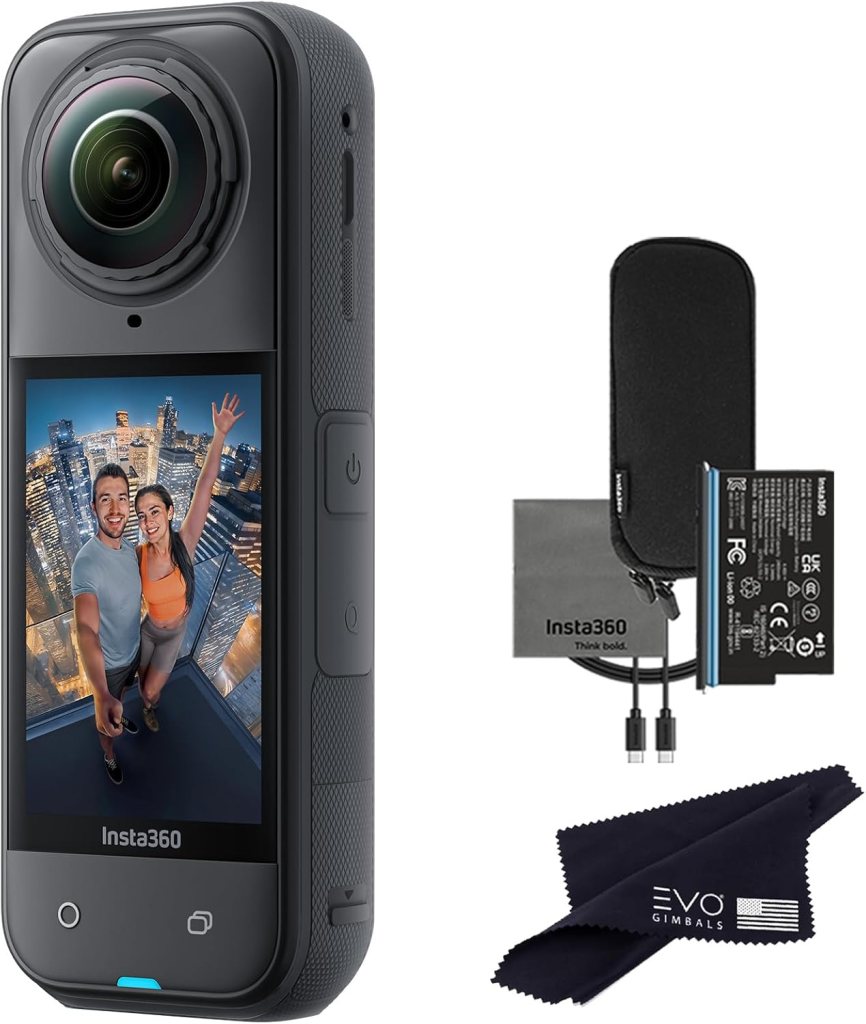
Best Overall
This is the one I would put first without much hand-wringing. The X5 fixes the thing that annoys riders most about 360 cameras: fragile lenses paired with real-world abuse. It has replaceable lenses, IPX8 waterproofing to 15 meters, and a 2400mAh battery rated for up to 208 minutes in endurance conditions.
That battery number matters more than the headline 8K. On a motorcycle, battery anxiety ruins the experience faster than almost anything else.
The other reason it lands at the top is balance. It does not force a weird trade. You get strong stabilization, a mature editing app, high-resolution 360 capture, and durability that finally feels designed by someone who has actually dropped a camera.
That is rare. Most 360 cameras still feel a little too precious. This one feels less precious. Good.
Review summary: The X5 is the cleanest recommendation because it does not have an obvious flaw that would push me toward something else for motorcycle use. It is not just the most capable. It is the least annoying.
Pros
- Replaceable lenses
- 8K 360 capture
- Very strong battery profile
- 15m waterproofing
- Mature app and reframing tools
Cons
- Costs more than older alternatives
- Still a 360 camera, so exposed glass needs respect
- Full 8K workflows can feel heavy in post
Real Testimonial
The Insta360 X5 is the easiest camera on this list to recommend for motorcycle use because it fixes the stuff that usually makes 360 cameras annoying. The big one is the replaceable lens design. That matters on a bike. So does the stronger battery, improved durability, and better wind-handling pitch. It feels like a 360 camera made by people who finally accepted that riders are hard on gear. You also get 8K 360 capture, larger 1/1.28-inch sensors, and up to 208 minutes of battery life in endurance mode.
2. Insta360 X4
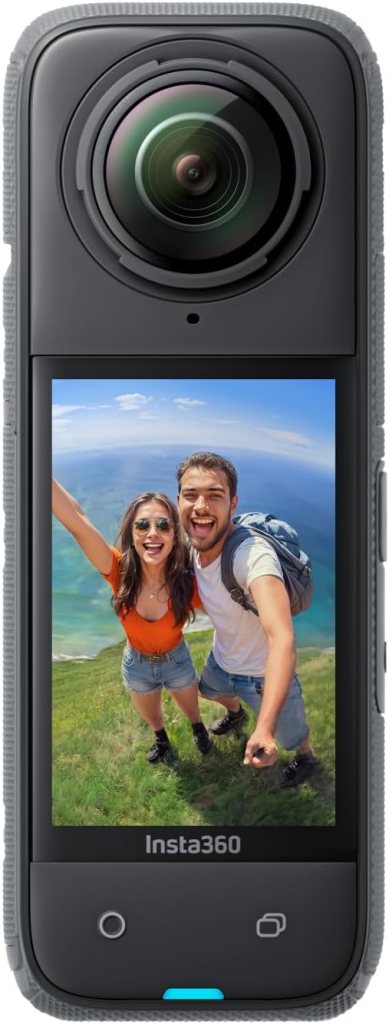
Best for Strong Value
The X4 is still a very smart pick. Not because it is the flashy choice. Because it already proved itself. It records 8K/30fps 360 video, uses removable lens guards, and gives you up to 135 minutes of battery life in the standard quoted setup.
That is enough camera for a huge number of riders, especially the ones who want something dependable without needing the newest body on the market.
What I like about the X4 is that it avoids the trap of feeling compromised. It is not some stripped-down backup recommendation. It is a real primary camera.
The stabilization is good, the invisible-stick effect still looks great on a bike, and the software side is already familiar to a lot of creators. You buy it because it works, not because you are settling.
Review summary: If the X5 is the easiest no-questions answer, the X4 is the smart-money answer. It still feels current. It still earns its place.
Pros
- 8K 360 video
- Removable lens protection
- Proven editing workflow
- Good battery life
- Strong motorcycle fit for helmet or bike mounts
Cons
- Waterproofing is lower than X5
- Battery and durability gains on X5 are real
- Lower ceiling if you want the newest hardware
Real Testimonial
The Insta360 X4 is still a very good motorcycle camera, even with the X5 above it. It shoots 8K 360 video, supports removable lens guards, and sits in that sweet spot where the platform already feels proven. That matters more than people admit. A mature app, stable workflow, and predictable performance are not glamorous, but they make ownership easier.
3. DJI Osmo 360

Best for low-light ride footage
DJI took a different angle with the Osmo 360, and I respect it. This camera leans into image quality. It offers native 8K 360 video, 120MP panoramic photos, 10-bit color performance, and what DJI describes as a 1-inch 360 imaging design.
For riders who care about dawn rides, late-day shadows, or footage that grades better later, this is the interesting one.
It is also a reminder that not every rider wants the same thing. Some people want the safest all-around purchase. Some want prettier files. If you are the second type, the Osmo 360 deserves a long look.
It also has a 10m waterproof rating and accessory options such as a battery extension pole that DJI says can extend 8K/30 recording to 4.5 hours, which matters for longer travel days.
The hesitation is simple. This is a newer ecosystem for 360 work. Newer can be exciting, but it also means fewer years of accessory habits and rider feedback to lean on. That does not make it a bad choice. It just makes it a slightly nerdier one.
Review summary: The Osmo 360 is the camera for riders who look at footage first and shopping logic second. If you care about color and low-light potential, it has a real argument.
Pros
- Native 8K 360 video
- 10-bit color
- 120MP panoramic photos
- 10m waterproofing
- Strong image-first appeal
Cons
- Newer 360 platform
- Less battle-tested in motorcycle setups
- Workflow may be less familiar than Insta360 for some users
Real Testimonial
The DJI Osmo 360 is the image-quality pick. It stands out because DJI is clearly pushing a more footage-first argument here: native 8K 360 video, 10-bit color, 120MP 360 photos, and a 1-inch 360 imaging design. That makes it especially interesting for riders who shoot early mornings, late afternoons, or mixed-light conditions where cheaper-looking footage starts to fall apart fast.
4. GoPro MAX2
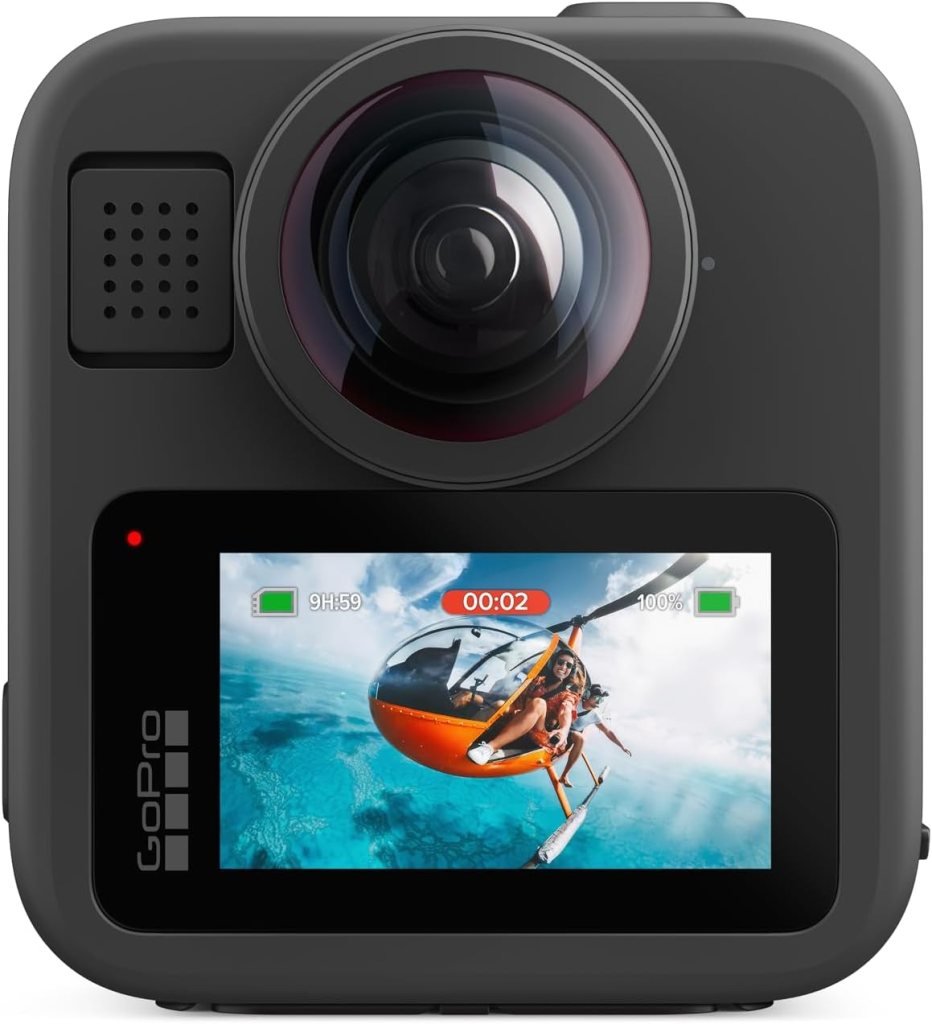
Best for GoPro riders
The MAX2 makes sense for a very specific person, and that person absolutely exists. If you already use GoPro mounts, know GoPro menus, and trust HyperSmooth, the MAX2 is the easiest transition into 360.
GoPro says it records true 8K 360 video, shoots 29MP 360 photos, includes easily interchangeable lenses, and keeps the familiar action-camera feel. Waterproofing is rated to 5 meters.
That 5m rating is not class-leading, but on a motorcycle that is usually less important than lens protection, stabilization, and whether the camera integrates cleanly with the rest of your setup. The replaceable-lens design helps a lot here. Motorcycle cameras live dangerously. One scratched dome can ruin your week.
I would not rank it above the X5 or X4 for most buyers. But for a GoPro rider, lists like that can be misleading. Familiarity matters. A camera you already know how to mount, charge, update, and edit often beats a slightly better camera that you keep postponing learning.
Review summary: The MAX2 is not my first pick for everyone. It is a very good pick for the right rider.
Pros
- True 8K 360 capture
- Replaceable lenses
- Familiar GoPro handling
- HyperSmooth stabilization
- Easy fit for existing GoPro users
Cons
- 5m waterproofing is modest
- Less universally compelling than Insta360’s top two
- Not the strongest value if you are starting from scratch
Real Testimonial
The GoPro MAX2 makes the most sense for riders who already trust GoPro gear and do not want to relearn everything. It offers true 8K 360 video, 29MP 360 photos, replaceable lenses, and GoPro’s familiar stabilization approach. It is not the most aggressive spec jump on the list, but the combination of brand familiarity and easier system compatibility is real value for the right buyer.
5. KanDao QooCam 3 Ultra

Best for night riding and GPS-backed footage
The QooCam 3 Ultra is the wildcard, which is exactly why I like it on this list. It uses dual 1/1.7-inch sensors, an F1.6 aperture, 10-bit HDR video, 96MP photos, and built-in GPS. KanDao also says it is IP68-rated and waterproof to 10 meters, with a replaceable 2280mAh battery.
That is a meaningful combo for touring riders, route-documentation types, and anyone who likes ride overlays that actually sync well.
It is not the mainstream pick. That is part of the point. It earns its spot by doing a few things the others do not emphasize as strongly, especially GPS and low-light-leaning hardware. I would still put the X5 ahead for most people.
But if your riding life includes dark backroads, travel logs, and the urge to keep location data attached to footage, the KanDao suddenly becomes a lot more interesting.
Review summary: More niche, less obvious, but not random. The QooCam 3 Ultra has a real use case, and for the right rider it might be the most satisfying pick here.
Pros
- Dual 1/1.7-inch sensors
- 10-bit HDR
- Built-in GPS
- IP68 / 10m waterproofing
- Strong low-light pitch
Cons
- Heavier, more niche camera
- Editing ecosystem is less mainstream
- Not the simplest recommendation for casual riders
Real Testimonial
The KanDao QooCam 3 Ultra is the niche pick, but not a random one. It uses dual 1/1.7-inch sensors, 10-bit HDR, 96MP photos, built-in GPS, and an F1.6 aperture, which gives it a very different personality from the more mainstream options. This is the camera for riders who care about route data, darker roads, travel logs, and footage that feels a little more specialized.
What matters more than specs on a motorcycle
Mount placement matters more than people admit. A chest-high viewpoint from the bike can look dramatic, but it also magnifies vibration. Helmet mounting usually looks cleaner, but it changes weight and comfort.
A rear extension mount can give you that floating chase-cam look, but it also leaves the lenses more exposed. There is no magic solution. There is only choosing the compromise you can live with.
Wind noise also wrecks more footage than shaky video. A 360 camera can save a rough horizon. It cannot invent clean motorcycle audio out of chaos. If you care about sound, build around that early. If you do not, fine. Just admit you are choosing image over usable audio.
And then there is the lens issue. Every 360 camera is vulnerable because that is how 360 cameras work. Even with guards or replaceable lenses, these are still glass-first devices. Riders who hate babying gear should pay extra attention to lens durability before they obsess over resolution.
Which one I would buy for each kind of rider
Daily commuter: Insta360 X4
Because it is proven, simpler to justify, and still very good.
Weekend canyon rider: Insta360 X5
Because the footage matters and the better durability is worth paying for.
Rider who shoots sunrise or dusk: DJI Osmo 360
Because that image pipeline is the whole reason to buy it.
GoPro loyalist: GoPro MAX2
No reason to pretend ecosystem comfort does not matter.
Touring rider tracking routes: KanDao QooCam 3 Ultra
GPS gives it a real identity.
Rider who wants the least second-guessing: Insta360 X5
Easy answer. Probably the right one.
FAQ
What is the best 360 camera for motorcycle riding?
Right now, I would give that to the Insta360 X5 because it combines 8K 360 video, replaceable lenses, 15m waterproofing, and a much stronger battery profile than most riders actually expect from a 360 camera.
Are 360 cameras good for motorcycles?
Yes, especially if you like reframing later instead of committing to one angle while riding. A 360 camera can capture everything around you and let you decide later whether the shot should face forward, backward, or off to one side. That flexibility is the whole appeal.
Is a 360 camera better than a regular action camera for a motorcycle?
Not always. A regular action camera is simpler and often tougher. A 360 camera is better if you want creative angles, easier reframing, and the invisible-stick effect. If you just want a straightforward road camera, a standard action cam can still be the more practical choice.
Can you mount a 360 camera on a motorcycle helmet?
Yes, but it changes weight and catch in the wind. The cleaner answer is usually a well-placed bike mount or a compact extension mount that keeps the camera stable without turning your helmet into a sail.
Can a 360 camera survive highway wind?
Usually yes, if the mount is good. Highway wind is not the real problem. Poor mounting is. A bad mount turns any camera into shaky junk.
Which 360 camera is best in low light for night rides?
The DJI Osmo 360 and KanDao QooCam 3 Ultra stand out most on paper because DJI pushes its 1-inch 360 imaging design and 10-bit color, while KanDao pairs dual 1/1.7-inch sensors with an F1.6 aperture and 10-bit HDR.
Are 360 cameras waterproof enough for rain riding?
Most of the cameras here are. The X5 is rated IPX8 to 15m, the X4 to 10m, the Osmo 360 to 10m, and the QooCam 3 Ultra carries an IP68 / 10m claim. The MAX2 is rated to 5m. Rain is not the issue. Open ports and bad seals are.
Do 360 cameras overheat on long rides?
They can, especially at high resolutions in hot weather. Airflow helps on a bike, but direct sun and long 8K sessions still push these cameras hard. Battery strategy matters here more than people think.
What is the best mount position for a motorcycle 360 camera?
There is no single best position. Helmet gives a natural point of view. Rear extension mounts create the most dramatic footage. Handlebar and fairing mounts can work, but they often show more vibration.
Can a 360 camera capture front and rear views at the same time?
Yes. That is one of the strongest reasons to use one. You are effectively recording the whole sphere and choosing your angle later.
Is 8K necessary for a motorcycle 360 camera?
Necessary, no. Helpful, yes. 360 footage gets cropped and reframed constantly, so extra resolution gives you more room before the image falls apart.
Do 360 cameras record sound well on a motorcycle?
Usually not well enough on their own at highway speeds. Wind is brutal. If audio matters, plan for that separately instead of hoping the internal mics will perform miracles.
Are 360 camera lenses easy to scratch on a bike?
Yes. Painfully easy. That is why replaceable lenses or removable guards matter so much for motorcycle use. X5 and MAX2 both lean into that. X4 helps with removable lens protection too.
Can I use a 360 camera for motovlogging?
Yes, but it depends on what you mean. For visual storytelling, absolutely. For clean rider commentary, less so unless you build the audio setup around it.
Which 360 camera is easiest to edit?
For most people, the Insta360 models still feel easiest because the reframing workflow is already familiar and mature. That alone is a bigger advantage than some buyers realize.
Final take
If I had to rank these without hedging, it goes X5 first, X4 second, Osmo 360 third, MAX2 fourth, QooCam 3 Ultra fifth. That is not because fifth is bad. It is because the top two are just easier recommendations for actual riders.
The National Highway Traffic Safety Administration has spent years stressing visibility, awareness, and reducing avoidable complexity on the road, and I think that logic belongs here too: the best camera is the one that gets you the shot without turning your ride into a tech support session.
If you want the clean answer, buy the Insta360 X5. If you want the smarter spend, buy the X4. If your heart is in the footage itself, not the spreadsheet, the Osmo 360 is the camera here with the most interesting upside. That is the list. I would not pad it with anything else.
Affiliate Disclaimer
This article contains affiliate links. We may earn a small commission if you purchase through these links, at no extra cost to you.




Leave a Reply