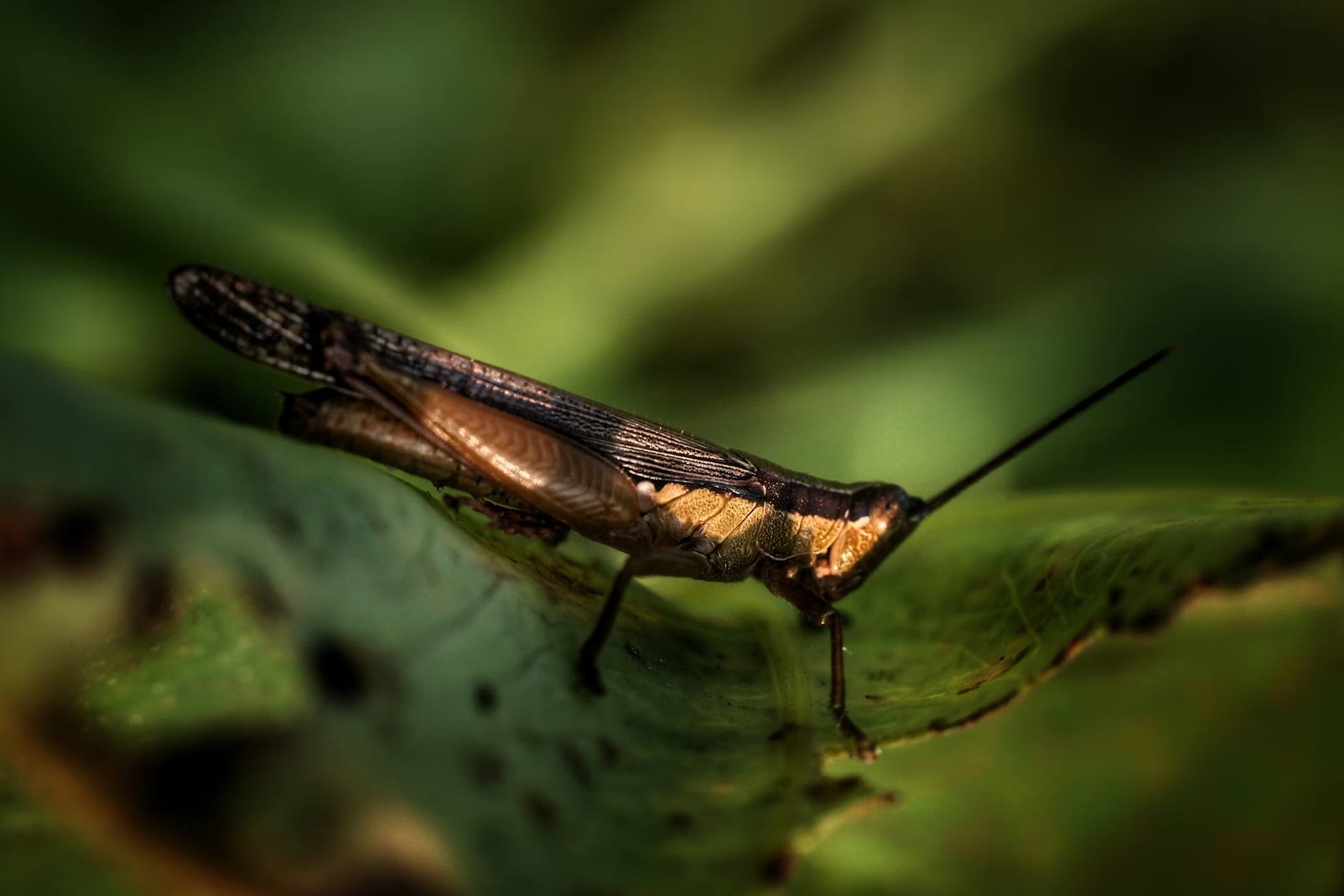
The best camera for macro photography should help you get close, stay steady, and keep detail clean without making the process miserable. True macro photography usually refers to 1:1 magnification, where the subject appears life-size on the sensor, but a lot of good close-up work also happens just outside that strict definition.
Nikon explains macro as extreme close-up photography, technically using a macro lens with a minimum 1:1 magnification ratio.
That distinction matters.
A good macro camera is not just a camera with a “macro” icon buried in the menu. It needs to work well at awkward angles. It should let you focus carefully. It should have enough resolution to crop when a bug moves or the wind ruins your perfect framing.
For most people, the lens matters more than the body. Still, the body changes how often you actually get the shot.
Related articles
- 5 Best Lens for Insect Photography
- 5 Best Cameras for Jewelry Photography
- 5 Best Lenses for Food Photography (Every Budget and Brand)
Quick Comparison: Best Cameras for Macro Photography
| Camera | Best For | Sensor | Lens Type | Why I’d Pick It |
|---|---|---|---|---|
| OM System Tough TG-7 | Best Overall | 1/2.3-inch | Built-in zoom | Excellent close-focus modes and rugged handling |
| Canon EOS R50 | Best Lightweight Mirrorless | APS-C | Interchangeable RF/RF-S | Small, sharp, beginner-friendly system body |
| Sony RX100 VII | Best Travel Compact | 1-inch | Built-in 24-200mm zoom | Pocketable camera with strong detail and reach |
| Nikon Z50 II | Best Beginner System Camera | APS-C DX | Interchangeable Z mount | Comfortable body with good long-term lens options |
| Fujifilm X-T30 II | Best Creative Color | APS-C X-Trans | Interchangeable X mount | Beautiful files, tactile controls, strong stills camera |
1. OM System Tough TG-7
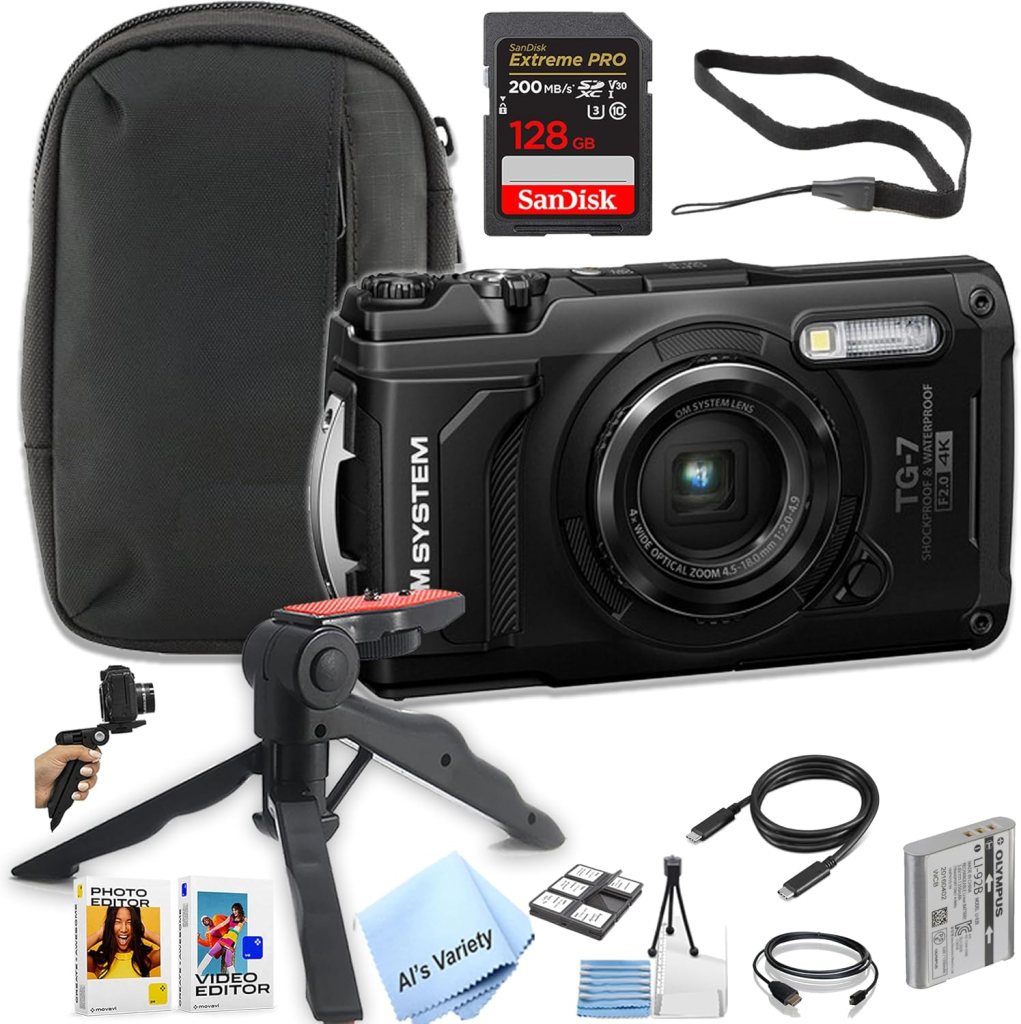
Best Overall for Macro Photography
The OM System Tough TG-7 is the camera I’d put first for most people who want macro without building a whole kit around it.
It is not the biggest sensor here. It is not the most “serious” camera on paper. But macro is full of annoying practical problems, and the TG-7 solves a lot of them cleanly.
It can focus as close as 1 centimeter from the end of the lens, and its variable macro system includes multiple macro modes. It is also waterproof, dustproof, shockproof, crushproof, freezeproof, and built for ugly shooting conditions.
That matters if you photograph tide pools, wet leaves, mushrooms, bugs after rain, garden textures, or anything outside where real life gets in the way.
The TG-7 is also less intimidating than a mirrorless setup. You can hand it to a beginner and they will probably come back with usable close-ups. That is not always true with a camera body plus a 100mm macro lens.
Review Summary
The TG-7 feels like the least precious camera on this list, and that is its charm. It invites you to get close, low, wet, muddy, and careless in the best possible way. Image quality will not beat a larger-sensor camera with a dedicated macro lens, but it gets more people into macro faster.
Pros
- Excellent close focusing: The 1 cm close-focus capability is the headline feature.
- Rugged body: Great for outdoor macro, travel, water, and rough handling.
- Simple workflow: No lens swapping required.
- Strong for field details: Great for flowers, shells, insects, textures, moss, and small objects.
Cons
- Small sensor limits image quality: Larger cameras produce cleaner files, especially in lower light.
- Built-in lens only: You cannot grow into a full macro lens system.
- Not ideal for creamy background blur: Depth-of-field control is limited compared with APS-C or full frame.
Who Should Buy It
Buy the TG-7 if you want macro to feel fun, fast, and portable. It is the best choice for hikers, gardeners, beach shooters, field naturalists, and anyone who wants close-up detail without carrying a full camera bag.
Who Should Skip It
Skip it if you want studio-grade product photography, heavy cropping, large prints, or the look of a dedicated macro lens on a larger sensor.
Real Testimonial
This is the easiest camera here to actually use for macro. The close-focus capability is the reason people keep it. You can get extremely close without thinking about lenses or setup. It’s also built for real-world use. Dirt, water, rough handling, none of it really slows you down. That changes how often you shoot. Image quality is solid for the size, but it won’t match larger sensors. Still, most people accept that trade because the camera is fast and convenient.
2. Canon EOS R50
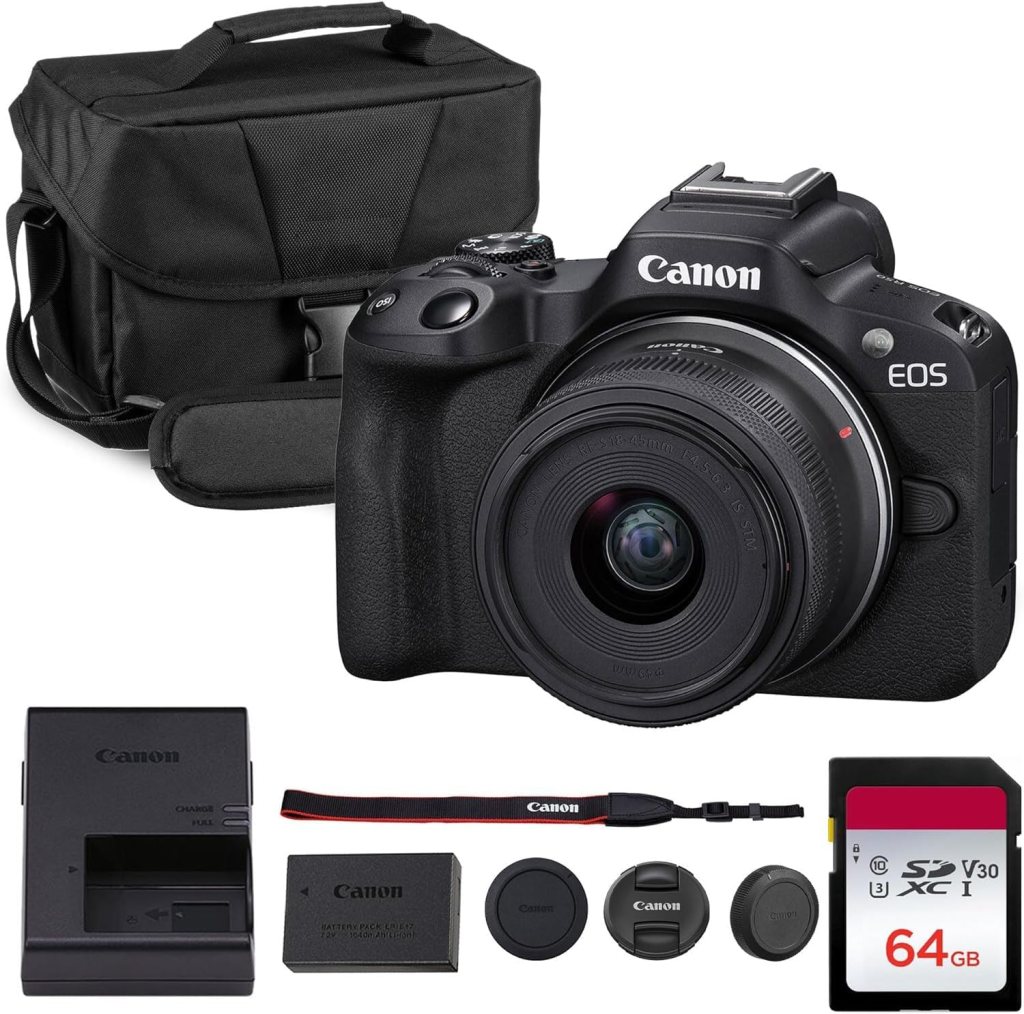
Best Lightweight Mirrorless Option
The Canon EOS R50 is the cleanest mirrorless recommendation here for someone who wants a small camera body and a path into real macro lenses.
It has a 24.2-megapixel APS-C sensor, Canon’s DIGIC X processor, and Dual Pixel autofocus. The body is small enough that you will actually bring it with you, which counts for more than people admit.
For macro work, the R50 makes the most sense if you plan to pair it with a dedicated macro lens. The kit lens is fine for everyday shooting, but the real value is the RF system. Add something like a Canon RF macro lens later, and the body becomes far more capable.
I also like Canon color for flowers and food. It tends to look clean without much fighting in post.
Review Summary
The R50 is the best “start here and grow later” camera for many new macro shooters. It is light, modern, responsive, and easy to learn. The body itself is not a magic macro machine, but it becomes very good once paired with the right glass.
Pros
- 24.2MP APS-C sensor: Plenty of resolution for close-up work and moderate crops.
- Small body: Easy to carry for casual nature walks and tabletop shoots.
- Good autofocus: Useful for flowers, food, products, and slower subjects.
- Strong upgrade path: RF and adapted EF macro lenses give room to grow.
Cons
- Needs a macro lens for serious work: The body alone is not enough.
- No in-body stabilization: You will rely on lens stabilization, shutter speed, flash, or a tripod.
- Small grip: Comfortable enough, but not ideal with heavier lenses.
Who Should Buy It
Buy the Canon EOS R50 if you want a modern mirrorless camera that can handle family photos, travel, video, and macro once you add the right lens.
Who Should Skip It
Skip it if you want the best close-up results straight out of the box without buying another lens.
Real Testimonial
The R50 is a clean starting point for macro if you plan to build a system. The body is light, responsive, and easy to learn. On its own, it’s not a macro specialist. Pair it with a proper macro lens and it becomes much more capable. That’s where it makes sense. Color is consistent, autofocus is reliable, and the overall experience feels modern without being complicated.
3. Sony RX100 VII

Best Compact Camera for Travel Macro
The Sony RX100 VII is not a pure macro specialist. I want to be clear about that.
Its real strength is that it gives you serious compact-camera image quality, a 1-inch sensor, and a 24-200mm equivalent zoom lens in a body that fits in a jacket pocket. The product page highlights the 24-200mm zoom and its color and texture reproduction.
For travel macro, that matters. You may not want to carry a mirrorless body and macro lens while walking through a market, botanical garden, museum, or old city street. The RX100 VII is the camera you bring when you are not officially “doing photography.”
And that is why it earns a place here.
It handles detail shots well: flowers, food, craft objects, textures, small travel finds, labels, patterns, and close-up documentary work. It is not the camera I’d choose for extreme insect macro, but it is one of the best small cameras for people who like finding details everywhere.
Review Summary
The RX100 VII is a beautiful little compromise. It gives up true macro specialization, but it wins on portability, speed, and usefulness. If your camera sits at home, it does not matter how good the lens is. This one is easy to keep with you.
Pros
- Pocketable design: Small enough for real travel use.
- Useful zoom range: The 24-200mm equivalent lens covers detail shots and general photography.
- Strong image quality for size: The 1-inch sensor gives better files than most basic compacts.
- Fast performance: Good for quick close-ups before light or subjects change.
Cons
- Not a true macro system: It cannot replace a dedicated macro lens.
- Small controls: Less comfortable for slow, deliberate macro work.
- Premium compact price: You pay for miniaturization.
Who Should Buy It
Buy the RX100 VII if you want one small camera for travel, street details, food, plants, textures, and everyday close-ups.
Who Should Skip It
Skip it if your main goal is 1:1 macro, controlled studio work, or insect photography with serious working distance.
Real Testimonial
This one wins on portability. It’s small enough to carry everywhere, which means you actually capture more detail shots in everyday situations. Image quality is strong for a compact, and the zoom range makes it flexible for close-ups. It’s not true macro, but it handles detail work well. The experience is more technical than enjoyable. It works well, but it doesn’t feel particularly intuitive.
4. Nikon Z50 II

Best Beginner Camera With Room to Grow
The Nikon Z50 II is the camera I’d point to for someone who wants a proper camera body, good handling, and a system they can keep building.
It uses a 20.9MP DX sensor and is sold in kits with Nikon’s compact DX zoom lenses. Current listings show the Z50 II with the 16-50mm VR kit lens, and some bundles include the 50-250mm lens as well.
For macro, I like Nikon because the system has a long history of serious close-up lenses. Nikon’s Micro-NIKKOR line has always had credibility among nature and detail shooters. The Z50 II body gives beginners a friendly way into that world.
It also feels better in the hand than many tiny entry cameras. That sounds minor until you are crouched beside a flower bed trying to hold focus on a moving stem.
Review Summary
The Z50 II is less flashy than some cameras, but it makes sense. It is comfortable, flexible, and a good base for someone who wants to learn photography properly. Add a true macro lens later, and it becomes a strong close-up tool.
Pros
- Comfortable handling: Good grip and sensible controls.
- Good image quality: 20.9MP is enough for most macro shooters.
- Nikon lens ecosystem: Strong long-term options for macro and nature work.
- Beginner-friendly but not toy-like: Easy to learn without feeling disposable.
Cons
- Needs the right lens: The kit lens is not the final macro setup.
- APS-C lens selection is still growing: Some users may adapt or use full-frame Z lenses.
- Not the smallest option: More portable than a DSLR, but not pocketable.
Who Should Buy It
Buy the Nikon Z50 II if you want a camera that can grow from everyday photography into more serious macro work.
Who Should Skip It
Skip it if you want the smallest possible setup or a camera with built-in close-up modes like the TG-7.
Real Testimonial
The Z50 II feels stable and predictable. The grip is comfortable, the controls make sense, and the camera doesn’t get in your way. Like the R50, it needs the right lens to unlock real macro performance. Once paired correctly, it becomes a solid option for close-up work. It’s not the smallest or most exciting choice, but it’s reliable.
5. Fujifilm X-T30 II
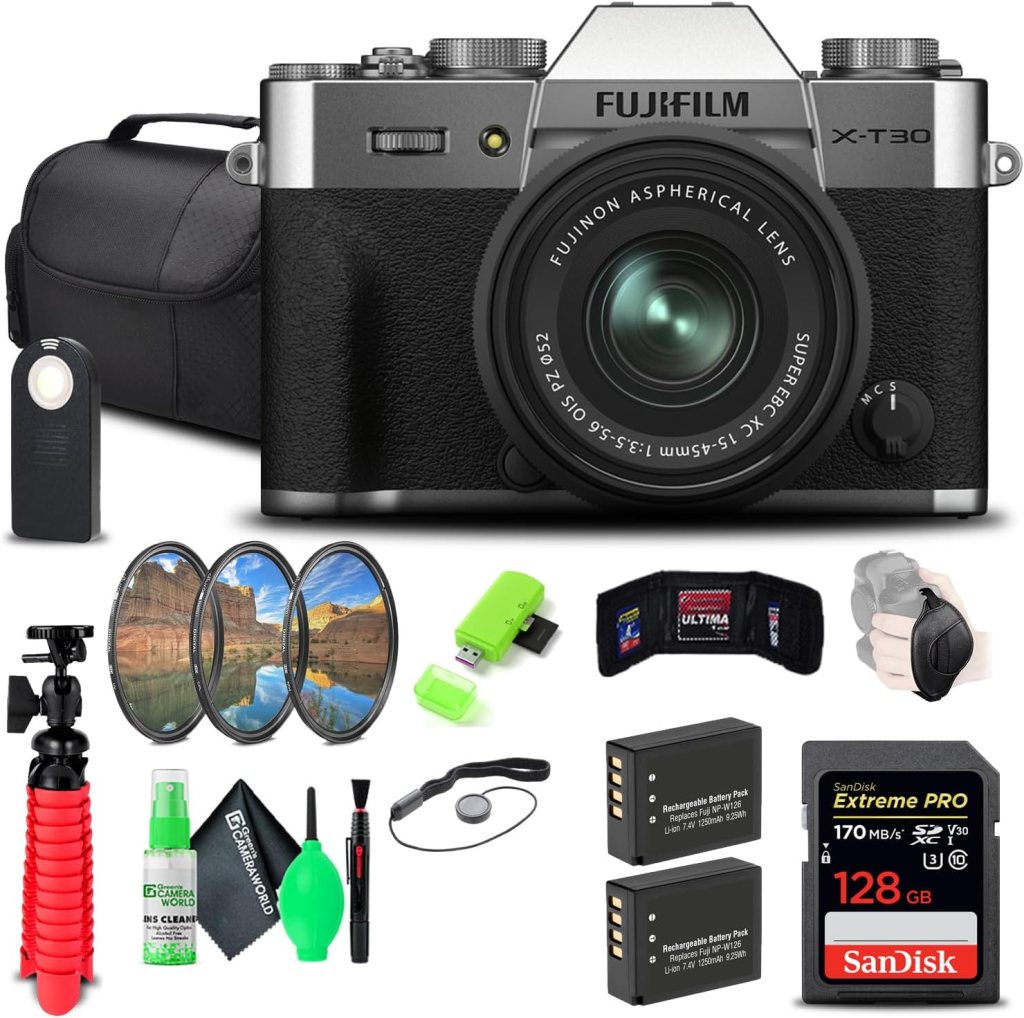
Best for Color and Creative Macro Work
The Fujifilm X-T30 II is the camera I’d choose for someone who cares about the mood of the image as much as the detail.
It uses Fujifilm’s 26.1MP X-Trans CMOS 4 sensor, shoots 4K video, and includes Fujifilm’s well-liked Film Simulation modes. The current product listing highlights the 26.1MP sensor and video/color controls.
Macro can get clinical fast. You photograph a petal, a ring, a beetle shell, or a coffee bean, and suddenly everything looks like a lab sample. Fujifilm helps fight that. The files have character, especially if you like working with JPEG color or subtle film-style looks.
Pair the X-T30 II with a proper Fujifilm macro lens and it becomes a lovely close-up camera for flowers, food, craft, jewelry, and natural textures.
Review Summary
The X-T30 II is not the easiest camera here, and that is fine. It rewards people who enjoy photography as a process. The controls feel more intentional. The color has taste. For macro shooters who want beauty, not just magnification, this one has a real pull.
Pros
- 26.1MP APS-C sensor: Strong resolution for detail and cropping.
- Excellent color options: Film Simulations give JPEG shooters more creative control.
- Compact body: Easy to carry with a small lens.
- Great for still-life macro: Food, flowers, objects, and textures look especially good.
Cons
- No in-body stabilization: Use a stabilized lens, tripod, flash, or careful technique.
- Small grip: Not ideal with larger macro lenses.
- Not as beginner-simple: The control layout may take time.
Who Should Buy It
Buy the Fujifilm X-T30 II if you want macro images with style, color, and a more tactile shooting experience.
Who Should Skip It
Skip it if you want the easiest beginner camera or the most rugged field setup.
Real Testimonial
This camera stands out for how images look, not just how sharp they are. Colors feel more natural and less clinical, which works well for flowers, food, and still-life macro. The controls are more hands-on, which some people enjoy and others find slower. It’s not the easiest camera here, but it rewards careful shooting. Like the other mirrorless options, it depends heavily on the lens you pair with it.
Best Camera for Macro Photography by Use Case
| Use Case | Best Pick | Why |
|---|---|---|
| Flowers | Fujifilm X-T30 II | Color, detail, and pleasing JPEGs |
| Insects | Nikon Z50 II | Better system path for longer macro lenses |
| Travel details | Sony RX100 VII | Small body, big zoom range |
| Outdoor adventure | OM System Tough TG-7 | Rugged body and strong close-focus modes |
| Jewelry | Canon EOS R50 | Good sensor and strong lens upgrade path |
| Food | Fujifilm X-T30 II | Strong color and natural texture rendering |
| Beginner macro | OM System Tough TG-7 | Fastest way to get close without extra lenses |
What Actually Matters in a Macro Camera
Lens Choice Beats Body Hype
A modest camera with a real macro lens usually beats a fancy camera with the wrong lens.
That is the boring truth.
For insects, working distance matters. For jewelry, flat-field sharpness matters. For flowers, color and background rendering matter. The camera body helps, but the lens does the heavy lifting.
Stabilization Helps, But Light Wins
People obsess over stabilization. It helps, especially for handheld flowers and detail shots.
But macro magnifies shake. It also magnifies bad light.
A small LED panel, flash, diffuser, or reflector can improve macro photos more than another camera upgrade.
A Tilting or Vari-Angle Screen Is Worth Having
Macro often happens low to the ground.
A fixed screen makes you hate your knees. A tilting or articulating screen lets you compose from weird angles without lying in mud every five minutes.
Autofocus Is Nice. Manual Focus Still Matters.
Autofocus works well for flowers, food, and products.
For very close work, manual focus is still a normal part of the process. Many macro photographers move the camera slightly forward and backward instead of turning the focus ring for every micro-adjustment.
It looks strange until it works.
Common Macro Buying Mistakes
Buying Megapixels Instead of a Setup
Resolution helps. It does not replace close focusing, stability, light, or a good lens.
Forgetting Working Distance
Short macro lenses can force you too close to insects. That scares them off and blocks your light.
Ignoring Light
Macro eats light. The closer you get, the more light becomes a problem.
Expecting the Kit Lens to Do Everything
Kit lenses are useful. They are not usually the best answer for true macro.
Choosing a Camera That Feels Annoying
Macro is slow. If the camera feels clumsy, you will use it less.
FAQ
What is the best camera for macro photography?
The OM System Tough TG-7 is the best overall pick for most people because it focuses extremely close, handles rough outdoor use, and does not require extra lenses. For higher image quality and long-term growth, the Canon EOS R50, Nikon Z50 II, and Fujifilm X-T30 II make more sense with dedicated macro lenses.
Do I need a macro lens for macro photography?
For true 1:1 macro, yes, a macro lens is usually the right tool. Some compact cameras have strong close-focus modes, but interchangeable-lens cameras need the right lens to perform serious macro work.
Is mirrorless better than DSLR for macro photography?
Mirrorless cameras are often easier for macro because electronic viewfinders, live exposure preview, focus peaking, and compact bodies help with close-up shooting. DSLR cameras can still be excellent if paired with a good macro lens.
What camera is best for insect photography?
The Nikon Z50 II is a strong beginner system choice for insect photography because it gives you access to longer macro lens options. The TG-7 can also work well for casual insect close-ups, especially outdoors.
What camera is best for flower photography?
The Fujifilm X-T30 II is my favorite here for flowers because of its color, resolution, and creative JPEG options. The Canon EOS R50 is also excellent with the right macro lens.
Is full frame necessary for macro photography?
No. APS-C cameras are excellent for macro. Smaller sensors can even help by giving more depth of field at the same framing, which can be useful for close-up work.
How many megapixels do I need for macro photography?
Around 20 to 26 megapixels is enough for most macro shooters. More resolution helps with cropping, but it also demands better lenses, steadier technique, and cleaner focus.
Can compact cameras be good for macro photography?
Yes. The OM System Tough TG-7 is a great example. The Sony RX100 VII is also strong for travel close-ups, though it is not a true macro specialist.
What settings should I use for macro photography?
Start around f/5.6 to f/11, keep your shutter speed high enough to prevent shake, and use low ISO when possible. For static subjects, a tripod helps. For outdoor handheld work, add light before raising ISO too far.
Is autofocus important for macro photography?
Autofocus helps, but it is not everything. At high magnification, tiny movements change focus. Manual focus and careful body movement are often more reliable.
What is 1:1 magnification?
1:1 magnification means the subject is projected onto the camera sensor at life size. A 10mm subject appears as 10mm on the sensor.
Do I need a tripod for macro photography?
Not always. A tripod helps with jewelry, products, flowers indoors, and focus stacking. For insects and field work, handheld shooting is often faster.
What is the best beginner camera for macro photography?
The OM System Tough TG-7 is the easiest beginner macro camera. The Canon EOS R50 is the better beginner choice if you want an interchangeable-lens system.
Which is better for macro, Canon or Nikon?
Both are strong. Canon is very beginner-friendly and has good RF macro options. Nikon has a deep macro history through its Micro-NIKKOR lenses and a practical path for nature shooters.
What is the best small camera for macro photography?
The OM System Tough TG-7 is the best small camera for close-focus macro. The Sony RX100 VII is better if you want one compact camera for travel, detail shots, and general photography.
Final Verdict
The OM System Tough TG-7 is the easiest camera to recommend first. It gets close, survives rough conditions, and makes macro feel less precious.
The Canon EOS R50 is the better long-term starter for people who want a mirrorless system.
The Nikon Z50 II makes sense for nature shooters who care about handling and lens growth.
The Sony RX100 VII is the travel pick.
The Fujifilm X-T30 II is the one I’d choose for color, still-life work, and images that feel less sterile.
Macro photography is not about owning the most impressive camera. It is about noticing small things, controlling light, and using gear that does not fight you.
Tamron’s macro guide also points to the importance of having the right tools, techniques, and lenses for close-up work, which is exactly why the body alone should never be the whole buying decision.
Affiliate Disclaimer
This article contains affiliate links. We may earn a small commission if you purchase through these links, at no extra cost to you.



Leave a Reply