
The phrase the best lens for insect photography sounds simple. It isn’t. Bug photography gets difficult fast because the subject is small, nervous, and usually sitting in bad light.
The lens matters more here than it does in a lot of other genres. True macro magnification matters. Working distance matters. The difference between a pleasant session and a miserable one can come down to a few extra centimeters and a lens that focuses without drama.
Nikon’s insect macro guide and Canon’s macro shooting advice both make the same basic point in different ways: life-size magnification and careful subject distance are central to getting sharp, believable insect photos.
What matters most in an insect photography lens
Start with magnification. If a lens does not reach 1:1, it is already making your life harder for true insect work. A real macro lens projects the subject at life size on the sensor. That is the baseline, not a luxury feature.
Canon’s macro guidance explicitly frames life-size magnification as the point where fine subject detail starts to become meaningful in this kind of shooting.
Then there’s working distance. This is where people get burned. A short macro lens can look great on paper, but if you have to crowd a dragonfly or a bee to fill the frame, you will get a nice photo of empty air because the insect left.
Lenses around 90mm to 105mm tend to hit the sweet spot because they give you more room to work while still offering strong magnification. Nikon’s 105mm macro, Sony’s 90mm macro, Canon’s RF 100mm macro, and Laowa’s 100mm 2x macro all sit right in that zone.
Autofocus helps, but this is not portrait photography. At high magnification, even tiny body movement changes focus. Plenty of insect shooters still prefer to rock gently in and out of focus or use manual focus for precision. So I do not treat manual focus as a dealbreaker here. I treat it as a tradeoff.
Stabilization is useful too, especially for handheld field work, but it is not magic. If your shutter speed is too slow or your plane of focus is wrong, stabilization will not rescue the file. It just gives you a little more margin.
Related articles
- 9 Best Lenses for Bird Photography (Sony, Nikon, Canon, Sigma)
- 6 Best Lenses for Bird Photography (By Budget & Brand)
Quick comparison table
| Lens | Best for | Max magnification | Stabilization | Focus style |
|---|---|---|---|---|
| Laowa 100mm f/2.8 2X Ultra Macro APO | Best overall for tiny subjects | 2:1 | No | Manual |
| OM System M.Zuiko 60mm f/2.8 Macro | Best for smaller, lighter kits | 1:1 | No | Autofocus |
| Nikon NIKKOR Z MC 105mm f/2.8 VR S | Best for Nikon Z users | 1:1 | Yes | Autofocus |
| Canon RF 100mm f/2.8L Macro IS USM | Best for extra magnification with AF | 1.4:1 | Yes | Autofocus |
| Sony FE 90mm f/2.8 Macro G OSS | Best for Sony users | 1:1 | Yes | Autofocus |
The product slate is grounded in current manufacturer specs and current Amazon listings for each lens.
1. Laowa 100mm f/2.8 2X Ultra Macro APO
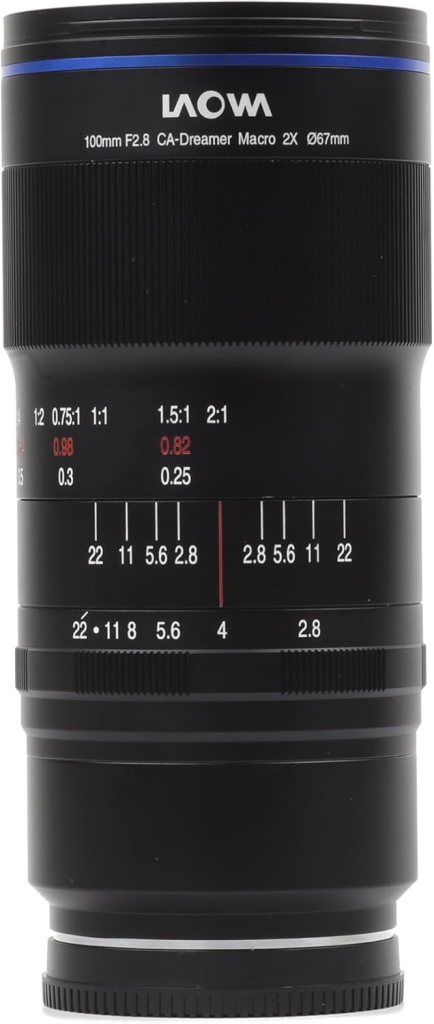
Best Overall
This is my top pick. Not because it is the easiest lens here. It isn’t. It wins because insect photography rewards magnification and working distance, and this lens gives you more of the first without sacrificing the second.
The Laowa 100mm reaches 2:1 magnification, covers full frame, focuses as close as 24.7cm, and comes in multiple mounts. That extra magnification is not some spec-sheet flex. It matters when the subject is genuinely tiny. A small beetle that looks underwhelming at 1:1 starts to feel substantial at 2:1.
The downside is obvious. It is manual focus. Some people will hate that on principle. I don’t. At macro distances, manual focus is often the cleaner tool anyway. You stop pretending autofocus will solve everything and start shooting with intent.
The APO design is also a serious plus because macro images fall apart quickly when color fringing creeps into fine edges. The Laowa is built for this kind of exacting work.
This is the lens I’d buy if the assignment were simple: go photograph insects and come back with frames that look like you meant it.
Pros
- 2:1 magnification is genuinely useful for small insects
- 100mm focal length gives practical working distance
- Full-frame coverage
- Excellent fit for deliberate macro shooting
Cons
- Manual focus only
- No built-in stabilization
- Less forgiving if you want point-and-shoot convenience
Review summary: The Laowa 100mm feels like a specialist lens built by people who actually understand macro shooters. It asks more of you. In return, it gives you the most interesting files in this lineup.
Real Testimonial
This lens feels built for people who care more about magnification than convenience. The 2:1 capability is the real draw, and it gives it an edge for very small insects that can look underwhelming through a standard 1:1 macro lens. Manual focus will turn some buyers off, but in actual macro use that is less of a weakness than it sounds. The bigger story is control, sharpness, and the kind of working distance that makes field shooting more realistic. It is not the easiest lens here. It may be the most rewarding.
2. OM System M.Zuiko 60mm f/2.8 Macro
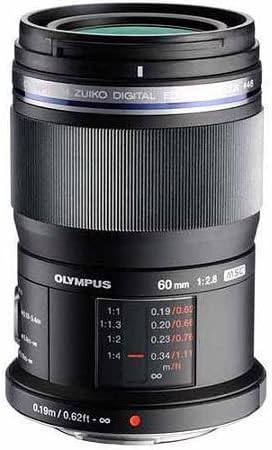
Best for a Smaller, Lighter Setup
This is the second recommendation and the strongest pick from the more accessible end of the field. I am not choosing it because it is the least expensive. I am choosing it because it is compact, smart, and unusually practical.
The lens offers 1:1 magnification, a 60mm focal length, a 120mm full-frame equivalent field of view on Micro Four Thirds, a 0.19m minimum focusing distance, and a very light 185g body.
That combination makes sense for insect photography.
The smaller system keeps the kit easy to carry. The effective angle of view gives you a tighter framing feel than the raw 60mm number suggests. And the lens is weather-sealed, which matters more than people admit when you’re kneeling in grass or leaning into damp foliage at sunrise.
No, it does not have stabilization in the lens. No, it does not hit 2:1. But it is sharp, light, sensible, and less annoying to live with than many bigger macro lenses.
Pros
- True 1:1 macro
- Very light and compact
- 120mm equivalent field of view on Micro Four Thirds
- Weather-sealed design
Cons
- No lens stabilization
- Less dramatic magnification than Laowa or Canon RF
- Requires buying into Micro Four Thirds
Review summary: This is the grown-up choice for people who want a serious insect lens without dragging a brick through the field. Small, sharp, and more capable than its size suggests.
Real Testimonial
This is the sensible lens in the group, and that is a compliment. It is light, sharp, compact, and easier to carry than the bulkier full-frame options. On Micro Four Thirds, the field of view works nicely for insect photography without making the setup feel oversized or awkward. It does not have the drama of a 2x macro lens, and it does not try to. What it gives you instead is consistency, portability, and a setup you are more likely to actually bring outside. That matters more than people think.
3. Nikon NIKKOR Z MC 105mm f/2.8 VR S
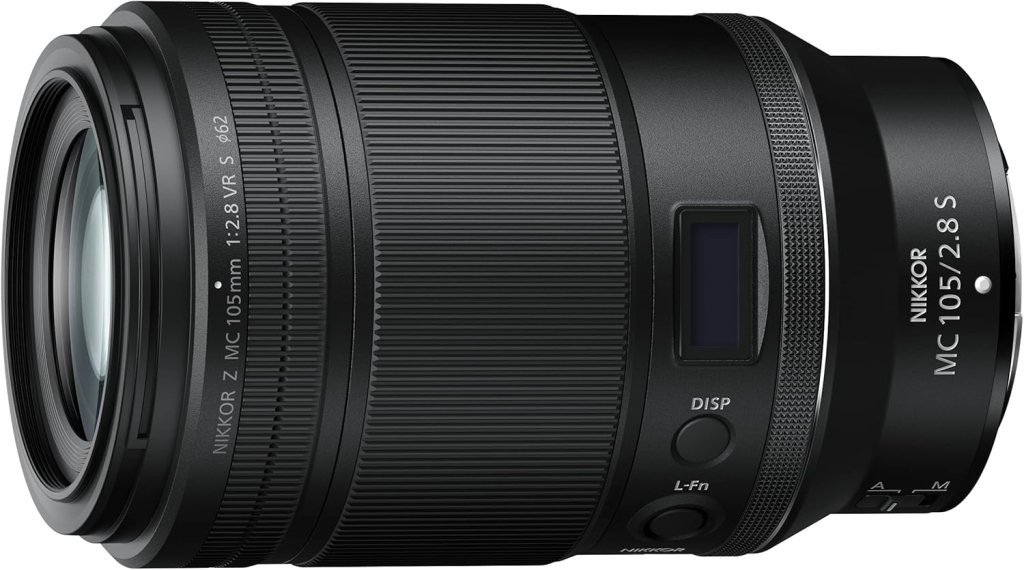
Best for Nikon Z Shooters Who Want the Easy Answer
If you shoot Nikon Z and want one clean answer, this is it. The NIKKOR Z MC 105mm gives you 1:1 reproduction, a 105mm focal length, vibration reduction, and S-Line optics in a lens Nikon positions as a life-size macro specialist.
Minimum focus distance is 0.29m. That is exactly the sort of spec profile that makes insect photography easier rather than merely possible.
The real appeal here is not novelty. It is composure. A good 105 macro sits at a very comfortable distance for live subjects, and Nikon did not overcomplicate the formula.
You get stabilization, autofocus, serious optical design, and the focal length most macro shooters already trust. This is a lens with very little drama in the best sense.
Would I still take the Laowa over it for the smallest insects? Yes. The 2:1 capability is simply more ambitious. But for Nikon Z users who want excellent files with less friction, the Nikon 105 is hard to argue against.
Pros
- Ideal focal length for insect work
- 1:1 magnification
- Built-in VR helps handheld shooting
- Premium Nikon Z macro option
Cons
- Larger and heavier than the OM System lens
- Stops at 1:1
- Best value only if you already shoot Nikon Z
Review summary: This is the safe recommendation, but not a boring one. It does the core macro job exactly right and removes excuses.
Real Testimonial
This is the clean, polished answer for Nikon Z users. It gives you the focal length most insect photographers already trust, plus stabilization and strong optics in a package that feels serious without being fussy. It does not have the exotic pull of the Laowa or the extra magnification trick of the Canon RF 100mm, but it does not need either. The appeal is that it handles the job with very few compromises. If you want a native Nikon macro lens that does exactly what it should and stays out of your way, this is the one.
4. Canon RF 100mm f/2.8L Macro IS USM

Best for Extra Magnification With Autofocus
Canon did something smart here. Instead of making another standard 1:1 macro and calling it a day, they pushed this lens to 1.4x magnification. The RF 100mm Macro is full frame, focuses as close as 0.26m, includes optical stabilization, and uses Dual Nano USM autofocus.
For insect shooters, that 1.4x figure is the real headline. It gives you more reach into tiny detail without forcing you into a fully manual 2x lens.
That makes this lens a very interesting middle ground. It is not as extreme as the Laowa. It is more ambitious than a standard 1:1 macro.
And because it is Canon RF with autofocus and stabilization, it stays friendly enough for people who want technical help from the lens instead of a philosophical lecture about manual focus.
I also like that it does not trap you in one use case. It can shoot insects, product details, flowers, and portraits without feeling misplaced. Some macro lenses are specialists with no social skills. This one can leave the house.
Pros
- 1.4x magnification is rare and useful
- 100mm focal length gives comfortable working distance
- Optical stabilization
- Autofocus stays in the equation
Cons
- Not as specialized as a true 2x lens
- Best fit only for Canon RF bodies
- Bigger investment than the OM System option
Review summary: The Canon RF 100mm is the clever hybrid in the group. It gives you more than standard macro without getting weird about it.
Real Testimonial
Canon made this lens more interesting than the average macro option by pushing it to 1.4x magnification. That alone gives it real personality. It sits in a nice middle ground where it feels more ambitious than a standard 1:1 lens but remains easier to live with than a manual-focus specialist. For insect photography, that extra magnification is useful, especially when the subject is smaller than expected and less cooperative than hoped. Add autofocus and stabilization, and it becomes one of the more versatile lenses on this list. It is not just good on paper. It is a smart tool.
5. Sony FE 90mm f/2.8 Macro G OSS
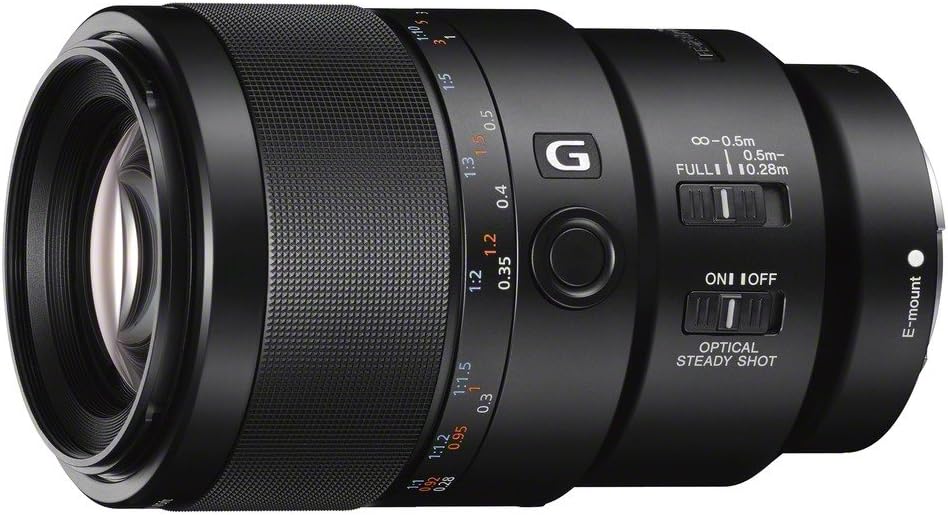
Best for Sony Shooters Who Want a Proven Classic
The Sony 90mm Macro has been around long enough to lose the novelty glow, which is fine. Novelty is overrated. It offers 1:1 magnification, a 0.28m minimum focus distance, Optical SteadyShot stabilization, and a weather-resistant design.
Sony’s own specs place it exactly where a strong insect lens should sit: long enough to give you room, sharp enough to justify the effort, and stable enough for real field use.
I would not call this the most exciting lens here. I would call it deeply trustworthy. That matters more. You can go into the field with it and know what the lens is going to do. No surprise personality. No gimmick. Just a very good 90mm macro that still earns its place.
For Sony shooters, this remains one of the least regrettable purchases in the macro category.
Pros
- True 1:1 macro
- Built-in stabilization
- Strong focal length for insects
- Proven long-term option for Sony E-mount
Cons
- Stops at 1:1
- Not especially small
- Less distinctive than the Laowa or Canon RF
Review summary: The Sony 90mm Macro is not trying to impress you with novelty. It just keeps delivering, which is its own kind of argument.
Real Testimonial
The Sony 90mm macro is one of those lenses that no longer needs to prove anything. It has been around long enough to feel established, and that is part of the appeal. The focal length is well judged for insect work, the stabilization helps, and the lens has a reputation for delivering sharp, dependable results without much drama. It does not stand out because of some wild feature. It stands out because it keeps doing the job well year after year. For Sony users, that kind of reliability is hard to dismiss.
A second quick table: strengths at a glance
| Lens | Biggest strength | Main tradeoff |
|---|---|---|
| Laowa 100mm 2X | Highest magnification in the group | Manual focus only |
| OM System 60mm | Lightest and easiest to carry | No stabilization |
| Nikon Z MC 105mm | Balanced all-around macro tool | Limited to Nikon Z |
| Canon RF 100mm | 1.4x magnification with AF | System-specific and premium |
| Sony FE 90mm | Reliable stabilized macro for Sony | Less adventurous on specs |
Which one should you actually buy?
Buy the Laowa 100mm f/2.8 2X Ultra Macro APO if your first priority is insect detail and you do not mind working manually. It is the strongest specialist pick.
Buy the OM System 60mm f/2.8 Macro if you want a light field kit that still takes the subject seriously. It is the smartest compact option here.
Buy the Nikon Z MC 105mm f/2.8 VR S if you shoot Nikon Z and want the cleanest answer with the fewest compromises.
Buy the Canon RF 100mm f/2.8L Macro IS USM if you want extra magnification but still want autofocus and stabilization.
Buy the Sony FE 90mm f/2.8 Macro G OSS if you shoot Sony and value consistency over novelty.
My broad opinion is simple: most people serious about insects should start around 90mm to 105mm. Shorter macro lenses can be excellent, but they ask you to work closer, and live insects are rarely generous about that. The OM System lens gets a pass because the smaller sensor changes the practical framing equation and keeps the setup exceptionally portable.
FAQ
What focal length is best for insect photography?
For a lot of people, 90mm to 105mm is the sweet spot. It gives you useful working distance without turning the lens into a giant specialty tool. That is why so many of the best insect lenses cluster there.
Is a 100mm macro lens better than a 60mm macro lens for bugs?
Often yes, especially for nervous live insects. A 100mm macro usually lets you shoot from farther back. That said, a 60mm macro can still work extremely well if the system is light, the effective field of view is tight enough, and you like a smaller setup. The OM System 60mm is the proof.
Do I need 1:1 magnification for insect photography?
You do not strictly need it for every insect photo, but it is the right baseline for a serious insect lens. Once you start photographing truly small subjects, anything less feels limiting fast. Canon’s macro guidance describes life-size magnification as the point where details are rendered at their actual size on the sensor.
Is 2:1 magnification worth it for insects?
Yes, if you photograph tiny insects often enough. No, if your subjects are mostly butterflies, dragonflies, or larger bugs. The Laowa 100mm earns its place because 2:1 opens up a level of detail that 1:1 simply cannot match.
Can I shoot insects with autofocus?
Yes. Nikon, Canon, Sony, and OM System all offer autofocus macro lenses that are fully capable for insect work. But autofocus is not always the star at high magnification. Plenty of macro photographers still prefer manual focus for precision.
Why do my insect photos still look soft with a sharp macro lens?
Usually because of depth of field, movement, or missed focus plane. At macro magnification, depth of field gets thin very quickly. The lens can be razor sharp and the image can still fail if the focus lands on the wrong part of the insect. Nature Photographers Network’s macro discussion makes this point clearly: as magnification rises, depth of field shrinks and technique becomes more demanding.
Is image stabilization important for insect photography?
Helpful, yes. Essential, no. Stabilization can improve handheld shooting, but it does not solve subject movement or poor focus placement. Nikon, Canon, and Sony all include stabilization in the lenses listed here. OM System’s 60mm and the Laowa 100mm 2x do not.
What is working distance in macro photography?
It is the usable space between your lens and the subject at close focus. More working distance usually means less chance of scaring the insect, blocking your own light, or physically crowding the scene.
Are shorter macro lenses bad for insect photography?
Not bad. Just less forgiving with live subjects. They can be excellent for controlled setups, flowers, static subjects, and compact kits. For nervous insects, longer macro lenses are usually easier.
Can beginners use a manual focus macro lens?
Yes, especially if they are patient. In fact, manual focus can teach better macro habits. You stop waiting for the camera to rescue the shot and start controlling the shot yourself. Still, it is not the easiest route.
Do I need focus stacking for insect photography?
Not always. For field work with moving insects, a single well-timed frame is often the goal. Focus stacking becomes more useful when the subject is still and you want more of the insect sharp across the frame.
What aperture works best for insect macro shots?
There is no single perfect aperture, but many insect shooters live in the middle range to trade a little diffraction for more usable depth of field. The right answer depends on magnification, subject angle, and light.
Can I use extension tubes instead of a dedicated macro lens?
You can, but it is rarely as elegant. Extension tubes are a workaround. A real macro lens is the cleaner solution if insects are a regular subject.
What is the best insect photography lens for Nikon users?
The Nikon NIKKOR Z MC 105mm f/2.8 VR S is the best native Nikon Z option in this lineup because it combines 1:1 macro, 105mm reach, and VR stabilization.
What is the best insect photography lens for Canon users?
The Canon RF 100mm f/2.8L Macro IS USM is the strongest Canon-native option here because it adds 1.4x magnification on top of autofocus and stabilization.
What is the best insect photography lens for Sony users?
The Sony FE 90mm f/2.8 Macro G OSS remains the safest Sony-native pick because it gives you 1:1 magnification, stabilization, and a very practical focal length.
What is the best light lens for insect photography travel kits?
The OM System M.Zuiko 60mm f/2.8 Macro is the lightest lens in this group at 185g, and that alone makes it unusually appealing for travel and long walks.
Is a macro lens useful for anything besides insects?
Absolutely. Macro lenses are often excellent for flowers, product details, food, textures, and even portraits. Their sharpness and close-focus ability make them more versatile than people expect.
Conclusion
The best lens for insect photography is not the one with the prettiest marketing. It is the one that lets you work at the right distance, reach the right magnification, and keep your technique from turning into a wrestling match.
That is why the Laowa 100mm f/2.8 2X Ultra Macro APO gets my top spot. It is the most purpose-built option here. For a smaller system, the OM System 60mm is smarter than it looks.
For native autofocus choices, Nikon, Canon, and Sony each have one lens that makes immediate sense. Macro gets harder as magnification rises and depth of field collapses, which is exactly why lens choice matters so much in the first place.
Affiliate Disclaimer
This article contains affiliate links. We may earn a small commission if you purchase through these links, at no extra cost to you.





Leave a Reply