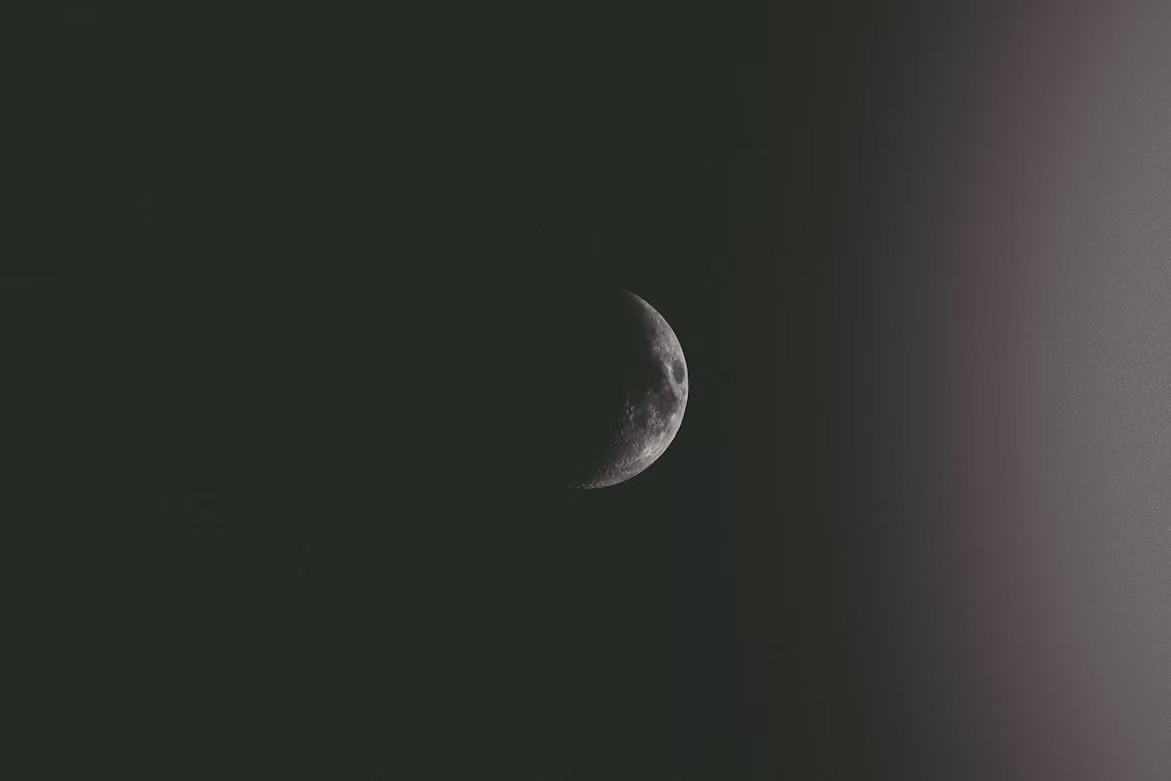
Night work exposes weak lenses fast. Soft corners, ugly coma, nervous autofocus, muddy contrast. You notice all of it once the sun drops and the file has to carry real tension, not just daylight detail.
Adobe’s beginner guide gets the basic logic right: open the aperture, control shutter speed, and manage ISO with intention, not panic.
This list is built for people who actually shoot after dark. City streets. Empty roads. Skylines. Stars. Wet pavement. Neon. Black water. Real low-light scenes where a lens either helps or gets in the way.
These five picks are the 5 best lenses for night photography if you care about strong optics, usable speed, and focal lengths that make sense once the light turns difficult.
Quick picks
| Pick | Lens | Best for |
|---|---|---|
| Best overall | Sony FE 24mm f/1.4 GM | The best all-around night lens |
| Best value-focused option | Viltrox AF 16mm f/1.8 FE | Wide low-light work without a painful buy-in |
| Best for astrophotography | Sigma 14mm f/1.4 DG DN Art | Stars, Milky Way, dramatic skies |
| Best for night street photography | Sigma 35mm f/1.4 DG DN Art | Handheld city scenes and subject-rich night frames |
| Best zoom | Tamron 35-150mm f/2-2.8 Di III VXD | Night events, city details, flexible travel work |
The focal length, aperture, weight, and current-market availability behind these picks come from the maker spec pages and current U.S. retail listings.
How I picked these lenses
I did not pick these because they look good on a spec sheet.
A good low light photography lens needs at least one of two things, and ideally both: a fast aperture and clean performance wide open. Night photography is not forgiving. If the lens only sharpens up at f/4, that is not a night lens to me. That is a daylight lens with good marketing.
I also cared about focal length in the real world. A 14mm lens and a 35mm lens both work at night, but they solve different problems. One sees the sky. One sees the city the way a person actually experiences it.
Comparison table 1
| Lens | Focal length | Max aperture | Weight | Format |
|---|---|---|---|---|
| Sony FE 24mm f/1.4 GM | 24mm | f/1.4 | 445g | Full-frame |
| Viltrox AF 16mm f/1.8 FE | 16mm | f/1.8 | about 550g | Full-frame |
| Sigma 14mm f/1.4 DG DN Art | 14mm | f/1.4 | specialty large-body astro prime | Full-frame |
| Sigma 35mm f/1.4 DG DN Art | 35mm | f/1.4 | 645g | Full-frame |
| Tamron 35-150mm f/2-2.8 Di III VXD | 35-150mm | f/2 to f/2.8 | 1,165g | Full-frame |
Sony lists the FE 24mm f/1.4 GM at 445g. Viltrox lists the 16mm f/1.8 at about 550g. Sigma’s 14mm f/1.4 is a dedicated ultra-wide f/1.4 design for starscape work. Sigma lists the 35mm f/1.4 DG DN Art as a compact mirrorless prime, and Tamron lists the 35-150mm at 1,165g in the Sony mount version.
1. Sony FE 24mm f/1.4 GM
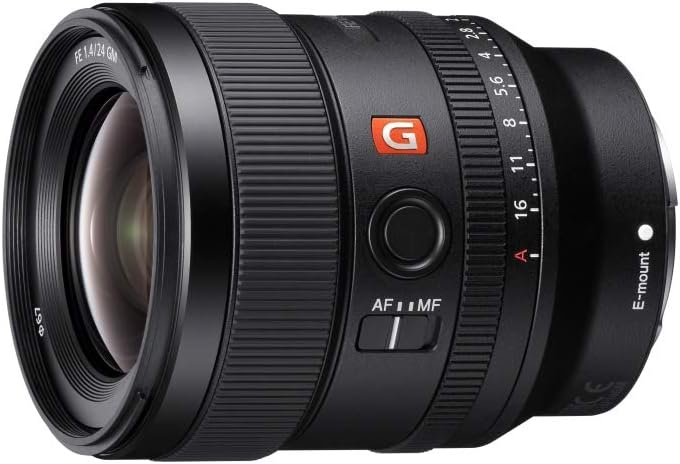
Best overall
This is the lens I would buy first if I wanted one serious night lens and did not feel like arguing with myself for three weeks.
Twenty-four millimeters is wide enough for cityscapes, architecture, environmental portraits, travel at night, and even some astrophotography, but it does not feel cartoonishly wide. That matters.
Sony’s own spec page emphasizes the compact build, 11-blade diaphragm, and 445g weight. That size is a big part of why this lens works so well after dark.
A lens can be optically brilliant and still become annoying if it feels like a brick during a long walk through a city at midnight. This one stays usable.
The real appeal is balance. You get f/1.4 speed, a focal length that suits a lot of night scenes, and a design that does not punish you for carrying it. It is one of the rare lenses that feels equally at home on a tripod overlooking a skyline and in your hand crossing an intersection under sodium vapor lights.
Pros
- Fast f/1.4 aperture
- Useful 24mm field of view for most night work
- Light enough to carry for long sessions
- Strong choice for both city and landscape shooting
Cons
- Not a budget-minded buy
- Not as wide as a dedicated astro lens
- Sony E mount only
Review summary
The Sony FE 24mm f/1.4 GM is the cleanest all-around answer here. It does not do the most dramatic thing on this list. It just does the most things well, which is usually the smarter buy.
Real Testimonial
This is the easiest lens on the list to recommend because it does not force a narrow shooting style. The 24mm focal length works for city streets, travel at night, environmental portraits, skylines, and even some astrophotography. Sony lists it at f/1.4 and 445g, which is a big part of its appeal. It gives you serious low-light speed without turning your camera into a burden. The main reason it lands as the best overall pick is balance. It is fast, wide enough for most night scenes, and still practical to carry for hours.
2.Viltrox AF 16mm f/1.8 FE
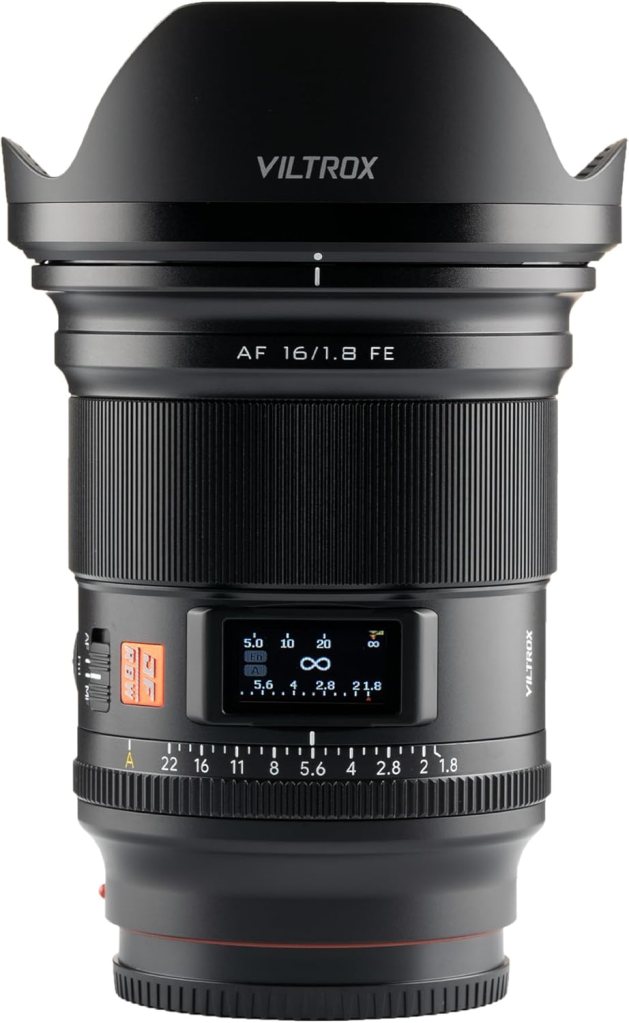
Best value-focused option
Some lenses earn a place on a list by being surprisingly competent. This is not that. The Viltrox 16mm f/1.8 earns its place because it is plainly good.
Viltrox lists it as a full-frame 16mm f/1.8 autofocus lens with a 77mm filter thread, 15 elements in 12 groups, and a weight of roughly 550g. That combination is attractive for night landscapes, architecture, wide travel scenes, and entry-level astrophotography.
You get a genuinely wide view and a bright aperture without moving into the bulk and cost of the biggest halo lenses.
This is the lens for the photographer who wants width, speed, and real usability without buying into prestige for its own sake. It is wide enough to be fun and fast enough to matter. That is already more than a lot of lenses can say.
Pros
- Wide 16mm view works well for night landscapes and sky scenes
- Fast f/1.8 aperture
- Autofocus and full-frame coverage
- Solid value in a category that usually gets expensive fast
Cons
- Not as specialized for stars as Sigma’s 14mm f/1.4
- Sony E mount version is the one most visible in current listings
- Still a fairly large lens compared with tiny travel primes
Review summary
The Viltrox 16mm f/1.8 is the pick for people who want serious night capability without paying for a flagship badge. It feels like a smart purchase, not a compromise.
Real Testimonial
The Viltrox 16mm f/1.8 feels like a smart pick for photographers who want a true wide-angle night lens without jumping straight into the biggest and most expensive specialty glass. Viltrox lists it as a full-frame autofocus lens with a 77mm filter thread and roughly 550g weight, which makes it unusually usable for wide low-light shooting. That matters more than people think. Some wide lenses look exciting on paper and then become annoying in real use. This one gives you real width, a bright aperture, and enough practicality to make it more than a backup option. It is especially good for cityscapes, wide travel scenes, and entry-level astro work.
3. Sigma 14mm f/1.4 DG DN Art

Best for astrophotography
This one is unapologetically built for stars. Sigma says that out loud. The company describes it as the world’s first lens designed specifically for starscape photography at 14mm f/1.4, with correction for sagittal coma flare and features aimed directly at night-sky shooters.
That is why it is here.
If your version of best lens for astrophotography means Milky Way, constellations, dramatic foregrounds, and big sky compositions, this is the strongest specialist in the group. Fourteen millimeters gives you room. F/1.4 gives you light. Sigma’s emphasis on coma control is not trivial. Point-light clarity at the edges is one of the first places cheaper wide lenses start to fall apart.
The tradeoff is obvious. This lens is big. It is specialized. It is not the lens I would carry for casual night street shooting. But for the sky, that is not the point.
Pros
- Built with starscape photography in mind
- 14mm gives a huge view for sky and foreground composition
- f/1.4 aperture is excellent for low-light sky work
- Sigma explicitly targets sagittal coma flare correction
Cons
- Large and less casual to carry
- More specialized than the other picks
- Not the most flexible option for everyday night photography
Review summary
The Sigma 14mm f/1.4 DG DN Art is the specialist’s lens on this list. If your favorite part of night photography is pointing the camera up, this is probably the one you really want.
Real Testimonial
This is the specialist lens in the group. Sigma explicitly says it was designed for starscape photography and highlights correction for sagittal coma flare, which is exactly the kind of thing night sky photographers should care about. A lot of lenses look fine until you point them at stars near the frame edges. Then they fall apart. The Sigma 14mm f/1.4 is built to avoid that problem. It is wide, fast, and clearly aimed at Milky Way shooters and anyone who wants dramatic sky-heavy compositions. The downside is obvious: it is more specialized and less casual than the other picks. Still, if astrophotography is the priority, this is the most purpose-built lens on the list.
4. Sigma 35mm f/1.4 DG DN Art
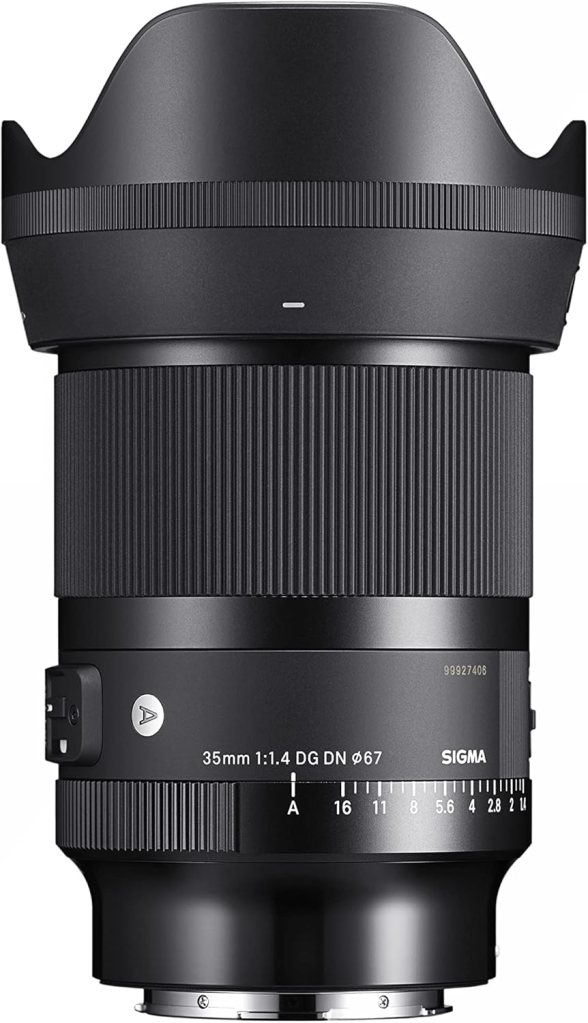
Best for night street photography
Thirty-five millimeters at night just feels right. You can frame a diner window, a train platform, a person under a sign, a couple walking past a liquor store, reflections in a puddle. It gives you context without drifting into visual chaos.
Sigma positions this mirrorless Art prime as a compact, premium 35mm f/1.4 with strong optical quality, and its U.S. listing highlights the same basic idea. That makes sense. A 35mm night lens lives or dies on sharpness, contrast, and confidence wide open. You do not buy this focal length to stop down and overthink it.
This is the lens here with the most personality. Not because the barrel has personality. Because 35mm sees night scenes with just enough intimacy to make them feel lived in.
Pros
- Great focal length for handheld night shooting
- Fast f/1.4 aperture
- Strong option for street, documentary, and environmental portrait work
- More emotionally useful than ultra-wide lenses in many city scenes
Cons
- Not wide enough for serious Milky Way shooters who want huge sky coverage
- Heavier than a small 35mm travel prime
- E mount and L mount focused
Review summary
The Sigma 35mm f/1.4 DG DN Art is the lens for people who like night photography with people in it, or at least signs of people. It sees the city well. That is not a small thing.
Real Testimonial
The Sigma 35mm f/1.4 DG DN Art is the lens here with the strongest street-photography instinct. Thirty-five millimeters sees the city in a way that feels natural. It gives you context, but not too much. Sigma positions it as a compact mirrorless Art prime, and that fits the experience. You get the speed of f/1.4 with a focal length that works beautifully for handheld night shooting, environmental portraits, and documentary-style frames after dark. This is less about stars and more about atmosphere. Storefront glow, reflections, crosswalks, diners, station platforms. It is a lens for photographers who want night images to feel lived-in instead of just technically bright.
5. Tamron 35-150mm f/2-2.8 Di III VXD
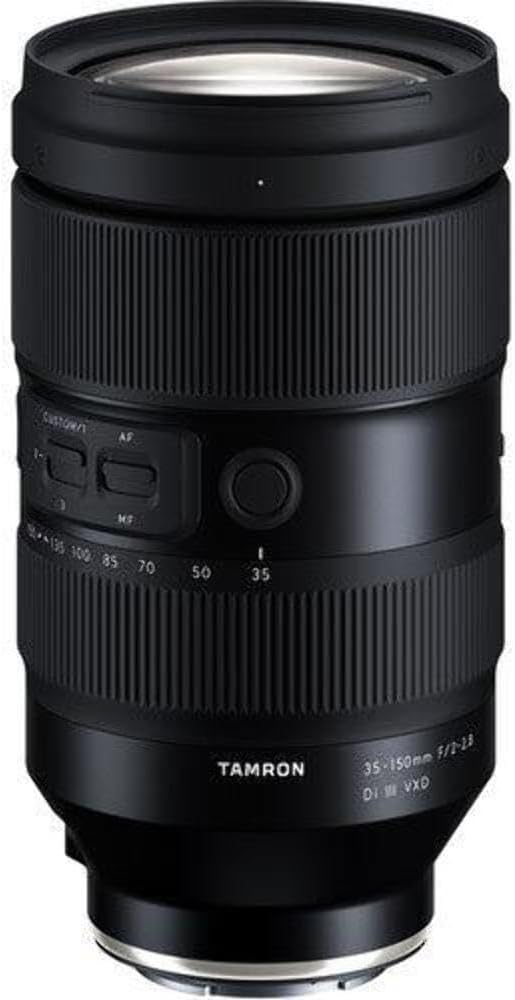
Best zoom for night events and city detail
A fast zoom is never going to beat a good f/1.4 prime on pure light-gathering. That is not the point. The point is range.
Tamron’s official specs list a 35-150mm zoom range, f/2 at the wide end, f/2.8 at the long end, 21 elements in 15 groups, and a weight of 1,165g for Sony mount. Current retail listings still call it the first zoom of its kind with that f/2 to f/2.8 range.
That makes this lens unusually useful for night events, music venues, city detail work, and travel where you do not want to swap lenses in the dark. You can start wide enough for atmosphere and push into tighter framing without walking into traffic or ruining the moment.
It is heavy. You will know it is there. But the flexibility is real.
Pros
- Rarely useful zoom range for night work
- f/2 at 35mm is a real advantage
- Excellent for events, travel, and varied city scenes
- Lets you work quickly without changing lenses
Cons
- Heavy
- Not as bright as an f/1.4 prime
- Less ideal for dedicated astrophotography
Review summary
The Tamron 35-150mm f/2-2.8 is the practical outlier. It is the lens for photographers who would rather keep shooting than keep swapping glass.
Real Testimonial
The Tamron 35-150mm f/2-2.8 is the outlier, but in a good way. Tamron lists a 35-150mm range with f/2 at the wide end and f/2.8 at the long end, plus a weight of 1,165g. That tells you almost everything. This is not the lens you buy to chase the cleanest possible night prime look. It is the lens you buy when you want to keep shooting instead of swapping glass in the dark. For events, city travel, concerts, urban details, and mixed night situations, that flexibility is a real advantage. The weight is the compromise, and there is no point pretending otherwise. Even so, it earns its place because it solves a different problem than the primes do, and it solves it well.
Comparison table 2
| Lens | Strongest night use | Main strength | Main tradeoff |
|---|---|---|---|
| Sony FE 24mm f/1.4 GM | General night photography | Best balance of width, speed, portability | Premium pricing |
| Viltrox AF 16mm f/1.8 FE | Wide cityscapes and budget-conscious astro setups | Strong value with real width | Less specialized than Sigma 14mm |
| Sigma 14mm f/1.4 DG DN Art | Astrophotography | Built for stars and coma control | Big and specialized |
| Sigma 35mm f/1.4 DG DN Art | Night street photography | Natural storytelling focal length | Less sky coverage |
| Tamron 35-150mm f/2-2.8 Di III VXD | Events and flexible city shooting | Huge practical range | Heavy |
These use-case judgments are mine. The underlying specs and product positioning come from the brands’ own materials and current listings.
How to choose a lens for night photography
Start with the kind of night work you actually do.
If you shoot stars, go wider. Fourteen to twenty-four millimeters makes sense. If you shoot city life, 24mm or 35mm usually feels better than ultra-wide glass. If you shoot events, flexibility starts to matter more than theoretical perfection.
Aperture matters, but not in the lazy way people repeat online. Yes, faster is better. But a mediocre f/1.4 lens can still disappoint if it turns point lights into a mess or loses confidence at the edges. A clean f/1.8 can beat a messy f/1.4 in actual use.
Weight matters too. People skip this because it sounds boring. It is not boring at 1:00 a.m. after two miles on foot.
FAQ
What focal length is best for night photography?
There is no single best focal length. For astrophotography and wide cityscapes, 14mm to 24mm makes the most sense. For street and documentary work at night, 35mm is often more natural. For flexible event shooting, a fast zoom can be more useful than a prime.
Is a 50mm lens good for night photography?
Yes, but it depends on the subject. A 50mm can work beautifully for portraits, details, and tighter street scenes at night. It is less useful for sky work and cramped city compositions.
Do I need f/1.4 for night photography?
No. It helps, obviously. But it is not mandatory. A strong f/1.8 lens can still be excellent for night photography if it stays sharp wide open and handles point light well.
What is the best lens for astrophotography beginners?
A wide lens with a fast aperture is the safest starting point. Something around 14mm to 20mm at f/1.4 or f/1.8 is a strong place to begin because it gives you more room in composition and more light to work with.
Are zoom lenses bad for night photography?
Not at all. Most are simply slower than prime lenses. A fast zoom like the Tamron 35-150mm f/2-2.8 can still be very effective at night, especially for events, travel, and city work where framing changes quickly.
Is image stabilization useful for night photography?
Sometimes. It helps for static handheld scenes, but it does not freeze moving subjects. For stars and long exposures, stabilization matters less than a tripod, a fast aperture, and good technique.
What matters more at night, aperture or sharpness?
Both. Aperture gets you the light. Sharpness and optical control decide whether the image holds together once you zoom in.
How wide should a lens be for Milky Way photography?
A lot of photographers land somewhere between 14mm and 24mm. Wider lenses make it easier to include foreground and more sky, and they also buy you a little more flexibility on exposure time before stars start to trail.
Is autofocus important for night photography?
For some kinds, yes. Night street photography and events benefit from reliable autofocus. For astrophotography, manual focus is still common, and often preferable once you know what you are doing.
What lens works best for city lights and street scenes?
A fast 24mm or 35mm prime is hard to beat. Twenty-four millimeters gives you more environment. Thirty-five millimeters feels more intimate and human.
Do expensive lenses really make a difference at night?
Sometimes more than in daylight. Night shooting exposes optical flaws fast. Better lenses often show cleaner edges, better contrast, stronger flare control, and more usable files wide open.
What is coma and why does it matter in a night lens?
Coma is an optical aberration that makes point light sources near the frame edges look smeared or winged instead of clean. If you shoot stars, it matters a lot.
Should I buy a prime or zoom for low-light photography?
Prime if you want speed and simplicity. Zoom if you need flexibility. The right answer depends less on theory and more on how often your framing changes.
What aperture is enough for stars?
F/2.8 can work. F/1.8 is better. F/1.4 gives you more light to play with, especially when you want lower ISO or shorter exposure times.
Final take
If I had to narrow this down brutally, I would say this.
Buy the Sony FE 24mm f/1.4 GM if you want the best one-lens answer.
Buy the Viltrox 16mm f/1.8 if you want serious width and speed without drifting into absurdity.
Buy the Sigma 14mm f/1.4 DG DN Art if your idea of a good night starts after the stars come out.
Buy the Sigma 35mm f/1.4 DG DN Art if your night photography is really about the city, not the sky.
Buy the Tamron 35-150mm f/2-2.8 if flexibility wins more often than purity.
Nikon’s night-sky guidance makes a simple point that still holds: use the widest aperture your lens allows, keep exposure times under control, and match the lens to the scene you want, not the one other people keep posting about.
The truth is less glamorous than most gear roundups admit. The 5 best lenses for night photography are not the five most expensive ones. They are the five that make darkness easier to work with.
Affiliate Disclaimer
This article contains affiliate links. We may earn a small commission if you purchase through these links, at no extra cost to you.



Leave a Reply