
Finding the best camera for social media is harder than it should be. Not because there are no good options. Because most camera lists are written like spec sheets wearing a fake smile.
Social media does not care about that. It rewards speed, clean autofocus, decent skin tones, sharp vertical video, and a camera you will actually carry.
Instagram itself has advised creators to use high-resolution 9:16 video without borders or giant text blocks covering the frame, which tells you a lot about what matters in practice.
I picked these five because each one solves a real problem.
One is the best all-arounder. One gives you a very easy way into better-looking content. One is built for movement. One is still the pocket favorite for people who care about both photos and video. One gives you room to grow without turning your bag into dead weight. None of them feel random.
What actually matters in a social media camera
A great social media camera needs to do a few things well.
It needs to focus on faces fast. It needs a screen you can actually use when you’re filming yourself. It should move files to your phone without making you regret your life. Video quality matters, of course, but clean workflow matters just as much.
That is why some technically “better” cameras do not make this list. They are annoying. Or bulky. Or weirdly bad at the small things creators do every day.
Quick picks
- Best overall: Sony ZV-1 II
- Best value: Canon EOS R100
- Best for walking video and Reels: DJI Osmo Pocket 3
- Best pocket camera for photos and clips: Canon PowerShot G7 X Mark III
- Best for creators who want room to grow: Sony ZV-E10 II
Related articles
- 5 Best Cameras for VIRAL TikTok CREATORS
- 5 Best Digital Cameras for Instagram (Every Budget)
- 5 Best Selfie Cameras for Content Creators
Comparison table 1
| Camera | Best for | Sensor | Lens type | Flip screen | Mic input |
|---|---|---|---|---|---|
| Sony ZV-1 II | Best overall | 1-inch, 20.1MP | Built-in 18-50mm equiv. zoom | Yes | Yes |
| Canon EOS R100 | Best value | APS-C, 24.1MP | Interchangeable RF mount | No fully articulating screen | No |
| DJI Osmo Pocket 3 | Reels and walking video | 1-inch | Built-in wide lens on gimbal | Rotating touchscreen | Via DJI ecosystem |
| Canon PowerShot G7 X Mark III | Pocket photo and video use | 1-inch, 20.1MP | Built-in 24-100mm equiv. zoom | Yes | Yes |
| Sony ZV-E10 II | Growth pick | APS-C, 26MP | Interchangeable E-mount | Yes | Yes |
These core specs come from the manufacturers’ current product pages. Sony lists the ZV-1 II with a 1-inch 20.1MP sensor and 18-50mm equivalent lens, Canon lists the EOS R100 with a 24.1MP APS-C sensor, DJI lists the Osmo Pocket 3 with a 1-inch sensor, Canon lists the G7 X Mark III with a 20.1MP 1-inch sensor and 24-100mm equivalent f/1.8-2.8 lens, and Sony lists the ZV-E10 II with a 26MP APS-C sensor.
Comparison table 2
| Camera | Best video strength | Best photo strength | Main drawback | Who should skip it |
|---|---|---|---|---|
| Sony ZV-1 II | Fast, simple creator workflow | Better than a phone without lens swapping | Limited zoom range | People who want interchangeable lenses |
| Canon EOS R100 | APS-C image quality for the money | Strong stills quality | Basic creator ergonomics | Self-shooters who need a flip-out screen |
| DJI Osmo Pocket 3 | Stabilized handheld video | Surprisingly decent grab shots | Not a true hybrid photo camera | People who mainly want traditional photography |
| Canon PowerShot G7 X Mark III | Good everyday clips in a tiny body | Very nice photo output from a pocket camera | Older autofocus feel compared with newer picks | Fast-moving video-first creators |
| Sony ZV-E10 II | Most headroom for serious video | Strong image quality with the right lens | Lens choices add cost and complexity | People who want one simple all-in-one camera |
1. Sony ZV-1 II
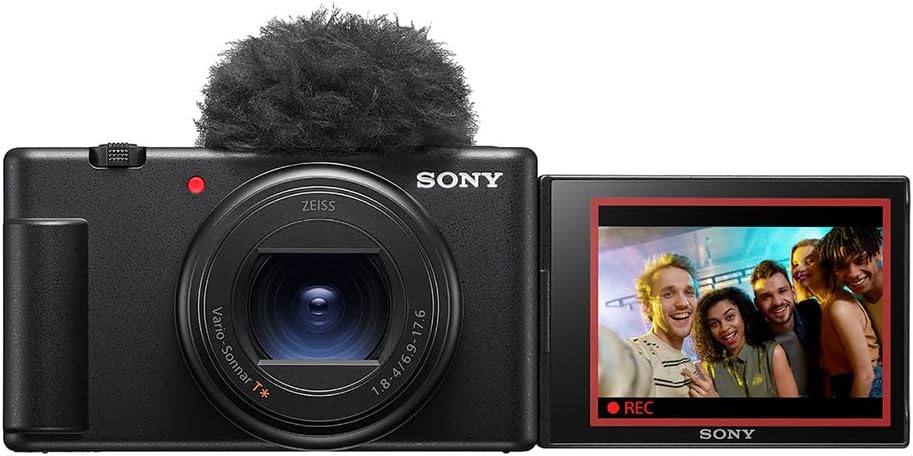
Best overall camera for social media
This is the one I would hand to most people first.
Not because it wins every spec battle. It doesn’t. It wins because it understands the assignment. The ZV-1 II is small, fast, easy to frame yourself with, and built around exactly the kind of content people post all day.
Sony’s current spec page lists a 1-inch sensor, about 20.1 effective megapixels, and an 18-50mm equivalent built-in zoom. That focal range is a smart move. Wider at the short end means fewer awkward arm-stretch shots and fewer moments where your face fills the whole frame for no good reason.
Review summary: The ZV-1 II is the cleanest answer for creators who want better-looking content without learning a whole camera system. It is not the most dramatic camera here. That is exactly why it works.
The real appeal is friction. Or rather, the lack of it. You pull it out, flip the screen, hit record, and keep moving. It gives you a real camera look without asking you to build a lens collection or overthink every shoot. For short-form creators, that matters more than a lot of people admit.
Pros
- Very easy to use for self-shot content
- Wide built-in lens makes framing simpler
- Compact enough to carry daily
- Strong all-around pick for mixed photo and video posting
- Mic input for better audio
Cons
- Built-in lens means less flexibility long-term
- Not the best pick for creators who want telephoto reach
- Some people will outgrow it if they get serious about lenses
Real Testimonial
The Sony ZV-1 II is the easiest camera on this list to recommend to most social media creators. It gets the basics right without making the process feel technical. Framing yourself is simple, autofocus is dependable, and the whole camera feels built for people who need to shoot, transfer, and post without slowing down. It is not the most expandable option here, but it is the most straightforward all-around choice.
2. Canon EOS R100

Best value camera for social media
The EOS R100 is here for one reason. It gets you into real APS-C image quality without forcing you into a bloated starter kit mentality.
Canon lists a 24.1MP APS-C sensor and RF mount on the current EOS R100 spec page. That larger sensor is the story. If you care about cleaner background blur, stronger low-light performance than a phone, and more photographic depth in your content, this camera gives you that look fast.
Review summary: The EOS R100 is the smartest lower-cost way into better image quality if your content leans photo-first, hybrid, or product-focused. It is not the slickest creator camera. It is a very sensible one.
I would not pretend it is perfect for everybody. It is less self-shooter-friendly than the Sony creator line. That matters. But if your workflow includes tripod work, product shots, portraits, flat lays, lifestyle posts, or voiceover video, the R100 punches well above what most people expect from an entry camera.
Pros
- APS-C sensor gives photos more depth and flexibility
- Interchangeable RF mount offers room to improve later
- Great option for creators who want stronger still image quality
- Good starting point for product and portrait content
Cons
- Less tailored to solo video creators
- Not the easiest body for selfie-style shooting
- Extra lenses can become part of the budget later
Real Testimonial
The Canon EOS R100 makes sense for creators who care more about image quality than flashy creator features. It gives you a more serious photographic look than most compact models, and that shows up in portraits, product shots, and more polished stills. The tradeoff is that it feels less tailored to solo social video than some of the other picks. Still, for creators who want better-looking content and a good place to start with interchangeable lenses, it is a smart buy.
3. DJI Osmo Pocket 3

Best for Reels, Stories, and moving shots
A lot of people do not need a camera. They need stable footage.
That is why the Osmo Pocket 3 keeps making sense. DJI’s current specs list a 1-inch sensor, 4K/120 capability, three microphones, and a 2-inch rotating touchscreen. The headline feature is still the gimbal, though.
Handheld footage just looks better when the camera is built around motion instead of trying to fix it after the fact.
Review summary: The Osmo Pocket 3 is the best tool here for creators who film while walking, talking, turning, panning, or moving through real places. It makes casual footage look unusually polished.
If your content is travel, food, street scenes, event coverage, behind-the-scenes, real estate walk-through snippets, or any form of “come with me,” this thing is wildly effective.
It also saves people from the fake-cinematic shake that ruins so much otherwise decent short-form video.
Pros
- Stabilized footage looks smooth immediately
- 1-inch sensor helps more than older tiny gimbal cameras ever did
- Small enough to keep in a jacket pocket or sling bag
- Excellent for motion-heavy short-form content
- Fast to use on the go
Cons
- Less satisfying for serious photography
- Built for video first
- Accessory ecosystem is more specific than a normal camera setup
Real Testimonial
The DJI Osmo Pocket 3 is the best pick here for people who shoot while moving. Walking videos, travel clips, behind-the-scenes content, street footage, and quick vertical clips all look smoother and more intentional with it. That is the whole point. It is less of a traditional camera and more of a content tool, which is exactly why it works so well for short-form video.
4. Canon PowerShot G7 X Mark III

Best pocket camera for everyday content
Yes, it is still here. And yes, it still earns the spot.
Canon’s spec page lists a 20.1MP 1-inch stacked sensor, a 24-100mm equivalent f/1.8-2.8 lens, 4K video, a 3.5mm mic input, and a tilt-up screen. That combination remains unusually good for a camera this small. The zoom range is especially useful. Some creator cameras go wide and then run out of ideas. The G7 X Mark III gives you more framing options without asking you to swap lenses.
Review summary: The G7 X Mark III still makes sense for people who want a real pocket camera with good image quality, flattering focal lengths, and fewer compromises than most tiny cameras.
I do not think it is the best pure video pick anymore. Newer creator cameras have caught up and, in some cases, passed it. But for people who want one camera for cafe shots, city photos, casual portraits, quick clips, and day-to-day posting, it still has real charm. More important, it still works.
Pros
- Pocketable body with a genuinely useful zoom range
- Strong stills for lifestyle and travel content
- Bright lens helps in mixed light
- Mic input is a real plus in this size class
- Easy to carry without planning your outfit around it
Cons
- Autofocus and handling feel less current than newer models
- Not the strongest option for video-first creators
- Older design means fewer modern workflow niceties
Real Testimonial
The Canon PowerShot G7 X Mark III is still one of the most appealing pocket cameras for creators who want both photos and video in one small body. It feels more like a classic everyday camera than a creator-first gadget, and that can be a good thing. The zoom range gives it flexibility, the image quality still holds up well, and it is easy to carry without planning around it. It is not the newest-feeling option, but it remains a strong everyday content camera.
5. Sony ZV-E10 II

Best for creators who want room to grow
This is the one for people who already know they are going to care more in six months than they do today.
Sony’s current specs list an APS-C 26MP sensor, interchangeable E-mount lenses, and 4K video up to 60p. That alone puts it in a different lane from the compact picks above. It is not just a creator camera. It is a bridge camera, in the best sense. It can start simple and then become more serious when your content gets more ambitious.
Review summary: The ZV-E10 II is the best choice here for creators who want to build a real system and are willing to accept a little more complexity in exchange for sharper upside.
There is a catch, and it matters. Interchangeable-lens cameras are only fun if you actually want that world. If you do, this is a strong entry point. If you don’t, it can become expensive clutter surprisingly fast.
Still, for creators thinking about YouTube, branded work, long-term growth, or more polished commercial-looking social content, this is the most expandable option on the list.
Pros
- APS-C image quality with strong upgrade potential
- Interchangeable lenses open up more creative control
- Better long-term ceiling than compact cameras
- Strong video specs for serious creators
- Flip screen and creator-focused design make sense
Cons
- Better only if you’re willing to learn and build around it
- Lenses add cost and decision fatigue
- Less grab-and-go than a fixed-lens compact
Real Testimonial
The Sony ZV-E10 II is the best choice here for creators who know they want to grow into a more serious setup. It gives you better long-term upside than the compact cameras because you can change lenses, improve your look over time, and build around your style. That flexibility is the draw. The downside is obvious: more choices, more cost, and more room to overcomplicate things. For the right person, though, it is the most future-proof camera in the group.
Which camera should you buy?
If you want the safest recommendation, buy the Sony ZV-1 II.
If you care most about image quality per dollar and do not need the smoothest creator ergonomics, buy the Canon EOS R100.
If your content lives in motion, buy the DJI Osmo Pocket 3.
If you want the best truly pocketable all-rounder for both photos and clips, buy the Canon PowerShot G7 X Mark III.
If you already feel the pull of lenses, upgrades, and higher-end video, buy the Sony ZV-E10 II and do it knowing exactly what rabbit hole you are entering.
FAQs
What is the best camera for social media beginners?
For most beginners, the Sony ZV-1 II is the easiest recommendation. It has the least friction. You do not need to learn lenses. You do not need to build a system. You just shoot.
Is a phone still better than a dedicated camera for social media?
Sometimes, yes. A phone is faster. But a dedicated camera still gives you better optics, better sensor performance, more natural background separation, and more control when light gets ugly. The right camera makes your content look less processed and more intentional.
Do I need 4K for Instagram Reels and TikTok?
You do not strictly need it, but it helps. Shooting in 4K gives you cleaner detail and more flexibility to crop for vertical framing. Even if your final export is 1080 x 1920, starting with stronger footage usually pays off.
Which camera has the best autofocus for social media content?
The Sony picks in this list are the safest answer if autofocus is your obsession. They are designed around creator use, face tracking, and solo shooting. That tends to show up in real-world results.
What camera do influencers use for Instagram photos?
A lot of creators still use compact cameras like the G7 X series, creator cameras like the ZV-1 line, and interchangeable-lens mirrorless bodies depending on how serious they are about photography. There is no single influencer camera anymore. There are just workflows.
Is the Sony ZV-1 II worth it for creators?
Yes, for the right creator. It is worth it if you want a dedicated social media camera that stays simple. It is less worth it if you already know you want interchangeable lenses and more advanced control.
Is the Canon EOS R100 good for content creation?
Yes, especially for product content, portraits, lifestyle photography, and more deliberate video setups. It is not as self-shooter-friendly as a true creator body, but it produces strong-looking files.
Is the DJI Osmo Pocket 3 better than a regular vlog camera?
For movement-heavy content, yes. For traditional photography, no. It depends on what you make. Walking tours, travel clips, and dynamic short-form video are where it really earns its place.
What is the best compact camera for Instagram and TikTok?
The Sony ZV-1 II is the best creator-focused compact in this list. The Canon G7 X Mark III is the better pick if you care more about a traditional pocket-camera feel and a more flexible zoom range.
Should I buy a mirrorless camera or a compact camera for social media?
Buy a compact camera if you want speed, simplicity, and less gear. Buy mirrorless if you want room to grow and do not mind lenses, accessories, and a steeper path.
Which camera is easiest for vertical video?
The Osmo Pocket 3 is unusually easy for vertical-first, motion-heavy content because of the way it handles stabilization and framing. The Sony ZV-1 II is also very friendly for creators who shoot themselves often.
What camera works best in low light for social media?
Among these, the APS-C models have the strongest ceiling in low light, especially with the right lens. The fixed-lens 1-inch cameras still do well, though, and often beat phones in more difficult lighting.
Do I need a microphone if I buy one of these cameras?
If you care about spoken content, yes. Built-in mics are fine until they are not. Room echo, wind, traffic, and distance all make audio fall apart faster than people expect.
Which camera is best for travel content?
The answer splits in two directions. The DJI Osmo Pocket 3 is best for moving travel video. The Canon G7 X Mark III is better if your travel content is a mix of casual photography and clips.
Can you livestream with these cameras?
Some of them can fit into livestream workflows, but that should not be the reason you buy them unless live streaming is central to your content. Most people asking this question would be better off choosing for everyday recording first.
What accessories should I buy with a social media camera?
At minimum: a spare battery, a fast memory card, a simple mini tripod, and a microphone if you talk to camera. That is enough to fix most beginner pain points without turning your setup into a suitcase.
Final verdict
The best camera for social media right now is still the Sony ZV-1 II.
That is not the sexiest answer. It is the right one. It gives most creators the biggest jump over a phone without dragging them into unnecessary gear drama.
The Canon EOS R100 is the sharper value play for people who lean more photo-first. The DJI Osmo Pocket 3 is the specialist pick that can make mediocre shooting habits look much better than they are. And the ZV-E10 II is the camera for people who already know “good enough” will stop being enough.
The last thing worth saying is simple. Platform output still matters.
YouTube’s own upload guidance recommends preserving the frame rate you actually shot and using proper progressive, high-quality exports, which is a reminder that the camera is only half the job. Clean footage and clean delivery still win.
Affiliate Disclaimer
This article contains affiliate links. We may earn a small commission if you purchase through these links, at no extra cost to you.


Leave a Reply