SPYPOINT makes two kinds of trail cameras that solve two very different problems. One sends images to your phone and keeps you out of the woods. The other skips the app drama and just records cleanly to a card. That split matters more than megapixels.
If you scout deer, monitor a gate, or watch a travel corridor without wanting to stomp in every few days, the 5 best spypoint cameras are really the five models that make the lineup make sense. Trail cameras work best when they reduce pressure and give you useful pattern data, not just a pile of random nighttime raccoon photos.
I kept this list tight. No filler picks. No “technically it exists so I included it” nonsense. These are the SPYPOINT models I’d actually sort into real roles: best overall, best simple cellular buy, best stealth option, best premium non-cellular camera, and best basic non-cellular camera. The core specs come straight from SPYPOINT’s current product pages and current retail listings.
Quick picks
- Best overall: SPYPOINT FLEX-S
- Best simple cellular pick: SPYPOINT LINK-MICRO-LTE
- Best for stealth: SPYPOINT FLEX-DARK
- Best premium non-cellular pick: SPYPOINT FORCE-PRO-S 2.0
- Best simple non-cellular pick: SPYPOINT FORCE-24
Related articles
- 7 Best Cellular Trail Cameras (Tested & Reviewed)
- 5 Best Budget Trail Cameras
- 5 Best 4G LTE Cameras for Off-Grid Security
How I picked these
I care less about inflated photo numbers than I do about what the camera actually changes in the field. Trigger speed matters. Flash style matters. Power matters more than people admit.
And with SPYPOINT specifically, the question is usually this: do you want the convenience of the app and photo transmission, or do you want a self-contained camera you can hang and forget? SPYPOINT’s own lineup is built around that divide, with FLEX and LINK covering cellular use and FORCE covering non-cellular use.
A second thing worth saying out loud: cellular only makes sense if it solves a pressure problem for you. That is the real argument for it. Not novelty. Less intrusion, fewer wasted card checks, and quicker reads on movement.
That logic shows up in both field coverage and hunting media because it’s obvious once you’ve burned a good spot by checking cameras too often.
Comparison table 1
| Model | Best for | Type | Photo / Video | Power setup |
|---|---|---|---|---|
| FLEX-S | Most buyers | Cellular | 36MP, 1080p video with sound | Integrated solar panel + internal lithium |
| LINK-MICRO-LTE | Straightforward cellular use | Cellular | 10MP photos | Standard battery-powered |
| FLEX-DARK | Stealth and lower visibility | Cellular | 40MP, 1080p video with sound | Standard battery-powered |
| FORCE-PRO-S 2.0 | Premium local recording | Non-cellular | 48MP, 4K video with sound | Integrated solar panel + internal battery |
| FORCE-24 | Simple local monitoring | Non-cellular | 24MP, 2K video with sound | Standard battery-powered |
Comparison table 2
| Model | Trigger speed | Detection / flash range | Standout feature | Main tradeoff |
|---|---|---|---|---|
| FLEX-S | 0.3 sec | 100 ft | Solar charging plus on-demand use | Costs more than basic cellular models |
| LINK-MICRO-LTE | 0.5 sec | 80 ft | Tiny, simple, proven cellular format | Photo-focused and older-feeling spec sheet |
| FLEX-DARK | 0.3 sec | 100 ft | No-glow and low-glow LED options | No built-in solar |
| FORCE-PRO-S 2.0 | 0.2 sec | 110 ft | Fastest trigger and strongest non-cellular spec set | No photo transmission |
| FORCE-24 | 0.5 sec | 70 ft | Easy low-fuss value | Shorter range and lighter feature set |
1. SPYPOINT FLEX-S

Best overall
This is the one I’d hand to the largest number of people and feel no need to explain myself. The FLEX-S gets the SPYPOINT pitch right. It’s cellular, so it cuts down on visits.
It has 36MP photos, 1080p video with sound, a 0.3-second trigger speed, 100-foot flash and detection range, and the built-in solar panel with internal lithium power is the part that actually changes life in the field. Less battery babysitting. Less accessory clutter. Less nonsense.
I also like where it sits in the lineup. It is more capable than the old entry-level cellular style without drifting into gimmicks. SPYPOINT’s FLEX series is built around automatic connection to the strongest carrier and app-based management, and the FLEX-S adds the power setup that makes remote placement more practical.
That is why it lands here at best overall instead of some cheaper or flashier option.
Pros
- Built-in solar panel and internal lithium battery
- Fast 0.3-second trigger
- Sends photos and 1080p video with sound
- 100-foot flash and detection range
- Good fit for remote spots you don’t want to revisit often
Cons
- Costs more than the simpler cellular models
- Still depends on cellular workflow, which not everyone wants
Review summary
The FLEX-S feels like the least regrettable SPYPOINT purchase. That’s not glamorous praise. It’s better. It means the camera solves the annoying parts without forcing you into a bunch of compromises.
Real Testimonial
The SPYPOINT FLEX-S is the strongest all-around pick in this group because it solves the main headache with cellular trail cameras: power management. Its built-in solar panel and internal lithium battery make it easier to leave in the field longer, and the 0.3-second trigger speed with 100-foot detection range gives it the kind of responsiveness most buyers actually need.
2. SPYPOINT LINK-MICRO-LTE

Best simple cellular pick
The LINK-MICRO-LTE is older and plainly specced, but that is part of its appeal. It’s a compact LTE camera with 10MP photos, 0.5-second trigger speed, up to 80-foot detection range, and app configuration.
No flourish. No oversized feature list. Just a very direct way to get into cellular scouting if what you care about most is fewer trips and simpler deployment.
I would not pretend it competes head-on with the FLEX generation on image ambition or flexibility. It doesn’t. But as a lighter, smaller camera for basic scouting, it still has a real lane. If your goal is to monitor movement, not make art, this is the kind of camera that stays useful longer than spec snobs think.
Pros
- Compact body that hides easily
- Cellular convenience without a complex learning curve
- 0.5-second trigger is still respectable
- Good fit for basic deer patterning and property checks
Cons
- 10MP photos look dated on paper
- Not the right choice if you want richer video-focused capture
Review summary
The LINK-MICRO-LTE is not sexy. It is useful. Those are not the same thing, and people confuse them all the time.
Real Testimonial
The LINK-MICRO-LTE still makes sense for buyers who want a smaller, simpler cellular camera and do not need a long feature list. It is not the most advanced SPYPOINT model now, but that is part of the appeal. The compact body hides easily, setup is relatively straightforward, and the core benefit is still there: fewer trips to pull a card just to see if anything happened. For basic scouting and routine property checks, it remains a practical pick.
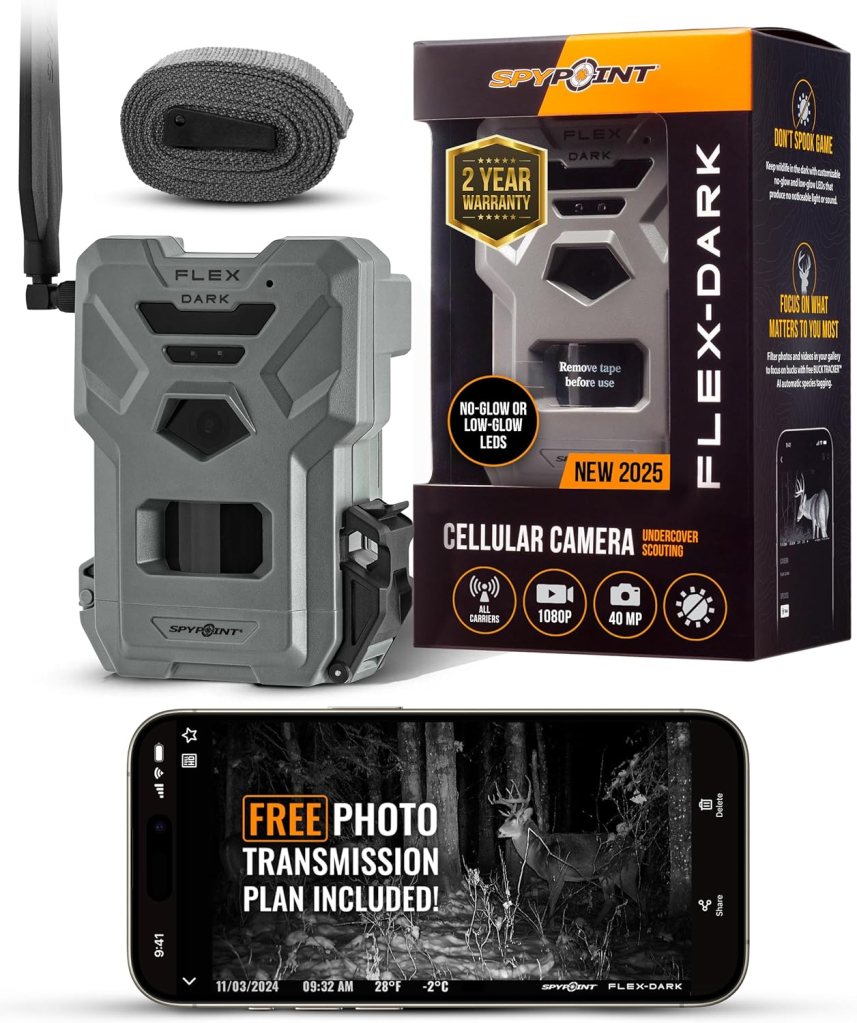
3. SPYPOINT FLEX-DARK
Best for stealth
If you care about concealment, the FLEX-DARK is the interesting one. SPYPOINT positions it around undercover scouting, and the real reason is the switchable no-glow and low-glow LED approach.
You also get 40MP photos, 1080p video with sound, a 0.3-second trigger, 100-foot flash and detection range, and the broader FLEX-series benefits like app control and cellular use.
That stealth angle is not marketing fluff. It matters in pressured areas, on edges, near access routes, and anywhere you want less visible flash at night.
This is the SPYPOINT camera I’d choose if my first priority was keeping the camera less noticeable to both animals and people, while still staying in the modern cellular category.
Pros
- No-glow and low-glow options
- 40MP photos and 1080p video with sound
- Fast 0.3-second trigger
- Better pick for discreet placement
Cons
- No built-in solar panel
- More specialized than the FLEX-S for most buyers
Review summary
This is the SPYPOINT camera for people who think about pressure first. That’s usually a good sign.
Real Testimonial
The FLEX-DARK is the best SPYPOINT option here for buyers who care about stealth. Its switchable no-glow and low-glow configuration gives it a real advantage in more pressured areas, and it keeps the faster 0.3-second trigger speed and 100-foot range found in the FLEX family. It also records 1080p video with sound, so it is not giving up capability just to be discreet. This is the model for buyers who want cellular convenience but care a lot about keeping the camera less visible at night.
4. SPYPOINT FORCE-PRO-S 2.0

Best premium non-cellular SPYPOINT camera
Some people do not want another app. Fair enough. The FORCE-PRO-S 2.0 is where SPYPOINT’s non-cellular line gets serious. It offers 48MP photos, 4K video with sound, a 0.2-second trigger speed, 110-foot flash and detection range, a viewing and configuration screen, and a built-in solar setup charging its internal battery. That’s a stout local-recording camera by any standard.
The reason I like it is simple: it gives you premium capture without the ongoing cellular layer. In spots where service is unreliable, or when you prefer to pull cards on your schedule, the FORCE-PRO-S 2.0 makes more sense than forcing yourself into a cellular model just because the industry keeps pushing them.
Pros
- Fastest trigger in this group at 0.2 seconds
- 4K video with sound
- Integrated solar charging
- Strong 110-foot range
- Great for high-quality local capture
Cons
- No remote photo transmission
- Better suited to deliberate setups than casual plug-and-play use
Review summary
This is the non-cellular SPYPOINT I’d buy if I wanted one good camera instead of three mediocre ones.
Real Testimonial
The FORCE-PRO-S 2.0 is the best non-cellular SPYPOINT camera for buyers who still prefer local recording over app-based photo transmission. It stands out with a 0.2-second trigger speed, 110-foot range, 4K video with sound, and integrated solar charging. That combination makes it the premium choice for people who want strong image capture and fast response without depending on cellular service.
5. SPYPOINT FORCE-24
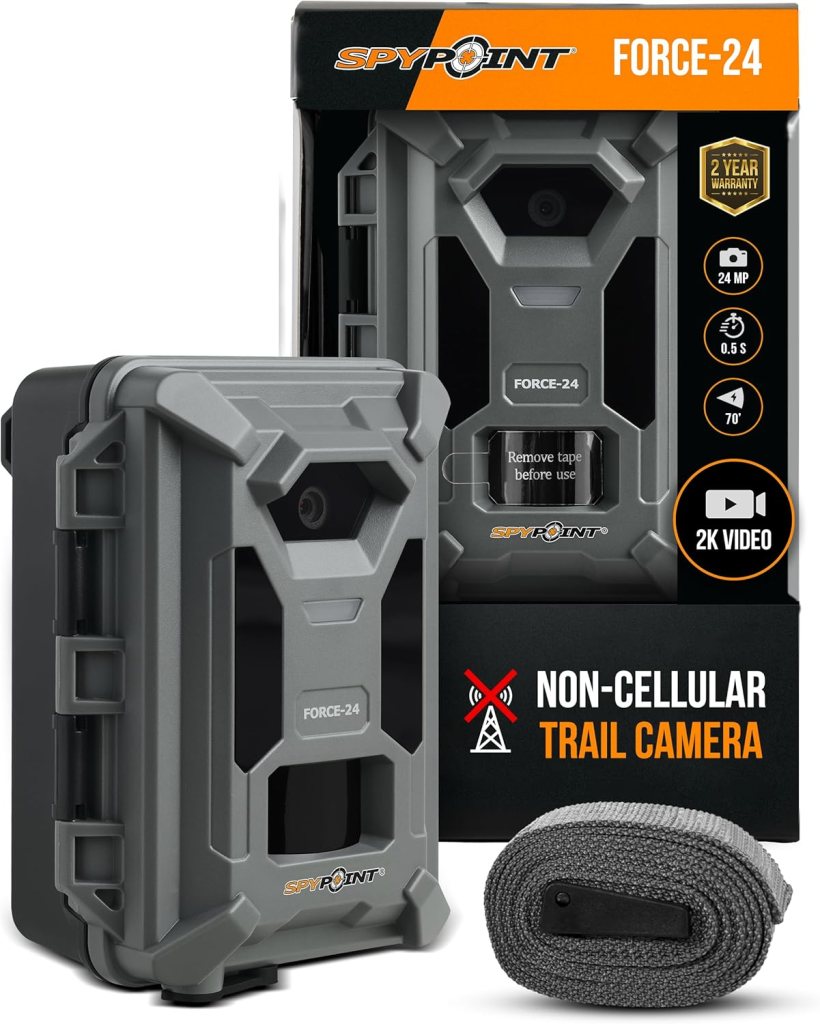
Best simple non-cellular pick
The FORCE-24 is the uncomplicated one. It records 24MP photos, 2K video with sound, has a 0.5-second trigger, and a 70-foot detection range. SPYPOINT positions it as a straightforward FORCE-series option with an easy setup screen, and that’s basically the appeal. It is a simple camera for straightforward jobs.
I’d use it for feeder monitoring, spare-cam duty, property access points, or anywhere you don’t need the broader range or richer feature set of the FORCE-PRO-S 2.0. Not every camera has to be a flagship. Some just need to behave.
Pros
- Easy non-cellular setup
- 2K video with sound
- 24MP photos
- Good basic option for local monitoring
Cons
- 70-foot range is more modest
- Less impressive than the PRO model if you care about top-end spec performance
Review summary
The FORCE-24 knows what it is. That helps. It doesn’t promise too much, and that usually leads to fewer headaches.
Real Testimonial
The FORCE-24 is the simple non-cellular pick in this lineup. It offers 24MP photos, 2K video with sound, and a 0.5-second trigger speed, which is enough for many straightforward monitoring jobs. It is not trying to be SPYPOINT’s flagship, and that is fine. For feeder sites, property access points, and spare-camera duty, it covers the basics without becoming complicated. Buyers who want a no-fuss local-recording camera will probably find this one easier to like than a more feature-heavy option.
SPYPOINT FLEX vs FORCE vs LINK
Here’s the clean version. FLEX is the modern cellular line. FORCE is the non-cellular line. LINK is the older compact cellular idea that still works if you want simpler photo-first scouting.
If you want images sent to your phone, you’re looking at FLEX or LINK. If you want to avoid data plans and manage everything on an SD card, FORCE is the better fit.
SPYPOINT also offers photo transmission plans that run from a free tier up to unlimited, which matters if you go cellular. That makes FLEX-S, FLEX-DARK, and LINK-MICRO-LTE easier to compare against each other.
It also explains why some buyers are better off skipping cellular completely and choosing FORCE instead.
Which SPYPOINT camera should you buy?
Buy the FLEX-S if you want the safest recommendation. It’s the most balanced camera here.
Buy the LINK-MICRO-LTE if your main goal is simple cellular scouting and you don’t need a richer media feature set.
Buy the FLEX-DARK if concealment matters more than anything else.
Buy the FORCE-PRO-S 2.0 if you want the strongest non-cellular SPYPOINT camera.
Buy the FORCE-24 if you want a basic non-cellular model that handles the job without becoming a project.
FAQ
Is SPYPOINT a good brand for trail cameras?
Yes, especially if you want an easy entry into cellular scouting. SPYPOINT’s current lineup covers both cellular and non-cellular use, and the brand’s real strength is that its app, plans, and camera ecosystem are built to work together rather than as disconnected add-ons.
What is the best SPYPOINT camera overall?
The FLEX-S is the best overall pick in this group because it blends modern cellular features, 0.3-second trigger speed, 100-foot range, 1080p video with sound, and built-in solar charging in one camera.
Which SPYPOINT camera is best for beginners?
The LINK-MICRO-LTE is a strong beginner cellular option because it is compact, simpler, and focused on the basic advantage of cellular scouting: fewer trips and quick photo checks. The FORCE-24 is the easier beginner pick if you do not want cellular at all.
Is the SPYPOINT FLEX-S worth it?
Yes, if you actually benefit from the solar power and cellular workflow. It is worth less to someone who checks cameras casually near home, and worth much more to someone hanging cameras in places they would rather not revisit constantly.
What is the difference between SPYPOINT FLEX and FORCE cameras?
FLEX models are cellular and managed through the app. FORCE models are non-cellular and store media locally on an SD card. That is the main dividing line.
Are SPYPOINT cellular cameras better than non-cellular ones?
Not automatically. Cellular cameras reduce site visits and help lower scouting pressure, but non-cellular cameras still make more sense in areas with poor signal or for buyers who prefer local recording with no plan attached.
Which SPYPOINT camera is best for night use?
The FLEX-DARK is the strongest night-use choice here if stealth matters, because it offers no-glow and low-glow LED settings. The FLEX-S is also strong at night, but it is not the stealth specialist.
Do SPYPOINT cameras require a subscription?
Non-cellular models do not. Cellular models use SPYPOINT photo transmission plans, and SPYPOINT advertises plan options from free up to unlimited.
Can SPYPOINT cameras record video?
Many current SPYPOINT models can. The FLEX-S and FLEX-DARK record 1080p video with sound, the FORCE-PRO-S 2.0 records up to 4K video with sound, and the FORCE-24 records 2K video with sound. The LINK-MICRO-LTE is more photo-oriented.
What is the best non-cellular SPYPOINT camera?
The FORCE-PRO-S 2.0 is the best non-cellular SPYPOINT camera in this list because it combines solar charging, a 0.2-second trigger, 110-foot range, and 4K video.
Which SPYPOINT camera has solar charging?
The FLEX-S and FORCE-PRO-S 2.0 both have integrated solar charging. SPYPOINT also sells separate solar accessories that work across its camera lineup.
Are older SPYPOINT cameras still worth buying?
Sometimes. The LINK-MICRO-LTE proves that. Older models can still be useful when the role is simple and the camera’s limits match the job. I just would not buy an older model hoping it behaves like a newer FLEX. It won’t.
Final verdict
The best SPYPOINT camera for most people is the FLEX-S. It is the least compromised pick. The FLEX-DARK is the smarter choice if stealth is the priority.
The FORCE-PRO-S 2.0 is the one for people who still believe an SD-card trail camera can be the better tool, which, depending on the property and signal conditions, is often true. Good trail camera use is mostly about pressure, placement, and picking the right lane for the job.
The camera matters, but the role matters first.
Affiliate Disclaimer
This article contains affiliate links. We may earn a small commission if you purchase through these links, at no extra cost to you.






Leave a Reply