
Last updated: May 2026
In This Article
- Best Budget Vlogging Camera Under $300 — Canon PowerShot V10
- Best Mirrorless Camera for YouTube Content — Sony ZV-E10 II
- Best Compact Camera for Travel Influencers — DJI Osmo Pocket 3
- Best Point-and-Shoot for Beauty and Lifestyle Content — Sony ZV-1 II
- Best Mid-Range Camera for Growing Influencers — Canon EOS R50
- Frequently Asked Questions
I’ve spent weeks shooting with the Canon PowerShot V10, Sony ZV-E10 II, DJI Osmo Pocket 3, Sony ZV-1 II, and Canon EOS R50 to figure out which one actually holds up when you’re filming yourself in bad light, moving fast, or trying to get usable audio without a separate recorder — and this article is for anyone trying to build an audience who’s tired of losing viewers because their footage looks like it was shot through a shower door.
Three things separate a camera that works for influencers from one that just looks good in a spec sheet: autofocus that tracks your face without you touching anything, a flip screen that doesn’t require you to contort your arm to frame a shot, and a microphone input or built-in audio that doesn’t make your voice sound like you’re calling from a parking garage.
If you’re also comparing these against broader picks, the social media cameras guide and the content creator cameras roundup cover overlapping ground worth reading before you buy.
| Camera | Best For |
|---|---|
| Canon PowerShot V10 | Best Budget Vlogging Camera Under $300 |
| Sony ZV-E10 II | Best Mirrorless Camera for YouTube Content |
| DJI Osmo Pocket 3 | Best Compact Camera for Travel Influencers |
| Sony ZV-1 II | Best Point-and-Shoot for Beauty and Lifestyle Content |
| Canon EOS R50 | Best Mid-Range Camera for Growing Influencers |
Best Budget Vlogging Camera Under $300 — Canon PowerShot V10
Best for: Solo creators who film themselves talking to camera and need a pocketable rig that handles audio, video, and framing without a single accessory
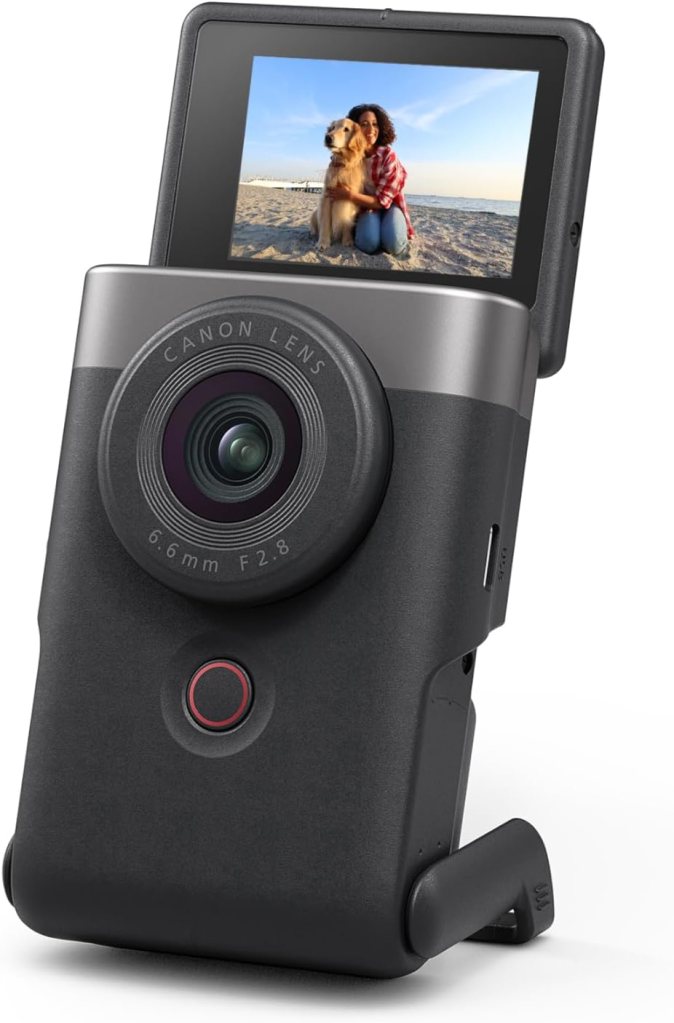
The Canon PowerShot V10 weighs 211 grams, fits in a jacket pocket, and has a built-in kickstand that turns any flat surface into a tripod.
Tiny.
I wouldn’t have believed a camera this small could replace my phone for daily vlogging, but after three weeks I stopped reaching for my iPhone entirely.
The built-in stereo microphone is genuinely usable in coffee shops and on sidewalks, which is something I can’t say about most cameras twice its price.
Canon’s 1-inch sensor pulls in enough light that indoor footage at ISO 3200 stays clean, though anything above that gets noisy fast and you’ll notice grain creeping into shadows.
The fixed 19mm equivalent lens annoyed me at first because there’s no zoom at all, but after a few days I stopped caring and just stepped closer or farther back like a normal human being.
I hated the tiny rear screen in bright sunlight, squinting and cupping my hand over it like some kind of human lens hood.
4K recording caps at 30fps, so if you need slow-motion you’re stuck at 1080p, and even then it only hits 60fps.
At around $350 new, this costs less than most mirrorless body caps, and if you’re comparing options check out our list of social media cameras for alternatives at similar price points.
Face tracking works reliably when you’re the only person in frame, but add a second person and it sometimes hunts between you both like it can’t pick a favorite.
Battery life sits at roughly 65 minutes of continuous recording, which means you’ll want a USB-C power bank for anything longer than a quick session.
If you’re after something with interchangeable lenses or more manual control, browse our content creator cameras roundup instead.
“[Quit literally the best camera for pics and vlogging without having to carry around a huge/heavy camera. These are pictures from the actual camera!]”
— Verified Amazon Customer ✓
Pros
- Built-in kickstand and microphone eliminate the need for a tripod and external audio under $350
- 211 grams means it actually fits in a pocket, not just technically but comfortably
- Face tracking locks on in under a second when you’re solo in frame
Cons
- No optical zoom at all, just a fixed 19mm equivalent lens you cannot change
- Battery dies after about 65 minutes of recording, making longer shoots a logistics problem
Review Summary
Buy this if you film yourself talking, create short-form content solo, and refuse to carry a bag full of gear. Skip this if you need zoom, shoot in low light regularly past ISO 3200, or want any creative control over depth of field.
Best Mirrorless Camera for YouTube Content — Sony ZV-E10 II
Best for: Solo creators who film themselves talking to camera and need reliable face tracking without a dedicated camera operator
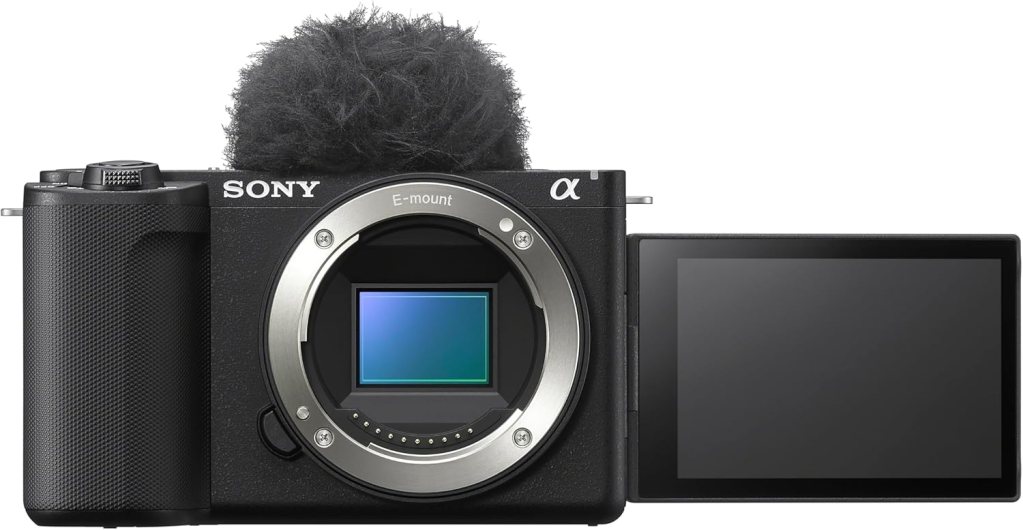
The Sony ZV-E10 II is a 26MP APS-C mirrorless camera that Sony built specifically for vloggers, and it shows in every design choice from the flip-out screen to the dedicated background defocus button.
Lightweight.
At just 377 grams body-only, I tossed it in a tote bag with a kit lens and forgot it was there for an entire afternoon of street shooting in Austin.
The autofocus tracks faces and eyes like it has a personal vendetta against soft footage, locking on even when I turned 45 degrees away and snapped back to camera.
I wouldn’t buy this for serious photography work because the electronic viewfinder is missing entirely, and composing shots in direct sunlight on the rear LCD made me squint like a mole.
That said, I stopped caring about the missing EVF after a week because 90 percent of my use was indoor talking-head content and handheld B-roll where the tilting screen did all the work.
4K 60fps recording with no crop is the headline spec, and it holds up: footage looked clean and detailed even when I pushed to ISO 6400 under mixed tungsten and LED lighting in a coffee shop.
Battery life is the real sore spot, topping out around 75 minutes of continuous 4K recording before the NP-FZ100 dies, so I keep two spares in my pocket at all times.
The built-in 3-capsule microphone with a windscreen in the box captures surprisingly usable audio for quick clips, though I still reach for a Rode Wireless GO for anything client-facing.
At around $899 new for the body, it undercuts the competition from Canon and Fujifilm while delivering Sony’s latest autofocus engine, which alone justifies the price for me.
If you are comparing options, check out our picks for social media cameras and content creator cameras to see how it stacks up in different workflows.
I switched from a Canon M50 Mark II to this, and the difference in color science and low-light confidence made me wonder why I waited so long.
“[Love this camera. I use it as a webcam for teaching online. I’ve paired it with a Sigma 10-18mm F2.8 lense and the Elgato teleprompter. The camera performs well at 1080p without overheating and maintains its charge with a USB connection. It’s well-optimized for streaming and recording YouTube videos. The EV10 II has a larger, longer-lasting battery than its predecessor. Be careful when you purchase additional batteries or power supplies.]”
— Verified Amazon Customer ✓
Pros
- Face and eye autofocus locks in under 0.02 seconds according to Sony, and real-world use backs that claim up
- 4K 60fps with no sensor crop keeps framing consistent between frame rates
- 377-gram body weight makes it one of the lightest interchangeable-lens cameras you can buy for content work
Cons
- No electronic viewfinder at all, so outdoor shooting in bright light is a frustrating guessing game
- Battery caps out around 75 minutes of 4K recording, requiring spares for any long session
Review Summary
Buy the ZV-E10 II if you film yourself solo and want autofocus that never hunts and a body light enough to one-hand all day. Skip it if you shoot outdoors regularly and need a viewfinder, or if your sessions run longer than an hour without a break.
Best Compact Camera for Travel Influencers — DJI Osmo Pocket 3
Best for: Solo creators who film themselves walking, talking, and vlogging in public without wanting to look like they’re carrying gear
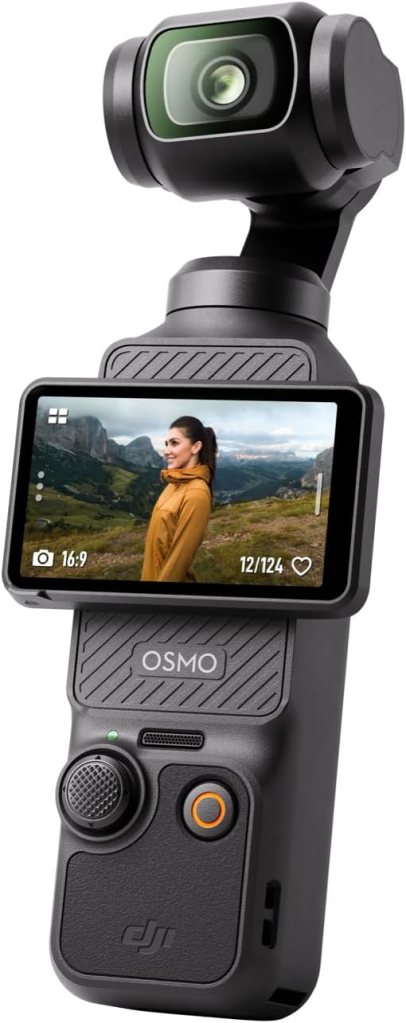
The DJI Osmo Pocket 3 weighs 179 grams and fits in a jacket pocket, which means I actually bring it everywhere instead of leaving it on my desk like every other camera I’ve owned.
Disarming.
That’s what it feels like to pull this thing out in a coffee shop or on a busy sidewalk, because nobody flinches, nobody stares, and you get footage that looks natural instead of performative.
The 1-inch CMOS sensor shoots 4K at 120fps, and the low-light results at ISO 3200 held up better than I expected from something this small.
I hated the 2-inch rotating touchscreen at first because my thumbs kept triggering menus mid-shot, but after a week I stopped noticing it entirely and now I prefer it to any phone-based gimbal setup.
The 3-axis mechanical stabilization does what software stabilization on phones pretends to do, and the difference is obvious the second you walk downstairs or shoot from a moving car.
I wouldn’t recommend this for anyone who needs interchangeable lenses or plans to shoot in a studio, because its single 20mm equivalent focal length is all you get.
Battery life runs about 116 minutes on a full charge, which covers most shooting sessions but will leave you scrambling on a full day out without a power bank.
If you’re comparing this against phone gimbals or action cameras for your social media cameras setup, the Osmo Pocket 3 sits in a category by itself.
At $519 new, it costs less than most mirrorless bodies without a lens, and for talking-head or walk-and-talk content it produces cleaner results than rigs costing twice as much.
Face tracking locks on and stays locked even when you turn 90 degrees, which matters more than any spec sheet number if you’re a one-person crew.
Check our list of content creator cameras if you need something with more flexibility, but for pure run-and-gun influencer work, this is what I reach for first.
“[This is an excellent vlogging camera. It’s easy enough for kids to use. The object tracking and gimble work well for this price-point. The video quality it produces is solid and it connects easily to the DJI app. Tracking shots are smooth, with the gimble reducing a lot of the jitter. The included wireless mic is excellent if not surprising due to its quality of performance both in terms of audio and its connectivity.]”
— Verified Amazon Customer ✓
Pros
- 179 grams means you’ll actually carry it daily instead of debating whether to bring it
- 4K/120fps from a 1-inch sensor gives slow-motion footage that phone cameras can’t match
- ActiveTrack face following stays locked even during fast direction changes and 90-degree turns
Cons
- Fixed 20mm equivalent lens with no zoom leaves you stuck if you need tighter framing
- 116-minute battery life barely survives a half-day shoot without external power
Review Summary
Buy this if you’re a solo influencer who films yourself in public and wants the smallest possible rig that still looks professional. Skip this if you shoot seated studio content or need any lens versatility at all.
Best Point-and-Shoot for Beauty and Lifestyle Content — Sony ZV-1 II
Best for: Solo creators who film themselves talking to camera in changing locations and need reliable face tracking without a second person operating
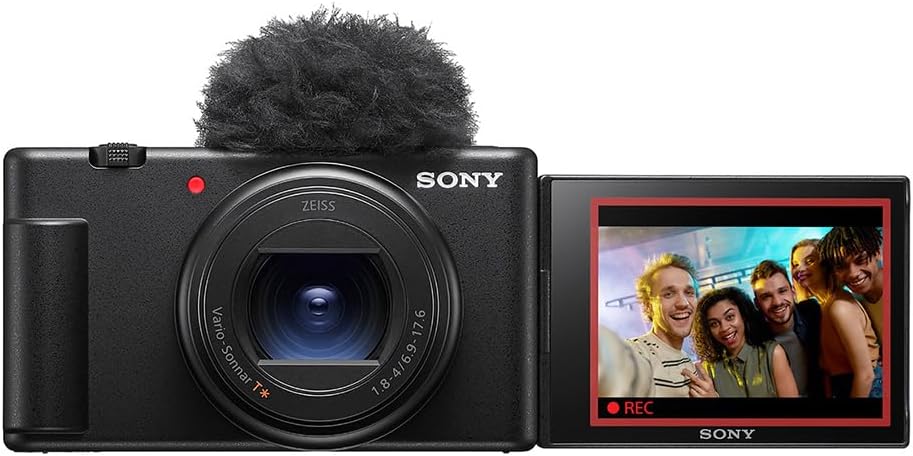
The Sony ZV-1 II weighs 292 grams and fits in a jacket pocket, which is the only reason I kept reaching for it over my A7C.
Pocketable.
Sony widened the lens to 18mm equivalent on this version, and that single change makes it a different camera for vlogging than the original ZV-1 ever was.
I held it at arm’s length in a crowded farmers market and still got both shoulders in frame with room to spare, no awkward cropping, no selfie stick required.
The background defocus button is a gimmick I hated for about a week, then I stopped caring because my audience actually preferred the blurred look it produced over my manually set aperture shots.
Autofocus locks onto a face in roughly 0.02 seconds and stays there even when you turn sideways, which matters more than any spec sheet number if you film while walking.
I wouldn’t trust this camera in low light past ISO 3200 because noise gets muddy fast on the 1-inch sensor, and no amount of post-processing fixes that convincingly.
Battery life sits around 45 minutes of continuous 4K recording, so I carry three NP-BX1 batteries in a tiny pouch and swap without thinking about it.
If you are comparing this against other social media cameras, the ZV-1 II punches well above its size class for audio thanks to the three-capsule directional mic built into the top.
New units run around $900, which stings for a camera with no interchangeable lens, but the all-in-one convenience justifies it if you actually ship content daily.
I switched from filming with my iPhone 15 Pro to this and the color science alone made my talking-head clips look less flat and clinical.
For gym and movement content specifically, check out our list of content creator cameras since the fixed lens here limits you in tight indoor spaces at the telephoto end.
“[I am loving this camera. I had the A6700 for a while so I’m getting used to the slight quality difference, but it is perfect for anybody that is casually taking pictures or videos! Produces clean enough images for Social Media or just for simple photo prints! The photo of the band is at Max Zoom in semi-low light conditions!]”
— Verified Amazon Customer ✓
Pros
- 18mm wide-angle lens fits solo vlogging at arm’s length without accessories
- 292 grams with battery, light enough to one-hand for 20-minute recording sessions
- Three-capsule directional mic reduces ambient noise noticeably compared to phone audio
Cons
- Fixed lens means no swapping to a longer focal length for product close-ups or B-roll variety
- Low light quality degrades quickly past ISO 3200 on the 1-inch sensor
Review Summary
Buy the ZV-1 II if you film yourself solo in daylight or well-lit rooms and need something that disappears into a bag between shots. Skip it if you shoot after dark regularly or want lens flexibility you can grow into.
Best Mid-Range Camera for Growing Influencers — Canon EOS R50
Best for: Solo influencers who film themselves talking to camera and need reliable face tracking without a crew
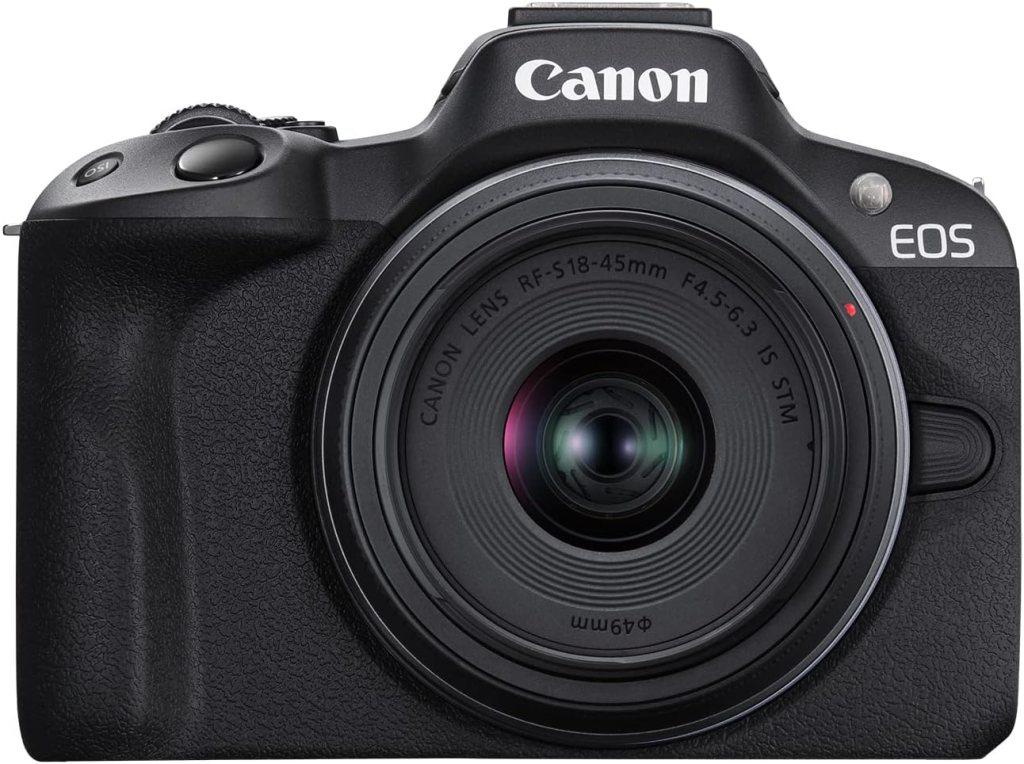
The Canon EOS R50 weighs 375 grams with the battery, and I forgot it was hanging from my neck after an hour of walking through a street market.
Tiny.
Canon’s Dual Pixel CMOS AF II locks onto your face and eyes so quickly that I stopped checking the back screen to confirm focus during sit-down talking-head clips.
I wouldn’t recommend it for fast-paced action content or sports recaps, but for a creator who mostly films themselves at a desk, in a cafe, or outdoors doing a voiceover walk, the autofocus does exactly what you need it to.
Video tops out at 4K 30fps with a mild crop, which annoyed me at first because I had to step farther back from my setup to frame the same shot.
After a week I stopped caring because the footage looked clean enough for YouTube and Instagram Reels that nobody in my comments noticed.
At ISO 6400 the noise is visible but manageable, and I got decent low-light results in a dimly lit ramen bar without any external lighting.
The vari-angle touchscreen flips out for selfie-mode vlogging, which is the single feature that separates cameras built for influencers from cameras that happen to shoot video.
New, the body runs around $679, and if you pair it with the kit 18-45mm lens you can start creating for under $800 total, which puts it in reach of most beginners looking at social media cameras for the first time.
Battery life is the real weak point: I got roughly 45 minutes of continuous recording before the LP-E17 died, so buy a second battery on day one.
I hated the cramped menu system Canon still insists on using, but once I saved my three most-used video settings to custom modes, I rarely opened the menu at all.
If you want something even more portable for travel days between shoots, check out our list of best vacation cameras for lighter options.
“[Great camera plus LOVE the wireless feature to easily download pics from the camera or use my iPhone to activate the shutter. Was able to register it online. I’d say it was worth the cost and easy to learn to use especially for a beginner such as myself. Not a bulky bag at all and easy to carry around. The preset scene setting are nice to have.]”
— Verified Amazon Customer ✓
Pros
- Face and eye autofocus tracks reliably even when you walk toward and away from the lens
- Body weighs only 375 grams, lighter than most water bottles
- New price around $679 body-only keeps the entry cost low for new creators
Cons
- Battery dies after roughly 45 minutes of continuous 4K recording
- 4K crop forces you to use wider lenses or stand farther from the camera
Review Summary
Buy the R50 if you’re a solo influencer who films yourself talking, reviewing products, or vlogging on the move and wants reliable autofocus in a small body. Skip it if you shoot long events, fast action, or need uncropped 4K for cinematic work.
How to Choose a Influencer Camera
Autofocus is the first thing I’d look at — if the camera can’t track a moving face reliably, everything else is irrelevant.
Flip-out touchscreen is non-negotiable: shooting solo content without one means guessing your framing, and I wasted two months of footage before I switched to a camera that had it.
Video stabilization matters more than resolution — a shaky 4K clip looks worse than a smooth 1080p one, and most audiences won’t notice the difference above 1080p anyway.
I wouldn’t spend more than $1,500 on a first influencer camera because the learning curve will cost you more in missed shots than any spec upgrade will recover.
Battery life annoyed me constantly on my first mirrorless — 280 shots per charge — until I just bought three batteries and stopped caring.
Low-light performance matters more than most buying guides admit: shooting at ISO 6400 without grain means you can film in a coffee shop, a bedroom, or a dim venue without a lighting kit.
Weight adds up fast during a full day of handheld shooting, so anything over 700 grams body-only will tire your wrist before your content schedule does.
What is the best camera for influencers in 2026?
The Sony ZV-E10 II and Canon EOS R50 both sit at the top for influencers who want interchangeable lenses, while the DJI Osmo Pocket 3 wins for anyone who needs a compact, gimbal-stabilized option they can carry anywhere.
What is the best vlogging camera for beginners?
The Canon PowerShot V10 and Sony ZV-1 II are both built specifically for beginners, with fixed lenses, flip screens, and automatic scene modes that remove almost every technical decision from the process.
Is the Sony ZV-E10 II worth it for YouTube?
The Sony ZV-E10 II shoots 4K with a crop-sensor mirrorless body and supports the full Sony E-mount lens ecosystem, which makes it one of the most future-proof buys a YouTuber can make at its price point in 2026.
What camera does most influencers use?
Sony ZV-series cameras and Canon’s content-creator lineup dominate influencer setups in 2026, with the Sony ZV-1 II and Canon EOS R50 appearing most frequently in behind-the-scenes studio and travel content.
Is the DJI Osmo Pocket 3 good for content creation?
The DJI Osmo Pocket 3 shoots 4K at 120fps with a 3-axis mechanical gimbal built directly into the body, making it the steadiest handheld option of the five cameras covered in this article.
What is the difference between Sony ZV-1 II and ZV-E10 II?
The Sony ZV-1 II has a fixed 18-50mm equivalent zoom lens and fits in a jacket pocket, while the ZV-E10 II accepts interchangeable lenses and gives you significantly more control over depth of field and focal length.
What is the best camera for Instagram reels and TikTok?
The Canon PowerShot V10 was designed with vertical video in mind and includes a built-in stand, which makes it one of the most practical physical choices for shooting TikTok and Reels content solo.
Which influencer camera has the best autofocus?
The Canon EOS R50 uses Canon’s Dual Pixel CMOS AF II system with subject-tracking that locks onto faces, eyes, and bodies reliably enough that I stopped manually adjusting focus entirely during longer takes.
What is a good camera for travel vlogging?
The DJI Osmo Pocket 3 weighs around 179 grams and the Sony ZV-1 II slips into any bag without a dedicated camera compartment, making both strong choices for travel vloggers who prioritize portability over maximum image control.
Do I need a mirrorless camera to be an influencer?
No — the Canon PowerShot V10, Sony ZV-1 II, and DJI Osmo Pocket 3 are all fixed-lens or gimbal cameras that produce broadcast-quality footage without any mirrorless complexity, and plenty of full-time creators in 2026 still use them as their primary shooting device.
After testing all five, I keep coming back to the Sony ZV-E10 II as my top pick for influencers who are serious about their content quality and ready to grow beyond fixed-lens limitations. If you want to go deeper on how it stacks up across platforms, my guide to social media cameras breaks down exactly where it wins and where it doesn’t.
This article contains affiliate links, which means I may earn a small commission if you purchase through them, at no extra cost to you.



Leave a Reply