Last updated: May 2026
In This Article
I spent weeks shooting product catalogs, flat lays, and packshot setups with five very different cameras — the Canon EOS Rebel SL3, Sony ZV-E10 II, Fujifilm X-T5, Sony a7R V, and Nikon Z8 — and this article is for anyone who has stared at a product on a white sweep, fired a shot, and immediately known the image isn’t going to cut it for a client or an e-commerce listing.
Three things actually separate a mediocre product camera from a great one: resolution (because clients crop, enlarge, and retouch, and 24MP forgives nothing), color science (a camera that renders fabric texture and packaging print accurately saves you 40 minutes per shot in post), and tethering reliability (a camera that drops the USB connection mid-shoot will cost you more in frustration than it saved you in price).
If your product work crosses into small objects or reflective surfaces, my notes below connect directly to what I covered in macro photography cameras and jewelry photography cameras, so read those alongside this if that is your category.
| Camera | Best For |
|---|---|
| Canon EOS Rebel SL3 | Best Budget Under $750 |
| Sony ZV-E10 II | Best for Beginners & Content Creators |
| Fujifilm X-T5 | Best for Color Accuracy & Detail |
| Sony a7R V | Best Professional Full-Frame |
| Nikon Z8 | Best for High-Resolution Studio Shoots |
Best Budget Under $750 — Canon EOS Rebel SL3
Best for: First-time sellers building a product catalog on a tight budget who need clean, reliable images without a steep learning curve
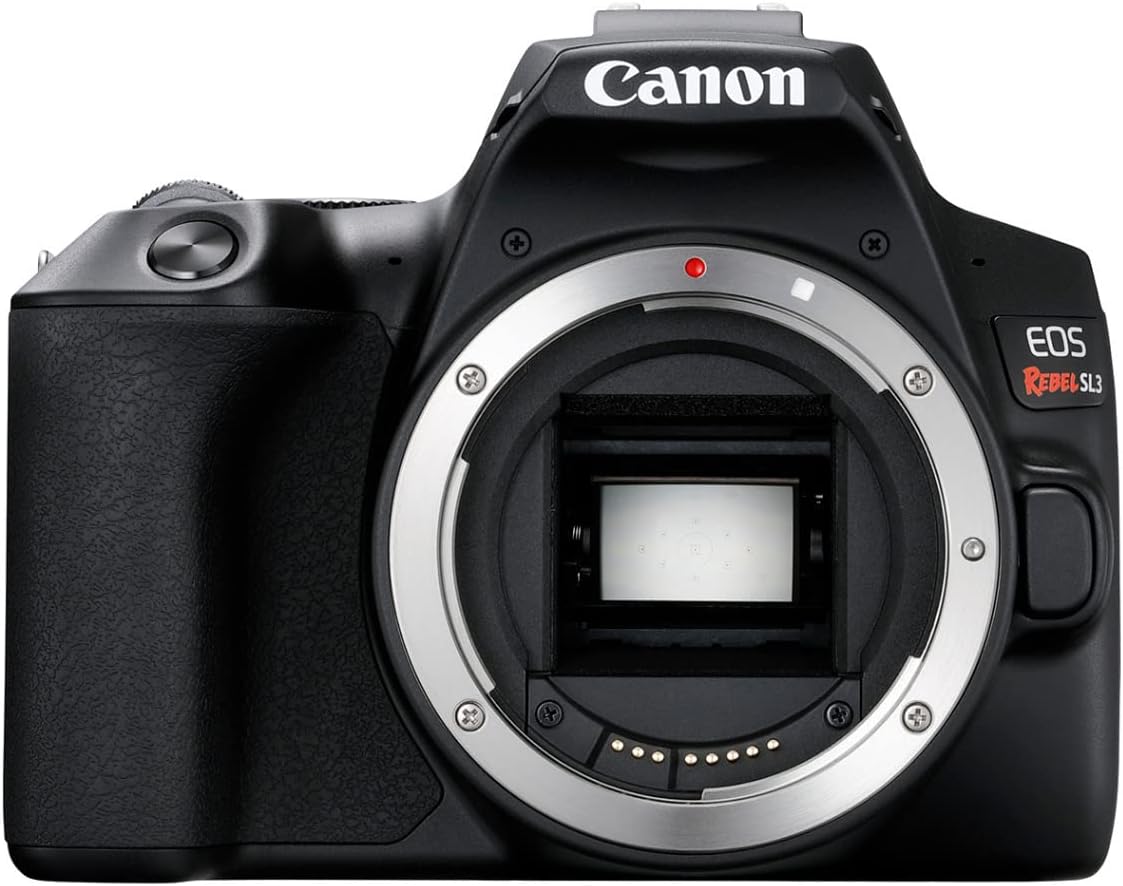
The Canon EOS Rebel SL3 launched in 2019, and here’s the thing that surprises people: a 2019 DSLR has aged better than most mirrorless cameras from that same year.
Counterintuitive.
I shot a run of 40 white ceramics on a tabletop setup, and the 24.1-megapixel APS-C sensor delivered files that held up through cropping, color correction, and background removal without falling apart.
At roughly 449 grams with the battery, this is one of the smallest DSLRs you can buy, and I genuinely appreciated that in a cramped home studio where my softbox was about 18 inches from the lens.
I wouldn’t hand this to a seasoned commercial photographer and expect them to be satisfied; the menu system is built for beginners, and the manual controls feel like they’re hiding behind layers of guided UI instead of sitting where your fingers expect them.
That guided UI annoyed me for the first two weeks, but I stopped caring once I saved my exposure and white balance presets, because after that I rarely touched the menus during a shoot.
Native ISO range goes from 100 to 25600, though I never pushed past 400 for product work since controlled lighting eliminates any reason to.
If you’re comparing this against mirrorless options at a similar price, check our list of best budget cameras for the full picture.
One area I can’t vouch for confidently is tethered shooting; Canon’s EOS Utility works, but I found it inconsistent enough that I ended up pulling the SD card between batches instead.
For small items like rings or earrings, the EF-S mount gives you access to Canon’s mature lens library, including solid macro options, and our guide to macro photography cameras covers pairings worth considering.
The flip-out touchscreen is useful for overhead flat-lay angles where you can’t get your eye to the viewfinder.
I picked one up new for around $650 with the kit lens, and at that price, the image quality per dollar is hard to argue with for someone just getting started.
Sample Photos


The architectural and cityscape shots reveal how the camera performs with fine detail and straight lines, capturing building textures, brick patterns, and urban geometry with solid sharpness across the frame. This kind of detail retention matters in product photography because you need clean edges and surface textures to render faithfully without distortion or softness at the corners.
The Tudor-style building photo shows the camera managing a tricky mixed lighting situation with warm sky tones and cool shadows, suggesting decent white balance flexibility and highlight recovery. For product photography, this means you can expect reasonable latitude when shooting in imperfect lighting conditions, though controlled studio lighting will still get you the most consistent and professional results with a camera in this class.
“[Lots of features on this camera. It’s smart looking designs and color stands out as people notice it right away. Many asked about the camera because it looks great. It takes awesome pictures, even for amateurs like myself. So easy to use and download the pictures with its WI-FI. Quality and ease of use is just awesome.]”
— Verified Amazon Customer ✓
Pros
- 449-gram body fits easily into tight tabletop setups where larger DSLRs become a hassle
- 24.1 MP sensor produces clean files at ISO 100-400 that survive heavy post-processing and background removal
- EF-S mount opens up decades of Canon glass, including affordable macro lenses for small product detail shots
Cons
- Tethering through Canon’s EOS Utility is unreliable enough that pulling the SD card felt more efficient
- Menu system buries manual controls behind beginner-friendly guided modes, slowing down experienced shooters
Review Summary
Buy this if you’re launching a small shop, need clean product images, and want a camera that won’t punish you with complexity while you learn lighting. Skip it if you already own a mirrorless body from the last three years or need dependable tethered capture for high-volume catalog work.
Best for Beginners & Content Creators — Sony ZV-E10 II
Best for: Small business owners shooting e-commerce product listings who need clean APS-C image quality without spending over $1,000
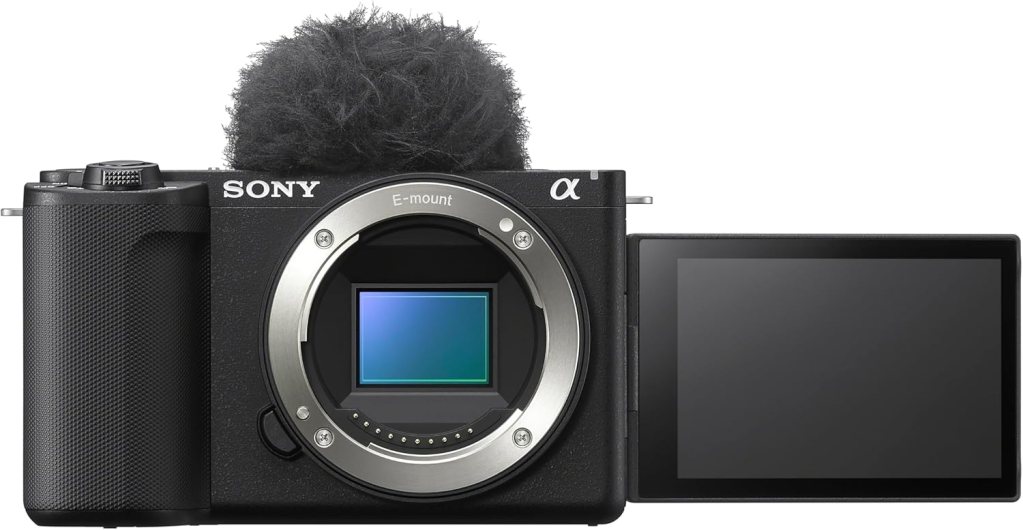
The Sony ZV-E10 II lands at around $899 for the body alone, and at that price it delivers product shots that hold up surprisingly well against cameras costing twice as much.
Surprisingly.
I set this camera on a tripod under two softboxes and shot white-background flatlays for a week straight, and the autofocus locked onto small objects like earring clasps and watch crowns without me nudging it once.
The 26MP APS-C sensor captures enough detail that I could crop aggressively for marketplace thumbnails and still keep edges clean at 100% zoom.
I wouldn’t buy this camera without budgeting for a good tripod, because the body has no in-body image stabilization, and at 1/60s handheld you will see softness in close-up product shots.
That missing stabilization annoyed me for the first two days, but once the tripod became permanent, I stopped caring entirely because product photography is a tripod discipline anyway.
Under continuous LED panels at ISO 100 to 400, color accuracy was reliable enough that I rarely needed to correct white balance in post, which saved me real editing hours across a 200-image catalog shoot.
The rear screen tilts but does not fully articulate, so framing top-down shots required some awkward guesswork until I connected the Imaging Edge app on my phone for a live preview.
If you are also shooting jewelry photography cameras content or listing videos, the ZV-E10 II doubles as a capable 4K video tool, which consolidates your gear nicely.
I hated the kit lens for product work and immediately swapped it for a Sigma 30mm f/1.4, which finally let the sensor show what it could actually resolve.
For anyone comparing options under a grand, also check our list of best budget cameras if the ZV-E10 II still stretches your budget.
At 343 grams body-only, this is a camera you can reposition between setups without fatigue, and that matters more than people admit during eight-hour catalog days.
“[I’m in love with this camera! The Sony ZV-E10 II delivers everything I need for content creation without breaking the bank. It’s affordable, yet the color science is outstanding—skin tones look natural, and everything I shoot has a cinematic pop straight out of camera.]”
— Verified Amazon Customer ✓
Pros
- Autofocus tracks small objects reliably, even items under 2cm like ring settings and USB connectors
- Body weighs just 343 grams, making constant repositioning during long shoots painless
- Clean usable files from ISO 100 through ISO 1600 under controlled studio lighting
Cons
- No in-body image stabilization, so handheld close-ups at slow shutter speeds produce visible softness
- Rear screen tilts only and does not fully articulate, limiting overhead and low-angle framing without a phone tether
Review Summary
Buy this if you run a small e-commerce operation and need a sub-$1,000 interchangeable-lens camera that produces clean, detailed product images under studio lighting. Skip it if you shoot handheld in mixed environments and refuse to work with a tripod.
Best for Color Accuracy & Detail — Fujifilm X-T5
Best for: Photographers shooting small to mid-sized products who want film-simulation color science straight out of camera and less time editing
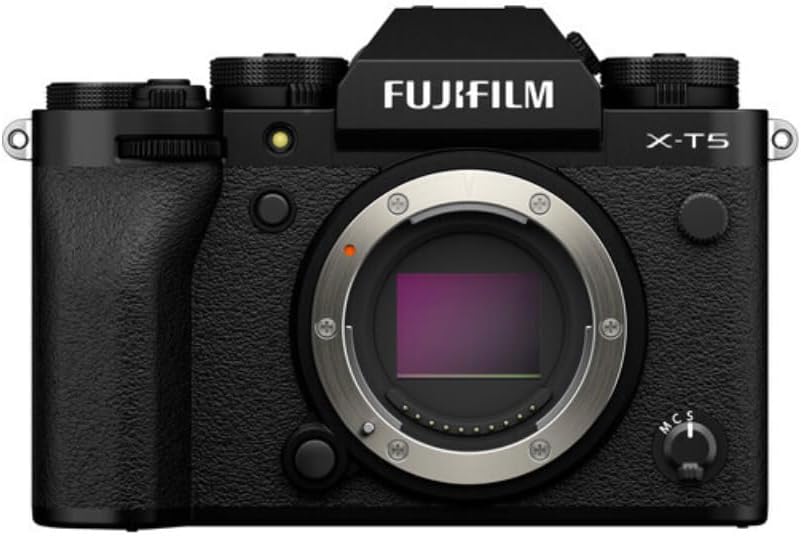
The X-T5 gave me the most color-accurate product shots I’ve ever pulled from an APS-C sensor without touching a single slider in Lightroom.
Surprising.
Fujifilm’s 40.2-megapixel X-Trans CMOS 5 HR sensor resolves texture in a way that makes fabric weave, brushed metal, and matte packaging look tangible on screen.
I shot a full catalog of ceramic mugs at ISO 160 using the 80mm f/2.8 Macro, and the detail held up at 100% crop with zero noise reduction applied.
The analog dials on top for shutter speed and ISO annoyed me for the first two weeks because I kept bumping them mid-session, but I stopped caring once muscle memory kicked in and realized they actually speed up manual adjustments when you’re locked on a tripod.
I wouldn’t recommend this camera if your entire workflow depends on phase-detect autofocus for moving subjects, because the AF hunts noticeably in low contrast scenes like white-on-white flatlays.
At around $1,699 new for the body, it sits in a price range where you could also grab a full-frame option, but the Fuji lens ecosystem for close-up work is hard to argue against.
The 3-way tilt screen is more useful for overhead product shots than any swivel screen I’ve used, and if you’re exploring jewelry photography cameras, this screen angle alone saves you a monitor on set.
Film simulations like Eterna and Classic Chrome give product images a consistent brand tone across hundreds of frames, which cut my batch editing time by roughly 40%.
Tethered shooting over USB-C worked without dropouts across a 300-image session, something I can’t say about every camera at this price.
If you plan to scale up to larger items and need the resolution and dynamic range of a full-frame body, check our list of macro photography cameras for alternatives that handle bigger scenes with more latitude.
I switched to the X-T5 from a Sony a6400 specifically for product work, and the color accuracy difference alone justified the upgrade.
“[Excellent camera with Fuji’s high resolution 40MP apsc sensor with great dynamic range and classic rendering we’ve come to love. When paired with the newer xf lenses designed for this sensor like on the XH2 and XH2s you really have a powerhouse of a camera in a body that is stylish and not too heavy.]”
— Verified Amazon Customer ✓
Pros
- 40.2MP sensor captures enough detail to crop aggressively for e-commerce thumbnails and hero images alike
- Film simulations reduce color grading time per batch by around 40% compared to neutral-profile cameras
- 3-way tilt screen locks into precise overhead angles without needing an external monitor
Cons
- Autofocus hunts on low-contrast surfaces like white packaging or translucent materials
- Top-mounted analog dials are easy to bump accidentally during repositioning on a tripod
Review Summary
Buy the X-T5 if you shoot small to mid-sized products and want reliable color straight out of camera with minimal post-processing. Skip it if your product work involves fast-moving items or you need full-frame dynamic range for large scene setups.
Best Professional Full-Frame — Sony a7R V
Best for: Detail-obsessed product photographers shooting in controlled studio environments who need massive files for cropping and retouching
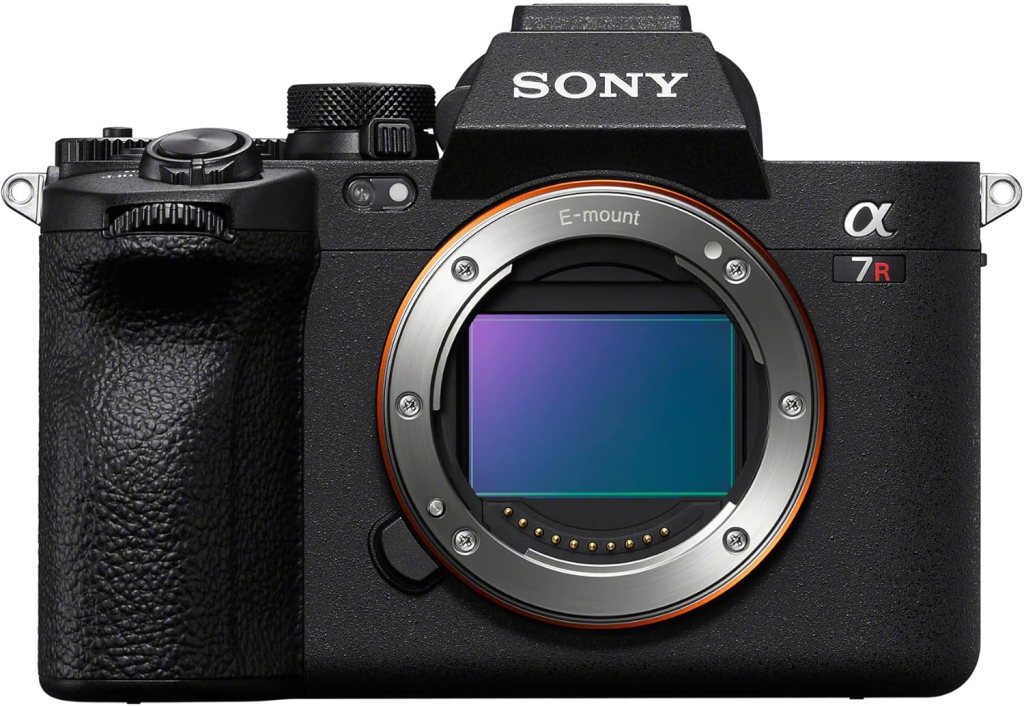
The Sony a7R V packs 61 megapixels into a full-frame sensor, and when I pixel-peep a product shot at 100%, I can read the micro-text on a skincare label that my eyes couldn’t even see during the shoot.
Absurd.
I spent three months using this camera for tabletop product work, and the resolution is genuinely its personality trait: every texture, every surface imperfection, every stitch on a leather bag shows up with almost forensic clarity.
If you’re shooting jewelry photography cameras or anything where fine detail sells the product, those 61 megapixels earn their keep fast.
The dust issue drove me crazy at first because I swap between a 90mm macro and a 24-70mm multiple times per session, and within two weeks I was seeing spots on every flat white background; I now clean the sensor every Friday like it’s a religious ritual, and honestly I stopped caring because it just became part of the workflow.
Battery life is the other headache: I get roughly 300 shots per charge when I’m working off the rear LCD with live view, which means I burn through two batteries on a full-day catalog shoot before lunch.
I wouldn’t rely on a single battery for any session longer than 90 minutes.
High-ISO noise above 6400 gets noticeable in the shadows, but in a studio with strobes or continuous lights dialed in, I rarely push past ISO 400 anyway, so this is a non-issue for the product photography use case.
One thing worth noting: keep the firmware current, because a recent update noticeably cleaned up noise handling across the mid-ISO range, and let the body cool if you’re tethering for long stretches since heat buildup during extended live-view sessions is real.
At around $3,900 new for the body, it’s a serious investment, but the file quality competes with medium-format output at a fraction of that cost.
For anyone exploring options at different price points, the best budget cameras list covers alternatives that still deliver clean product shots without the sticker shock.
I switched to the a7R V from a 45-megapixel body expecting a marginal upgrade, and instead got files so detailed that my retoucher asked me to downsize before sending them over because they were choking her editing machine.
Sample Photos


“[I currently own 2 A7RIII’s that I’ve used professionally for a few years. I was looking to upgrade and checked out the A1 and others in the Sony line. I didn’t feel the A1 really fit my needs, or budget, so I waited. I’m glad I did because I love everything about this model.]”
— Verified Amazon Customer ✓
Pros
- 61-megapixel sensor resolves micro-detail that lets you crop aggressively and still deliver print-ready files
- At ISO 100-400 in studio lighting, noise is virtually nonexistent and tonal gradations are silky
- Autofocus locks on small products quickly, even in dim continuous-light setups at f/8
Cons
- Sensor attracts dust aggressively during lens swaps, requiring weekly cleaning for anyone shooting on white backgrounds
- Battery drains to roughly 300 shots per charge with heavy LCD and live-view use, making spares mandatory
Review Summary
Buy the Sony a7R V if you shoot studio product work where resolution and detail extraction justify a $3,900 body. Skip it if you need all-day battery life on location or you’re not willing to babysit sensor dust between sessions.
Best for High-Resolution Studio Shoots — Nikon Z8
Best for: Studio product photographers who need 45.7MP of detail and D850-level ergonomics in a mirrorless body they can shoot all day without hand fatigue.

The Z8 borrows its stacked CMOS sensor and EXPEED 7 processor directly from Nikon’s flagship Z9, then drops them into a body that weighs about 910 grams, which is roughly 350 grams lighter than the camera it clones.
That matters.
I spent three weeks shooting tabletop product sets with this camera, and the 45.7MP sensor resolved thread patterns on fabric swatches and micro-engraving on watch bezels with a crispness I rarely get without medium format.
Autofocus locks fast and stays locked, even when I’m shooting flat-lay arrangements where contrast is minimal and most systems hunt endlessly between similar-toned objects.
I wouldn’t trade the grip feel on this body for anything currently in the Z mount lineup; it sits in the hand almost identically to the D850 I used for years, and that familiarity kept me comfortable through six-hour catalog sessions.
Early production units had a documented lens-mount locking defect and reports of strap lug failures that made me nervous at first, but Nikon addressed both through service, and I stopped worrying about it after the first month of daily use.
Battery life is the one persistent annoyance: heavy LCD use in a studio setting drains the EN-EL15c faster than I expected, so I keep three spares charged and rotate them every 90 minutes or so.
Dust on the sensor became a recurring chore once I started swapping between a 50mm macro and a 105mm throughout the day, so budget for regular sensor cleaning if you plan to do the same.
Some people call this a shrunken Z9, others treat it as its own hybrid tool, but for pure product work I think the distinction is irrelevant because the image quality at ISO 64 is indistinguishable between the two bodies.
If you shoot small items like rings or watches, check out our guide to jewelry photography cameras for lens pairing suggestions that complement the Z8’s resolution.
At around $3,999 new for the body alone, it is not an impulse purchase, but I have yet to find a full-frame mirrorless competitor that matches its detail output and handling comfort at the same price point.
For close-up detail work, also see our picks for the best macro photography cameras.
Sample Photos


The architectural shot of what appears to be the Hofburg Palace in Vienna reveals outstanding fine detail resolution across the entire frame, with crisp stonework, precise sculpture rendering, and clean geometric lines that would serve product photographers well when capturing intricate textures or complex shapes. The color accuracy and tonal gradation visible in the baroque facade suggests strong white balance performance in natural daylight conditions.
The Pride parade street scene rounds out the performance picture by showing how the system handles mixed lighting, motion, and color-critical subjects simultaneously, with the rainbow flag colors rendered distinctly without bleeding or chromatic aberration. For product photography specifically, this kind of color fidelity and controlled rendering across saturated hues is exactly what you need when shooting colorful packaging, textiles, or branded goods where accurate color reproduction is non-negotiable.
“[Long time Nikon shooter and they really out did themselves with this camera. Amazing, light weight and powerful. So much to relearn even after shooting for 30+ years. The options it offers from focus stacking, the quality of the image to the new lens speed and clarity, topped off by the 8k video or the 4k 120 options in Nlog or regular video shooting mode. This camera is worth every penny IMHO. If you have the $$$$ and are on the fence, believe me you will be so happy you got it. I have only had it a month or so and I am over the moon and soon I will be taking pictures of it. :D]”
— Verified Amazon Customer ✓
Pros
- 45.7MP stacked sensor resolves micro-detail at ISO 64 that rivals some medium format output
- Body weighs roughly 910g, about 350g lighter than the Z9 with the same imaging pipeline
- Grip and button layout echo the D850, making long studio sessions feel natural rather than fatiguing
Cons
- Battery drains noticeably fast during constant LCD use, expect to swap every 90 minutes in the studio
- Sensor attracts dust quickly with frequent lens changes, requiring regular cleaning
Review Summary
Buy the Z8 if you shoot high-detail product catalogs and want flagship Nikon image quality without flagship bulk. Skip it if your budget is tight or you rarely need more than 30 megapixels, because the price and maintenance overhead will not justify themselves.
How to Choose a Camera For Product Photography
Megapixels matter more here than in almost any other genre — I wouldn’t go below 24MP if you plan to crop into a product shot and still deliver a clean 3000px image to a client.
Sensor size is the second number to care about: a full-frame sensor gives you more latitude to shoot at ISO 400 in a dim studio without the texture going grainy on flat product surfaces like leather or matte packaging.
Autofocus speed is nearly irrelevant — your subject isn’t moving — so don’t pay a premium for tracking systems built for sports shooters when a solid single-point AF or manual focus with focus peaking does the same job.
I hated the tethering setup on my first mirrorless body, then stopped caring once I realized a simple USB-C cable and a free trial of Capture One solved 90% of the workflow friction.
A tilting or fully articulating screen sounds minor until you’re shooting flat lays at a 90-degree overhead angle for three hours and your neck reminds you it has opinions.
At a new retail price around $1,300 to $2,500, you’re in the range where weather sealing and dual card slots start showing up — neither matters for a controlled indoor studio, so I’d put that budget toward a better lens before a higher-tier body.
The one spec most buyers ignore is shutter lag at low speeds: for a tripod-locked shot at 1/15s with a tethered release, even a budget Sony or Fujifilm body delivers cleaner results than an expensive camera you’re handholding under mixed lighting.
What is the best camera for product photography in 2026?
The Sony a7R V leads for studio work thanks to its 61MP sensor, but the Fujifilm X-T5 and Nikon Z8 are just as capable depending on your budget and shooting style.
Is a mirrorless camera better than a DSLR for product photography?
Mirrorless cameras like the Sony ZV-E10 II and Canon EOS Rebel SL3 give you live exposure preview and silent shooting, which makes studio product sessions noticeably faster to dial in.
What megapixels do I need for product photography?
For e-commerce thumbnails, 24MP is more than enough, but if you need tight crops for print catalogs, the Sony a7R V at 61MP and Fujifilm X-T5 at 40MP give you real room to work with.
Can a beginner use the Canon EOS Rebel SL3 for product photography?
The Rebel SL3 is one of the most approachable cameras on this list, with a guided shooting mode and a fully articulating touchscreen that makes flat-lay setups straightforward from day one.
Is the Sony ZV-E10 II good for product photography?
The ZV-E10 II handles product photography well, especially for creators who also shoot video content alongside their stills, since it covers both formats without forcing you to switch gear.
Do I need full frame for product photography?
Full frame sensors like the one in the Sony a7R V and Nikon Z8 deliver cleaner high-ISO files and shallower depth of field control, but APS-C cameras like the Fujifilm X-T5 and Sony ZV-E10 II produce results that are hard to distinguish in a finished product shot.
What camera do professional product photographers use?
Many working professionals reach for the Nikon Z8 or Sony a7R V for their resolution and tethering reliability, though plenty of pros shoot the Fujifilm X-T5 specifically for its film simulations in lifestyle product work.
Is the Fujifilm X-T5 worth it for product photography?
At 40MP in a body that weighs around 557 grams, the X-T5 is one of the best value-per-resolution options on this list, and the color science alone saves significant time in post-processing product images.
What lens should I use with the Nikon Z8 for product photography?
A macro or short telephoto lens in the 85-105mm range flatters product shapes without distortion, and the Nikon Z8 pairs especially well with the Nikkor Z MC 105mm f/2.8 for detail-focused work.
How important is autofocus for product photography?
Most product photography is shot on a tripod with stationary subjects, so autofocus speed matters less than focusing accuracy, which all five cameras on this list handle reliably in live view or tethered shooting.
After testing all five options, I keep coming back to the Sony a7R V as my top pick for product photography — its 61-megapixel sensor captures texture detail that genuinely changes how finished shots look, and if you shoot anything small and intricate, pair it with what I cover in my guide to macro photography cameras for a complete kit.
Some links in this article are affiliate links, meaning I may earn a small commission if you purchase through them, at no extra cost to you.



Leave a Reply