Thermal cameras for phones used to feel like a novelty. Not anymore. A good one can help you spot air leaks around windows, track down a hot breaker, check ductwork, look for moisture patterns, or get uncomfortably close to the truth on a circuit board.
The useful part is not the color palette. It is speed. You point, you read the scene, you move on. The U.S. Department of Energy has a good plain-English explanation of why thermography matters for finding heat loss and insulation problems in buildings.
If you are looking for the 5 best thermal cameras for iphone, the short answer is this: buy the HIKMICRO Mini2Plus V2 if you want the strongest all-around pick, and look at the FLIR ONE if you want a simpler entry point that still makes sense in the real world.
The rest come down to how you work. Some are better for close electronics. Some are better for broad scans. One is better when you do not want a camera hanging off the phone at all.
Related articles
Quick comparison table
| Camera | Best for | IR resolution | Connection | Why it stands out |
|---|---|---|---|---|
| HIKMICRO Mini2Plus V2 | Best overall | 256 x 192 native, 512 x 384 enhanced | Wired | Manual focus, strong detail, solid scanning tool |
| FLIR ONE | Best simple starter pick | 160 x 120 native, 320 x 240 enhanced | Wired | Easy app, MSX overlay, familiar FLIR workflow |
| TOPDON TC002C Duo | Best for everyday diagnostics | 256 x 192 native, 512 x 384 enhanced | Wired | Strong spec sheet, fast enough, practical balance |
| InfiRay P2 Pro | Best for close-up work | 256 x 192 | Wired | Tiny body, macro lens, excellent for boards |
| FLIR ONE Edge Pro | Best wireless option | 160 x 120 native, 480 x 360 enhanced | Wireless | Works at awkward angles, flexible positioning |
What I looked for
I do not care about inflated marketing copy on thermal cameras. I care about five things.
First, actual thermal resolution. Not the prettified number. The native sensor matters most.
Second, app quality. A bad app can make a decent camera annoying in about ten minutes.
Third, focus and field of view. Wide scans are nice, but close work exposes weak optics fast.
Fourth, connection style. Wired is usually simpler. Wireless can be smarter in cramped spaces.
Fifth, temperature range and sensitivity. Not because most people need extremes, but because broader range and decent NETD tend to signal a more serious tool.
1. FLIR ONE
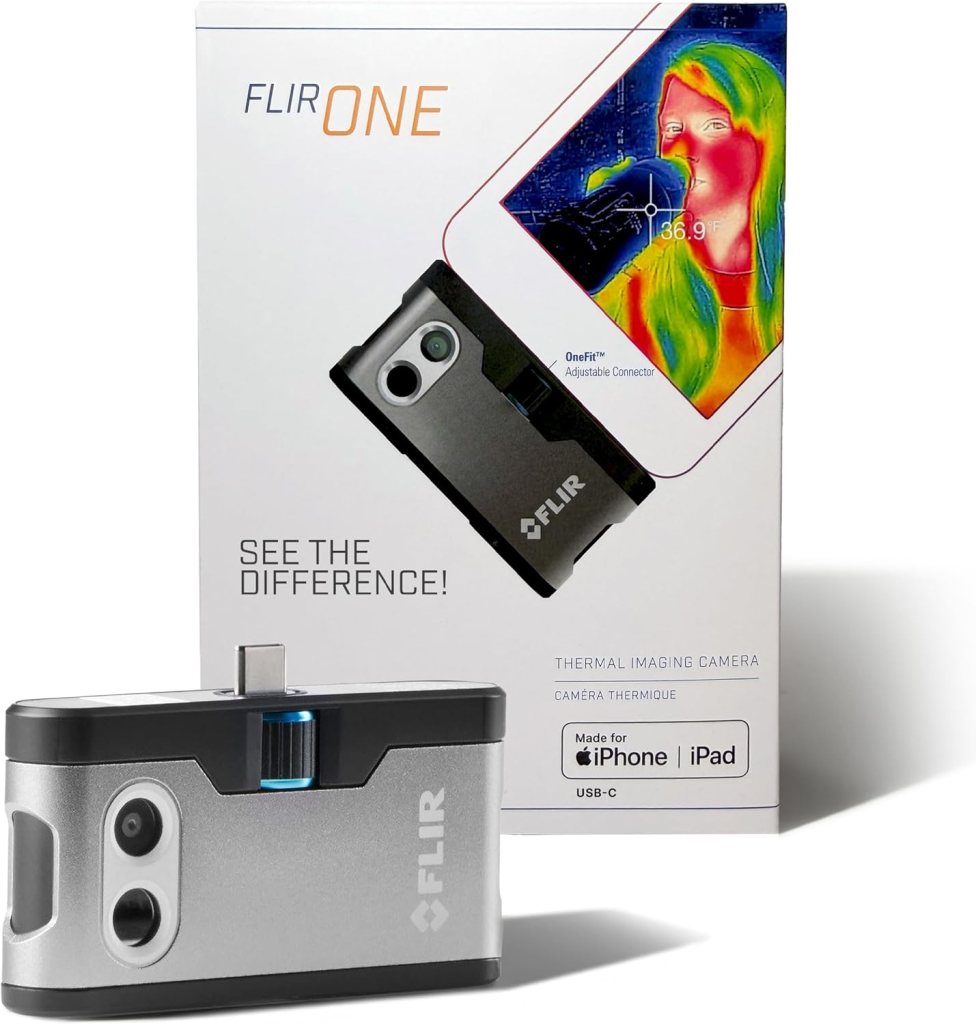
Best Simple Starter Pick
FLIR still has something many competitors do not: a workflow people already understand. The FLIR ONE for iPhone gives you a 160 x 120 native thermal sensor with 320 x 240 enhanced output, plus FLIR’s MSX image enhancement. That overlay trick is still useful. It adds visual edge detail to the thermal image so the scene makes more sense at a glance.
This is the one I would hand to someone who wants a straightforward infrared camera for iphone without getting dragged into spec-forum rabbit holes. It is approachable. It is recognizable. It works.
Why I like it
MSX is not magic, but it helps. Especially indoors. You see the shape of the outlet, trim, pipe path, or appliance edge more clearly.
Also, FLIR’s ecosystem is mature. That counts.
Pros
- Easy learning curve
- FLIR app and image processing are familiar for a reason
- MSX makes scenes easier to interpret
- Good pick for home problem-solving and casual diagnostic use
Cons
- Lower native resolution than the best options here
- Not the strongest pick for fine detail or advanced close work
Review summary
If you want something simple and proven, this is still a smart buy. It does not win on raw sensor numbers. It wins on usability.
Real Testimonial
The FLIR ONE is the easiest product here to like if you want a simple, familiar thermal camera for iPhone. It does not lead on raw resolution, but the app experience and FLIR’s MSX image enhancement make it easy to interpret what you’re seeing. It is a solid pick for casual home use and everyday diagnostics if clarity and simplicity matter more to you than squeezing out every last bit of detail.
2. TOPDON TC002C Duo
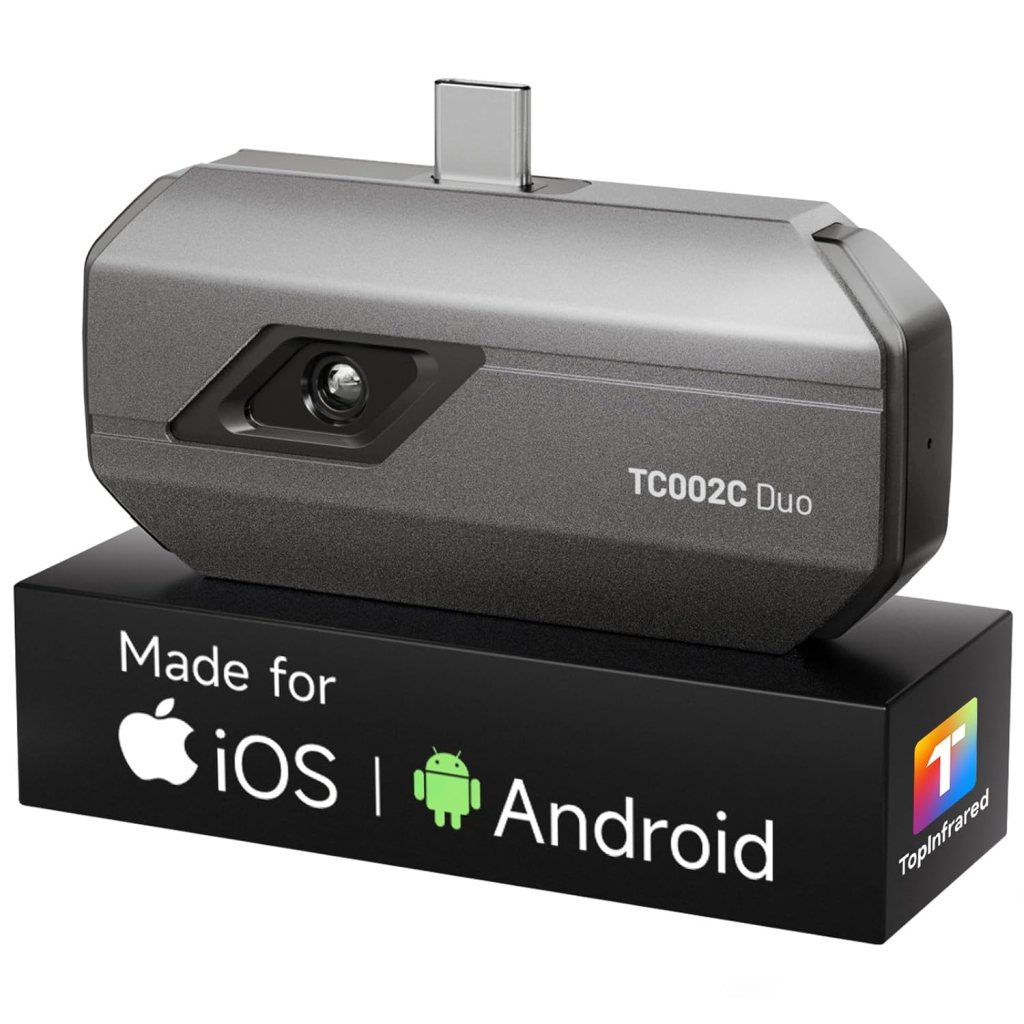
Best for Everyday Diagnostics
TOPDON’s TC002C Duo is one of those products that makes life hard for older legacy brands. It offers 256 x 192 native resolution, 512 x 384 enhanced output, 25 Hz refresh, and a temperature range up to 550°C. TOPDON’s official page and current Amazon listings both frame it as an iPhone-compatible USB-C tool for insulation inspection, circuit analysis, building checks, and general troubleshooting.
This is a very practical iPhone thermal camera attachment. Not flashy. Just capable.
Why I like it
The value here is not just price. It is competence. The spec sheet is strong enough that you do not feel like you settled. For routine building scans, auto checks, panel work, and HVAC, it makes sense.
It also feels like a product from a company trying to win, which I tend to like.
Pros
- Strong native resolution
- Enhanced 512 x 384 output improves image readability
- 25 Hz refresh feels smoother than low-frame alternatives
- Broad use case from buildings to vehicles
Cons
- Brand reputation is growing, but not as established as FLIR
- App polish may matter if you are picky
Review summary
For people who want a capable best iphone thermal camera without paying mainly for brand history, the TC002C Duo is easy to take seriously.
Real Testimonial
The TOPDON TC002C Duo is a very practical choice for people who want strong performance without paying mainly for legacy brand recognition. It offers the kind of detail and usability that make it feel serious for building checks, electrical work, HVAC, and vehicle diagnostics. This is the model I’d point to if you want a capable all-rounder that quietly does a lot right.
3. InfiRay P2 Pro

Best for Macro Work and Tight Close-Ups
The InfiRay P2 Pro is different. It is tiny, light, and weirdly serious. Official specs list a 256 x 192 sensor, up to 25 Hz refresh, NETD under 40 mK, and a temperature range from about -20°C to 550°C. The iPhone-ready versions on Amazon also include the macro angle in the product positioning, and that is the whole point. This is the one for electronics, tiny hotspots, and close-range inspection where other phone thermal cameras get vague fast.
I would not make this my first recommendation for a home inspector scanning whole rooms. I would absolutely recommend it for a technician staring at boards and connectors.
Why I like it
The macro lens changes the conversation. It lets this little camera do work most compact phone attachments simply cannot do well.
Also, the size is ridiculous in a good way. It disappears in a pocket.
Pros
- Excellent for PCB work and close thermal detail
- 256 x 192 sensor is genuinely useful
- Extremely compact
- Strong sensitivity for spotting small differences
Cons
- More specialized than the broader home-inspection style picks
- Not the best first choice for large-area scanning
Review summary
If your idea of thermal imaging involves circuit boards, connectors, battery packs, or tiny components, this is the standout.
Real Testimonial
The InfiRay P2 Pro is the specialist pick. It stands out because it is unusually good at close-up thermal work, especially on electronics, connectors, and small components where broader consumer models start to fall apart. I would not make it the first choice for scanning entire rooms, but for bench work and tight technical inspections, it is the most interesting camera in the lineup.
4. FLIR ONE Edge Pro

Best Wireless Option
The FLIR ONE Edge Pro earns its place because wireless is not a gimmick here. FLIR’s official specs list 160 x 120 native resolution, 480 x 360 super resolution, a wide 54° field of view, and a design that can clip to a phone or work separated from it. The whole point is flexibility. You can hold the camera where the phone cannot comfortably go.
That matters under sinks, around hot equipment, inside cramped mechanical areas, and anywhere your wrist starts negotiating with reality.
5. HIKMICRO Mini2Plus V2
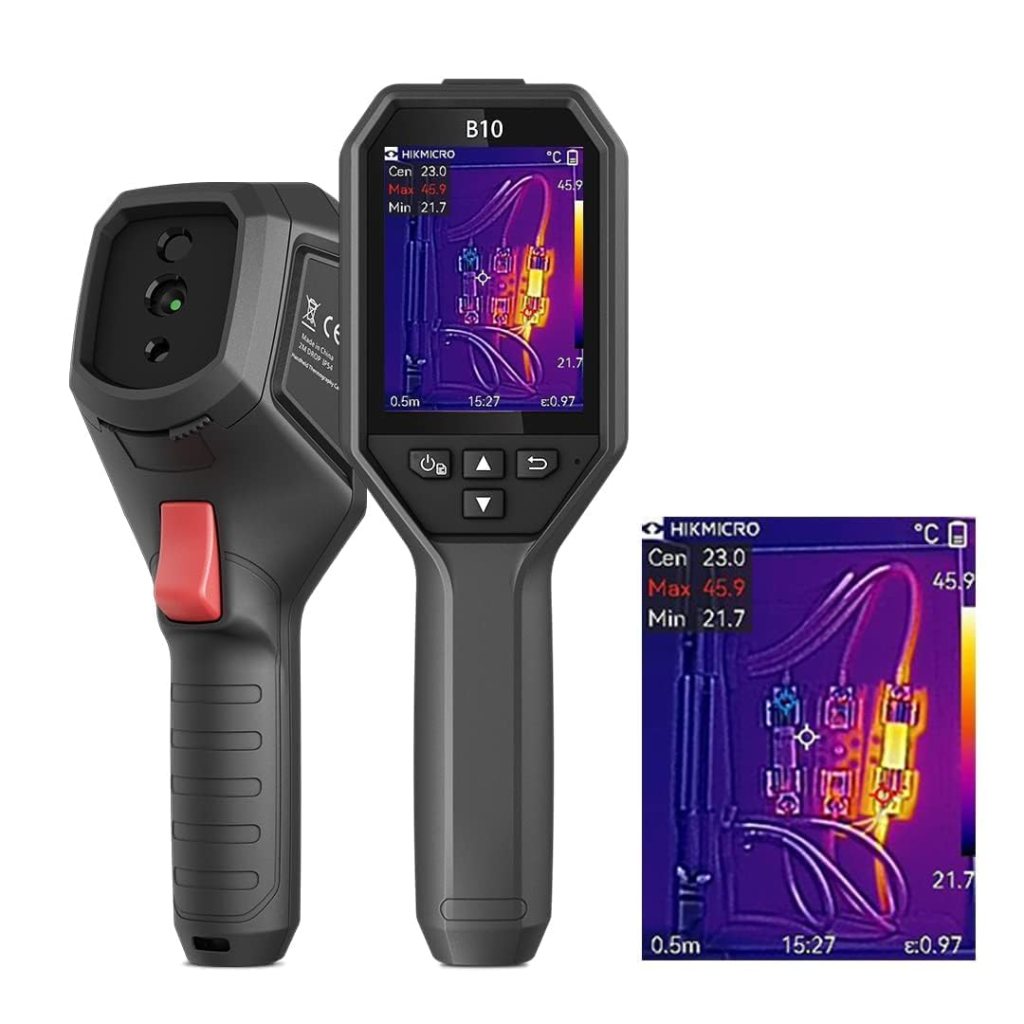
Best Overall
The HIKMICRO Mini2Plus V2 is the one I would buy first. It hits the sweet spot. You get a 256 x 192 sensor, enhanced output up to 512 x 384, manual focus, 25 Hz refresh, and a design that works with iPhone via USB-C or Lightning support depending on the kit. HIKMICRO positions it as a phone attachment for leak checks, insulation issues, electrical work, and close inspection, which is exactly the mix most people actually care about.
What makes it the best overall is not one flashy trick. It is the fact that it does not paint you into a corner. You can scan walls, check pipes, look at panels, and still get tighter detail than the usual entry-level phone thermal camera.
Why I like it
Manual focus matters more than people think. It gives this camera real range. A lot of phone thermal units are fine until you need precision. Then they go soft. This one holds up better.
The other thing is balance. It feels like a tool, not a toy with a thermal filter.
Pros
- Manual focus gives it more flexibility than most clip-on phone units
- 256 x 192 native resolution is still a strong place to start
- Enhanced 512 x 384 output helps for readability
- Good fit for home, electrical, HVAC, and general diagnostic work
Cons
- Wired attachment is practical, but not elegant
- App experience is decent rather than memorable
Review summary
This is the best thermal imaging camera for iphone for most readers. Not because it wins every category, but because it has the fewest obvious weaknesses.
Real Testimonial
The HIKMICRO Mini2Plus V2 is the best all-around pick in the group. It feels like a real diagnostic tool instead of a novelty add-on, and the manual focus gives it a clear advantage when you move between broader scans and more precise inspection work. This is the one I’d recommend to most people because it handles home, HVAC, electrical, and general troubleshooting without feeling limited.
Why I like it
Wireless thermal cameras make more sense than they first appear to. Not all the time. But when they do, they really do.
FLIR also leans on MSX and VividIR here, which helps compensate for the lower native sensor resolution.
Pros
- Wireless use is genuinely useful in awkward spaces
- Works clipped-on or detached
- Wide field of view helps with room and wall scanning
- Good if you already like FLIR’s imaging approach
Cons
- Lower native resolution than the strongest wired competitors
- More expensive than a simple plug-in option
Review summary
This is the best pick if cable-free flexibility is the reason you are shopping in the first place.
Real Testimonial
The FLIR ONE Edge Pro earns its spot by solving a real problem: sometimes you do not want the camera physically attached to the phone. Its wireless design makes awkward inspections much easier, especially around mechanical equipment, tight corners, or hot surfaces. It is not the strongest option on pure native resolution, but it is the smartest pick if flexibility and positioning matter more than anything else.
Which one should you buy?
Buy the HIKMICRO Mini2Plus V2 if you want one answer and do not want to think about it again.
Buy the FLIR ONE if you want a simpler entry point and like FLIR’s visual style.
Buy the TOPDON TC002C Duo if you want a very capable all-rounder that feels practical rather than precious.
Buy the InfiRay P2 Pro if you do close technical work and want a camera that is unusually good at it.
Buy the FLIR ONE Edge Pro if you know you will benefit from wireless positioning.
What actually matters in an iPhone thermal camera
Native resolution matters. The enhanced number is nice, but the sensor tells the real story.
Macro capability matters if you work on electronics. More than brand prestige, honestly.
App quality matters because you will use it every time. Bad interface design makes a tool feel worse than it is.
Connection type matters less than people think until it matters a lot. Wired is simpler. Wireless is better when the angle is bad or access is awkward.
One more thing. Thermal cameras read surface temperature. They do not grant x-ray vision, and shiny materials can mislead the reading. FLIR’s explanation of emissivity is worth knowing because it explains why some surfaces lie more than others.
FAQ
What is the best thermal camera for iPhone right now?
For most people, it is the HIKMICRO Mini2Plus V2. It has the best overall mix of resolution, flexibility, and real diagnostic usefulness.
Do thermal cameras for iPhone actually work?
Yes, if you buy a real one. They are useful for spotting heat patterns, insulation gaps, overheating components, moisture clues, and airflow issues. The Department of Energy specifically notes thermography as a way to identify thermal defects and air leakage in buildings.
Can an iPhone thermal camera detect water leaks?
It can help reveal moisture patterns or temperature differences caused by leaks, especially behind drywall or under flooring. It does not literally see water. It shows temperature contrast.
Which iPhone thermal camera is best for home inspections?
The HIKMICRO Mini2Plus V2 and TOPDON TC002C Duo make the most sense here. Both have stronger native resolution than the basic FLIR ONE class and are better suited to broad scanning.
Is FLIR still the best option for iPhone users?
Not automatically. FLIR still makes very good products, and its app experience and MSX processing remain strong. But on pure native thermal resolution, some newer rivals now look better on paper and in practice.
What is the difference between FLIR ONE and FLIR ONE Edge Pro?
The basic FLIR ONE is a wired phone attachment. The Edge Pro can work wirelessly and can be used detached from the phone, which is much better for awkward inspections. The Edge Pro also offers 480 x 360 super resolution.
Is higher thermal resolution worth it?
Usually, yes. Especially if you want clearer edges, better scene interpretation, and more confidence in small hotspots.
Do thermal cameras for iPhone work for electrical inspections?
Yes. They are very useful for spotting hot breakers, loose connections, overloaded circuits, and abnormal heat on panels or components.
Can a thermal camera see through walls?
No. It reads surface temperature. It can suggest what is happening behind a wall by showing temperature patterns, but it does not see through the wall itself.
Can a thermal camera find insulation problems?
Yes. That is one of the most common and legitimate uses. DOE specifically points to thermographic inspection as a way to identify missing insulation and air leakage.
Which iPhone thermal camera is best for HVAC work?
The HIKMICRO Mini2Plus V2 and TOPDON TC002C Duo are the safest bets. They balance scanning ability with enough detail for ducts, vents, registers, and equipment.
Do I need a wireless thermal camera?
Probably not. Wired is simpler and usually cheaper. Wireless becomes worth it if you work in cramped spaces, around heat, or in positions where holding the phone and camera together is awkward.
Are thermal cameras useful for hunting or wildlife spotting?
They can be, but most phone thermal cameras are really better for inspection work than serious outdoor scanning at distance. A dedicated handheld thermal monocular is usually stronger for that job.
What does macro mode do on a thermal camera?
It lets the camera focus on very small subjects at close distance. That matters for electronics, tiny connectors, and PCB diagnostics. The InfiRay P2 Pro is the standout here.
Will these work with USB-C iPhones?
The current iPhone-ready models listed above are sold in USB-C compatible versions, and several brands explicitly market them for newer iPhone models.
How accurate are these cameras?
They are useful diagnostic tools, not laboratory instruments. Many quote accuracy around ±2°C or ±2%, depending on the model and conditions. Surface properties and emissivity still matter.
Final take
If I were buying one today, I would start with the HIKMICRO Mini2Plus V2 and stop there unless I had a specific reason not to. It is the least compromised option in the group.
The InfiRay P2 Pro is the clever specialist. The FLIR ONE is the easy on-ramp. The Edge Pro is the one for awkward spaces. The TOPDON sits in the middle and does a lot right.
The one thing I would not do is shop by color palette or by the biggest enhanced-resolution number on the box. Learn what native resolution, focus, and emissivity actually mean, and the buying decision gets simpler fast.
FLIR’s explanation of emissivity is a good last read if you want better results from whichever camera you end up buying.
Affiliate Disclaimer
This article contains affiliate links. We may earn a small commission if you purchase through these links, at no extra cost to you.




Leave a Reply