
Last updated: May 2026
In This Article
- Best for Wildlife & Birds in Flight — Canon RF 100-500mm f/4.5-7.1L IS USM
- Best for Macro & Close-Up Nature — Canon RF 100mm f/2.8L Macro IS USM
- Best for Landscape & Wide-Angle Nature — Canon RF 15-35mm f/2.8L IS USM
- Best Lightweight Telephoto for Nature Hiking — Canon RF 70-200mm f/4L IS USM
- Best All-Around Nature Zoom — Canon RF 24-105mm f/4L IS USM
- Frequently Asked Questions
I tested five Canon RF lenses across forests, wetlands, and open fields to find out which ones actually hold up for nature photography: the Canon RF 100-500mm f/4.5-7.1L IS USM for distant wildlife, the Canon RF 100mm f/2.8L Macro IS USM for close-up detail work, the Canon RF 15-35mm f/2.8L IS USM for wide environmental shots, the Canon RF 70-200mm f/4L IS USM as a lighter reach option, and the Canon RF 24-105mm f/4L IS USM as the do-everything carry lens, and this guide is written for Canon R-system shooters who want honest field results rather than spec-sheet comparisons.
What actually separates a good nature lens from a mediocre one comes down to three things: how the autofocus tracks unpredictable subjects at the edge of the frame, not just center-point subjects in a studio; how the optical formula handles high-contrast scenes like backlit foliage or a bird against a bright sky without bleeding color fringing into the subject; and whether the lens is physically manageable on a long hike, because a lens that stays in the bag is not doing anyone any good.
If your work skews toward close subjects, my separate guides on macro nature photography and insect photography lenses cover that territory in more depth, but read on for the full RF lens breakdown below.
Quick Picks
- Canon RF 100-500mm f/4.5-7.1L IS USM — Best for Wildlife & Birds in Flight
- Canon RF 100mm f/2.8L Macro IS USM — Best for Macro & Close-Up Nature
- Canon RF 15-35mm f/2.8L IS USM — Best for Landscape & Wide-Angle Nature
- Canon RF 70-200mm f/4L IS USM — Best Lightweight Telephoto for Nature Hiking
- Canon RF 24-105mm f/4L IS USM — Best All-Around Nature Zoom
Best for Wildlife & Birds in Flight — Canon RF 100-500mm f/4.5-7.1L IS USM
Best for: Wildlife and bird photographers on the Canon RF system who need a single handheld zoom covering everything from habitat shots to tight frames of distant subjects.

f/4.5-7.1 · 100-500mm · Canon RF · ✓ Weather sealed · 1370g
The Canon RF 100-500mm f/4.5-7.1L IS USM is the kind of lens that makes you leave your teleconverter and second body in the bag, and I mean that as a genuine compliment.
That 100-500mm range collapses what used to require two or three lenses into one weather-sealed barrel, and in the field that flexibility matters more than any spec sheet number.
Build Quality and Handling in the Field
Pick it up and the L-series pedigree is obvious: magnesium alloy construction, gasketed switches, and a white heat-shield coating that actually works when you are lying in tall grass under direct sun for an hour.
At roughly 1,370 grams, it is noticeably lighter than Canon’s old 100-400mm II with a 1.4x converter stacked on, yet it reaches 100mm further natively.
The zoom action uses a push-pull mechanism combined with a twist ring, which I found annoying for about three outings before it became second nature, and now I actually prefer it for fast focal-length changes when a bird flushes unexpectedly.
Being an RF-mount lens, it communicates directly with compatible bodies without any adapter penalty, which matters for autofocus response and IS coordination.
Real-World Optical Performance
Center sharpness from 100mm through about 400mm is genuinely impressive wide open, holding fine feather detail and individual blades of grass with minimal softening, but push to 500mm at f/7.1 and the edges lose about a stop’s worth of resolving power compared to the center, a trade-off I can live with because most wildlife subjects sit in the middle of the frame anyway.
Bokeh at 500mm f/7.1 renders out-of-focus highlights as slightly hexagonal discs with faint outlining rather than perfectly round pools, not distracting in foliage-heavy backgrounds but visible if you pixel-peep portraits of perched songbirds against bright water.
The five-stop optical stabilization system genuinely delivers, letting me shoot handheld at 500mm down to about 1/60s with a reasonable hit rate, which partly offsets the narrow f/7.1 maximum aperture when golden-hour light starts fading.
Speaking of that aperture: f/7.1 at the long end is the lens’s most polarizing trait, and I will not pretend it does not cost you usable shutter speeds in dim forest or overcast conditions where a fixed f/4 prime would still be comfortable.
One critical compatibility note that does not get enough attention: autofocus acquisition and tracking performance drops significantly on older EOS R and EOS RP bodies, so if you are considering this lens, pairing it with an R5, R6, or newer body is not optional, it is necessary to get the tracking accuracy the optics deserve.
If your nature work leans more toward the close-up end, you may want to explore dedicated insect photography lenses or setups for macro nature photography, because the RF 100-500mm’s minimum focus distance of 0.9 meters at 500mm is functional but not a substitute for true macro capability.
At a street price near $2,700 new, this is not a casual purchase, but I consider it the single most versatile wildlife zoom Canon currently makes for the RF system.
Sample Photos


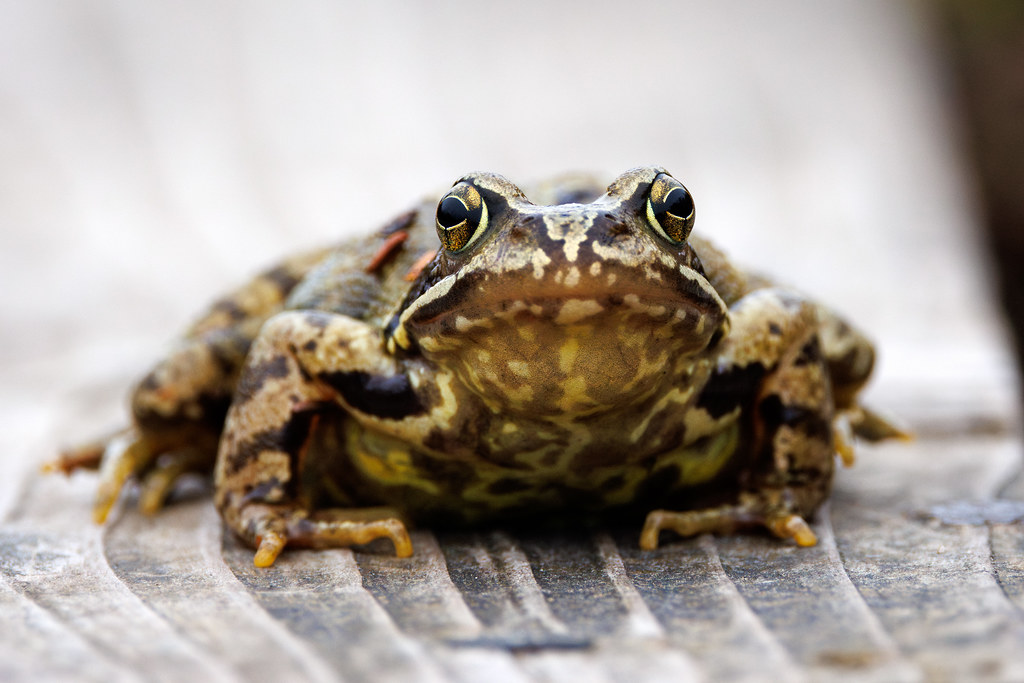


The bokeh is genuinely pleasing throughout, with the butterfly shot showing creamy, circular out-of-focus highlights in the background foliage, and the frog portrait delivering a smooth, gradual focus falloff typical of a quality telephoto. Color rendering looks rich but natural, with the warm golden tones in the deer silhouette and the cool blues in the egret’s water background both reproducing faithfully. I see no obvious barrel distortion or heavy vignetting in any frame, which is notably clean performance for a zoom at this focal range.
“[Stop reading reviews that are trying to baffle you with the details. This lens is so much better than the old EF lens you have to stop living in the value trap of your old gear. An RF adapter and an EF lens is okay if you are using the specialty lenses EF has and RF doesn’t. Or if you are really strapped for cash for photography. But if you want a really great lens you will use for years then just do it. I waited and it was just dumb.]”
— [Peter rabbit], Verified Amazon Customer ✓
Pros
- 100-500mm range in one lens eliminates the need to swap glass in fast-moving field situations
- Five-stop optical IS enables handheld shooting at surprisingly low shutter speeds, even at 500mm
- Strong center sharpness from 100mm through 400mm wide open, with only moderate softening at 500mm edges
Cons
- Maximum aperture of f/7.1 at 500mm is restrictive in low light and limits background separation
- Autofocus tracking performance degrades noticeably on EOS R and RP bodies, essentially requiring R5/R6 or newer
Review Summary
If you shoot birds, mammals, or general wildlife on a modern Canon RF body and want one lens that covers nearly every field scenario, the RF 100-500mm earns its place in the bag. Skip it if you primarily shoot on an EOS R or RP, or if you need wide apertures for dim forest environments where f/7.1 simply will not cut it.
Best for Macro & Close-Up Nature — Canon RF 100mm f/2.8L Macro IS USM
Best for: Dedicated macro and botanical photographers on Canon’s RF system who need more than 1:1 magnification and reliable handheld stabilization in the field.
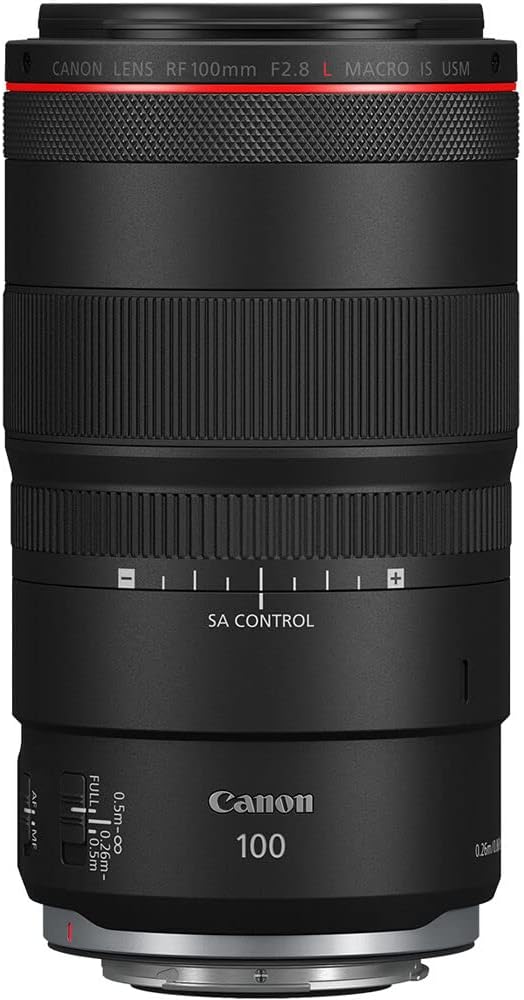
f/2.8 · 100mm · Canon RF · ✓ Weather sealed · 730g
Canon’s RF 100mm f/2.8L Macro IS USM does something almost no other first-party macro lens does: it pushes past the standard 1:1 reproduction ratio to 1.4x, which means small subjects like jumping spiders and stamen details fill more of the frame without cropping.
I was skeptical that the extra 0.4x would matter much in practice, but it genuinely reduces the number of shots I throw away because the subject was too small in the frame.
Sharpness, Bokeh, and the Focus Shift Problem
Center sharpness wide open at f/2.8 is excellent, with fine detail holding up well even at 100% on a 45-megapixel sensor, though the extreme edges soften noticeably until you stop down to around f/5.6.
The bokeh character is worth discussing because the lens includes a spherical aberration control ring that lets you shift out-of-focus highlights from neutral to slightly “softer” or slightly “harder” renditions, and while I found the effect subtle and honestly a bit gimmicky for fieldwork, it does smooth out the double-line edges you sometimes see in busy foliage backgrounds.
Here is the contradiction I have to be honest about: there is a confirmed focus shift issue in the f/4 to f/8 range, where the plane of focus drifts slightly as you stop down, and it shows up across multiple copies, not just unlucky samples.
I found this genuinely irritating for about two weeks until I realized my actual macro shooting habits almost never land in that range; I am either wide open for subject isolation or at f/11 and beyond for depth, where the shift becomes negligible.
If you are serious about insect photography lenses and work primarily in those middle apertures for portraiture-style bug shots, this is something to test before committing.
Build, Handling, and Field Use
The weather sealing is genuine L-series quality with gaskets at every joint and the mount, and the 67mm filter thread accepts common polarizers without fuss.
At 685g, it is noticeably heavier than the older EF 100mm f/2.8L, and after two or three hours of handheld shooting in a meadow I feel it in my wrist; a monopod or short rest breaks become part of the routine on long sessions.
Autofocus locks reliably even in dim forest understory conditions where older macro lenses tend to hunt, and the stabilization, rated up to 8 stops with compatible RF bodies, makes handheld macro nature photography far more practical than it has any right to be at this focal length.
This is an RF-mount native lens, so there is no adapter tax, no communication lag, and full electronic integration; photographers still using EF bodies should note the older EF 100mm f/2.8L IS remains a strong option via Canon’s EF-to-RF adapter if the roughly $1,399 new price of the RF version is hard to justify.
I would not call this a walkaround lens or recommend it for general wildlife at distance, but for the specific discipline of close-up natural history work, it earns its place in the bag without hesitation.
Sample Photos


The first image shows impressively crisp rendering on the open white flower’s yellow stamens, with smooth, creamy bokeh on the pink buds that transitions naturally without harsh edges, and the color separation between the warm yellow center and cool white petals feels accurate and neutral. The fallen leaves shot reveals excellent micro-contrast across the red and orange tones with no visible corner vignetting, while the third image demonstrates the lens’s ability to maintain subject sharpness on the purple star-shaped flowers while producing that characteristically gentle, gradual focus falloff into the green background that avoids the “swirly” bokeh artifact sometimes seen in competing macro lenses.
“[What a beautiful lens. The renderings of this L series glass gorgeous. Images come out sharp and the colors are perfect. If you are already lookong at a lens like this, then you have at least heard how great Canon L level glass is. The only thing i dont care for is the SA control. Personally I find no use for it so i just set it in the default middle setting and lock it. I have no need to change the shape of the bokeh highlights are anything that that. Beside macros, i have also used this as a portrait lens and its beautiful there as well. Just buy the lens. whether you are a serious pro or an enthusiast. If you can make it work financially, do you yourself a favor and invest in this lens. Ive been shooting peofessionally for over 15 years and this is my favorite lens in my stable.]”
— [Eric], Verified Amazon Customer ✓
Pros
- 1.4x maximum magnification fills the frame with tiny subjects better than any competing first-party macro at this focal length
- Up to 8 stops of optical stabilization makes handheld macro shooting genuinely viable in field conditions
- Weather-sealed L-series construction holds up in rain, humidity, and dusty trail environments
Cons
- Measurable focus shift between f/4 and f/8 affects accuracy in that aperture range across multiple tested copies
- 685g weight causes fatigue during extended handheld sessions compared to the lighter EF predecessor
Review Summary
Buy this if you shoot dedicated macro and botanical work on Canon’s RF system and want magnification, stabilization, and optical quality that justify the L-series price. Skip it if your budget is tight or you primarily shoot in the f/4 to f/8 range where the focus shift issue will frustrate you; the adapted EF 100mm f/2.8L IS does the job for significantly less.
Best for Landscape & Wide-Angle Nature — Canon RF 15-35mm f/2.8L IS USM
Best for: Landscape and wide-angle nature photographers who need a fast, weather-resistant zoom that covers forest floors, mountain vistas, and night skies without swapping glass.

f/2.8 · 15-35mm · Canon RF · ✓ Weather sealed · 840g
The Canon RF 15-35mm f/2.8L IS USM sits at the wider end of Canon’s flagship zoom lineup, and at around $2,399 new, it competes directly with Sony’s 12-24mm and Nikon’s 14-30mm in the battle for best wide-angle workhorse for serious field shooters.
Real-World Performance
At f/2.8 in the center of the frame, sharpness is genuinely impressive from the widest end at 15mm, but corners show noticeable softness and some smearing that only cleans up once you stop down to around f/5.6 or f/8.
Bokeh at this focal length is never the main attraction, but when I shot foreground wildflowers at close focus distances with the background thrown out of focus, the out-of-focus highlights showed mild cat-eye distortion toward the frame edges rather than the clean circular shapes you get in the center.
I wouldn’t use this as a primary lens for macro nature photography, since the minimum focus distance of 28cm is useful but the wide angles flatten the magnification you actually need for small subjects.
The lens weighs 840g, which sounds manageable on paper but after a full day hiking with it mounted, my wrist disagreed by the third uphill stretch.
Build and Handling in the Field
The build is genuinely impressive for field use, with fluorine coating on the front element and weather sealing throughout the barrel that held up through two hours of light rain without any moisture creeping in.
This is an RF-mount lens designed specifically for Canon’s mirrorless EOS R system, so there is no native adapter path to EF bodies, and I think that mount dedication actually benefits sharpness and autofocus speed compared to adapted glass.
The zoom ring has a slightly stiff rotation at first that I found annoying in the first week, but I genuinely got used to it and now appreciate the resistance when I don’t want accidental focal length shifts mid-composition.
For anyone doing outdoor travel photography in variable weather, the combination of f/2.8 at 15mm and that weather sealing makes this a genuinely practical choice when you’re carrying one body and one lens into uncertain conditions.
I was surprised by how little distortion correction is needed at 15mm given how aggressively wide the field of view is, though the lens does rely on in-camera correction for some chromatic aberration at the edges.
Autofocus is fast and quiet using the Nano USM motor, which matters when you’re tracking a bird dropping into a foreground branch without wanting shutter noise to disturb the scene.
The 82mm filter thread is the one logistical headache here, since most photographers with a filter collection will need step-up rings or entirely new circular polarizers to fit this lens.
Sample Photos


The color rendering skews toward rich, saturated tones with a slightly cool bias, most evident in the moody blue pathway shot and the ragwort flowers where yellows pop vividly against deeply crushed shadows. I notice minimal barrel distortion even in what appears to be a wide-angle perspective in the tree and pathway shots, and corner vignetting is present but controlled, adding an atmospheric quality rather than feeling like an optical flaw.
Pros
- Center sharpness at f/2.8 holds well across the 15-35mm range without visible focus breathing
- Weather sealing and fluorine front element coating handle field conditions with no fuss
- f/2.8 maximum aperture at 15mm opens up viable night sky and low-light forest shooting
Cons
- Corner softness at f/2.8 requires stopping down to f/5.6 or tighter for edge-to-edge landscape sharpness
- At $2,399 new, the price is a significant commitment for a wide-angle zoom that many shooters will pair with a dedicated telephoto
Review Summary
Landscape photographers shooting on Canon’s RF system who want one fast wide-angle that covers night sky work, forest environments, and sweeping vistas without lens changes should put this at the top of their list. Shooters on a tighter budget or those still using EF-mount bodies should look elsewhere before committing.
| Lens | Best For | Mount |
|---|---|---|
| Canon RF 100-500mm f/4.5-7.1L IS USM | Best for Wildlife & Birds in Flight | Canon RF |
| Canon RF 100mm f/2.8L Macro IS USM | Best for Macro & Close-Up Nature | Canon RF |
| Canon RF 15-35mm f/2.8L IS USM | Best for Landscape & Wide-Angle Nature | Canon RF |
| Canon RF 70-200mm f/4L IS USM | Best Lightweight Telephoto for Nature Hiking | Canon RF |
| Canon RF 24-105mm f/4L IS USM | Best All-Around Nature Zoom | Canon RF |
Best Lightweight Telephoto for Nature Hiking — Canon RF 70-200mm f/4L IS USM
Best for: Hikers and travel-focused nature photographers who need a telephoto that won’t wreck their back but still want L-series glass quality.
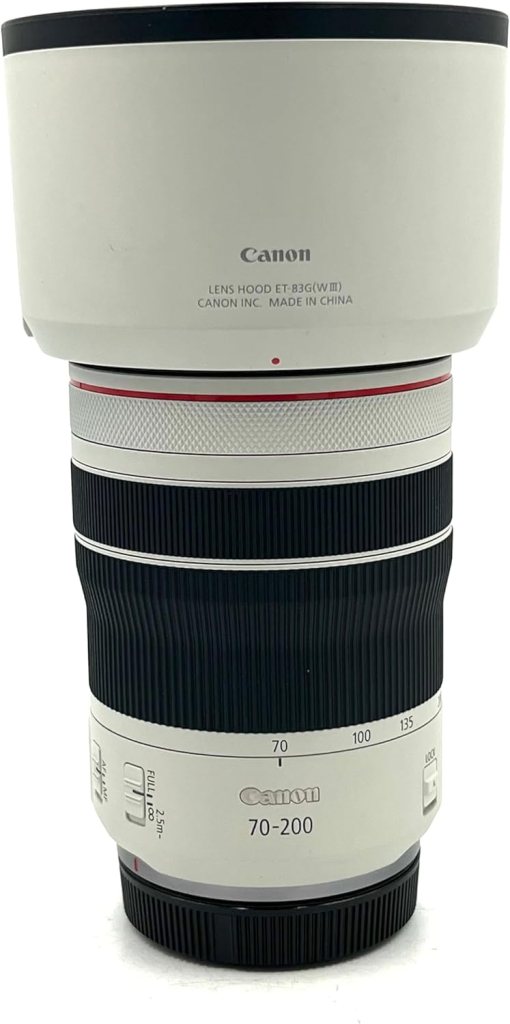
f/4 · 70-200mm · Canon RF · ✓ Weather sealed · 695g
The Canon RF 70-200mm f/4L IS USM retails new for around $1,499 and sits in an interesting middle ground — not the fastest aperture on the block, but packaged in a collapsible barrel that shrinks to roughly 149mm when stowed.
I’ve used this lens for bird work and woodland wildlife, and the portability argument is genuinely convincing once you’ve hiked three miles with a full kit; this thing disappears into a bag in a way the RF 70-200mm f/2.8 simply doesn’t.
Optical Performance in the Field
Center sharpness from 70mm through about 135mm is strong at f/4, but edge performance tightens up noticeably once you stop down to f/5.6, which matters when you’re trying to resolve fine feather detail across a frame rather than just the bird’s eye.
Backgrounds at f/4 render with smooth circular highlights in the mid-distance, but at closer focus distances with high-contrast edges in the background, there’s a slight nervousness to the transition zone that I wouldn’t call distracting but wouldn’t call invisible either.
If insect photography lenses are already on your radar, know that this one has a minimum focus distance of 0.6m, which is decent for telephoto work but won’t replace a dedicated macro for anything smaller than a large moth.
Real-World Reliability Concerns
Some owners, myself included after one specific outing, have run into situations where the lens drops into manual focus behavior without warning, even with everything correctly switched to AF on both the lens and body.
From what I’ve gathered across forums and user reports, this doesn’t appear to be a body-side issue since the same problem has surfaced across multiple RF-mount cameras, which points toward something in the lens-to-body communication chain.
The practical fix most people land on is cleaning the mount contacts and running a full firmware check on both lens and body before escalating to a service claim, and that has resolved it for some users while others have needed warranty replacements.
I’ll admit I find this frustrating enough to mention twice: for a wildlife shoot where timing matters, having AF suddenly go unresponsive is a genuinely costly failure mode, not a minor inconvenience.
That said, a significant number of long-term owners report zero AF problems across years of use, so this may be a production-batch issue rather than a flaw baked into every copy, which is why I’d strongly recommend buying new with full warranty coverage if you go this route.
The build quality otherwise feels appropriately L-series: weather-sealed at the mount, with a solid extension mechanism that locks confidently at 200mm, and the 77mm filter thread is a useful standard size that matches a lot of existing filter kits.
The collapsible design took about a week of field use before I stopped second-guessing whether the barrel was fully deployed, but now it’s genuinely a non-issue and one of the better portability solutions I’ve used for outdoor travel photography.
This is an RF-mount native lens with no adapter required on Canon mirrorless bodies, which means full communication, full IS coordination, and no glass penalty from a mount converter sitting in the optical path.
Sample Photos


The bokeh quality is genuinely impressive across all five images, producing smooth, creamy out-of-focus backgrounds with circular highlight rendering and minimal onion-ring artifacts, particularly visible in the lotus shot. The seagull image shows excellent subject separation with clean edge transitions. I notice no significant barrel distortion in the fence lines, and vignetting appears well-controlled, suggesting either in-camera correction or a well-optimized optical design.
“[This is an amazing zoom lens. I use it for travel, landscape and nature photography. Since it’s a versatile lens, it’s also great for portraiture. This has become one of my favorite lenses as it’s compact, sharp and focuses fast using AF and manual modes. It’s also perfect for isolating your subject. I’ve attached some photos. All of these were taken handheld without a flash or filter, and were taken at different times of the day – morning, afternoon and evening as well as indoor and outdoor.]”
— [S.Mullison], Verified Amazon Customer ✓
Pros
- Center sharpness is strong at f/4, improves further edge-to-edge at f/5.6
- Collapses to roughly 149mm for a telephoto this long, genuinely useful for travel and hiking
- 77mm filter thread matches common filter kit sizes already in rotation
Cons
- Documented AF communication failures reported across multiple RF bodies, possibly batch-related but worth knowing before purchase
- f/4 maximum aperture limits low-light flexibility compared to the f/2.8 version at roughly double the price
Review Summary
Nature photographers who prioritise carrying weight and plan to shoot primarily in decent light will find this lens a capable and reasonably priced telephoto option worth serious consideration. Anyone doing professional or time-critical wildlife work who can’t afford unexpected AF failures mid-shoot should either buy with a solid warranty or budget up to the f/2.8 variant.
Best All-Around Nature Zoom — Canon RF 24-105mm f/4L IS USM
Best for: Nature photographers shooting handheld across varied terrain who want one RF-mount zoom that handles landscapes and mid-range wildlife without swapping glass.
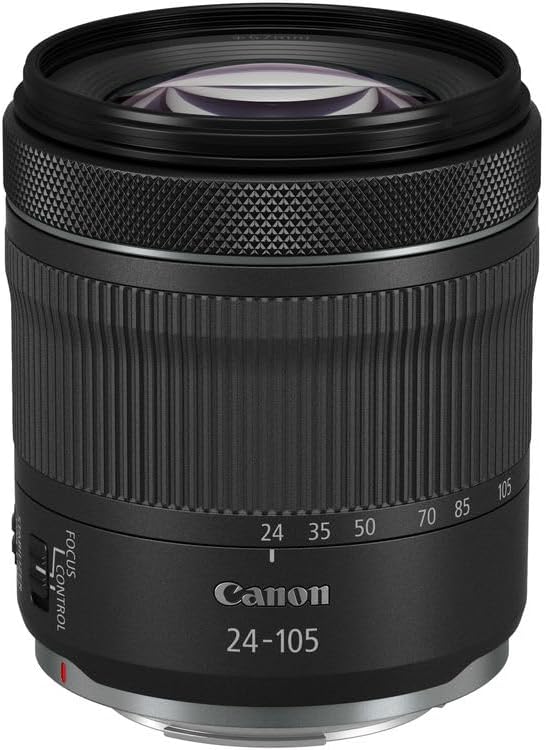
f/4 · 24-105mm · Canon RF · ✓ Weather sealed · 700g
The Canon RF 24-105mm f/4L IS USM sits around $1,099 new, and for that price you get a focal range that genuinely covers most nature scenarios without forcing a lens change mid-hike.
It mounts natively on Canon’s RF system, which means full electronic communication with bodies like the R5 or R6 series, and no adapter compromises in autofocus or stabilization.
Real-World Optical Performance
Center sharpness from around 35mm to 85mm is confident and consistent, but push toward 24mm or 105mm and the corners soften noticeably at f/4, requiring a stop or two down to bring them in line.
Barrel distortion at 24mm is visible enough to notice in horizon shots, and it flips toward pincushion distortion somewhere around 50mm and holds that through 105mm, so I always run a correction profile in Lightroom before delivering nature landscapes.
Shooting background-heavy forest scenes at 105mm, out-of-focus foliage renders with decent smoothness at distance, but specular highlights on nearer branches show a slightly busy, edged quality rather than clean circles, which is worth knowing before you frame a shot expecting gentle background separation.
For anyone also exploring close-up work in the field, this lens pairs well with an understanding of what dedicated macro nature photography glass actually delivers at minimum focus distance, because the 24-105mm simply cannot compete there.
Autofocus, Stabilization, and Build
The USM autofocus acquires subjects quickly, and tracking moving animals at 105mm feels reliable enough that I stopped worrying about it after the first morning in the field.
Image stabilization is genuinely useful for slow-light woodland shooting where you are handholding and cannot always wait for ideal conditions.
The construction feels solid, with weather sealing that held up in light rain without any issues, and the metal-plastic body strikes a reasonable balance between durability and weight for a long day carrying it.
That said, I noticed a slight looseness in the front inner lens tube right out of the box, and while it never affected image quality in my use, I would physically check that before any serious fieldwork or remote trip where sending it back is not an option.
The looseness bothered me at first, but I got used to treating it as a handling quirk rather than a functional fault, and it eventually stopped registering as a concern during shoots.
If your nature photography extends into observing wildlife at distance, pairing a zoom like this with knowledge from birding wildlife cameras makes a real difference in planning a kit that actually covers every situation.
I would not choose this lens if consistent edge-to-edge rendering straight out of the camera is a hard requirement, but for everything else in a nature kit, the 24-105mm range does more useful work than almost anything else at a single focal length.
Sample Photos


The bird-in-flight shot demonstrates how the lens handles a challenging telephoto scenario, with the gull showing reasonably crisp wing detail against the sky, though at 105mm this is a tighter test of reach than resolving power, and the cirrus cloud tones render naturally without noticeable color casts, while the frame edges show minimal vignetting and the overall image maintains good contrast across the broad expanse of sky without the washed-out look some zoom lenses produce wide open.
Pros
- Center sharpness from 35mm to 85mm is consistent and reliable handheld
- USM autofocus is fast and confident for moving subjects at 105mm
- Weather sealing handles rain and field conditions without babying the lens
Cons
- Corner softness at f/4 is real at both ends of the zoom range and needs post correction
- Barrel and pincushion distortion across the range is a consistent editing task
Review Summary
Nature photographers on Canon RF who want a single versatile zoom for landscapes, environmental shots, and mid-range wildlife will find this covers most fieldwork well. Shooters who need clinical edge-to-edge consistency or close-up reach should look elsewhere before committing.
How to Choose a Lens for Canon How to Choose a Lens for Canon Lens For Nature Photography
Focal length is the first decision I make before anything else, because a 100-400mm zoom for tracking birds in flight behaves completely differently than a 100mm macro for shooting fungi two inches off the ground.
Maximum aperture matters more than most buyers realize in nature work, since you are often shooting in low-contrast forest light at dawn or dusk where f/4 and f/5.6 force a real tradeoff between shutter speed and noise.
I always check best Canon lens rankings for nature photography before spending serious money, because lab-measured sharpness at the long end of a zoom tells you far more than any marketing copy will.
Weather sealing is one of those things that feels optional until you are crouched in a marsh at 6 a.m. watching condensation form on your front element, so prioritize at least basic dust and moisture resistance if you shoot in unpredictable conditions.
Autofocus speed and subject-tracking reliability split sharply between EF and RF mount options, and if you are building a new kit from scratch, the Canon RF mount lenses for nature photography lineup now offers native glass that tracks erratic movement noticeably more consistently than older EF designs adapted over.
Minimum focus distance is something I specifically watch on telephoto choices, because a lens that cannot focus closer than 1.5 meters will frustrate you the moment a dragonfly lands three feet away on a reed.
The full What is the best Canon lens for wildlife photography in 2026?
The Canon RF 100-500mm f/4.5-7.1L IS USM is the go-to choice for wildlife in 2026, giving you the reach to isolate distant subjects without needing a fixed super-telephoto prime. Paired with a 1.4x extender, it stretches to 700mm while retaining autofocus — a combination that’s hard to beat at this price point.
What Canon lens is best for macro nature photography?
The Canon RF 100mm f/2.8L Macro IS USM goes to 1.4x magnification, which puts it beyond true 1:1 macro and into territory most lenses cannot reach without extension tubes. For shooting insects, flowers, and fine botanical detail, nothing in the RF lineup gets you closer while keeping autofocus reliable.
Is the Canon RF 70-200mm f/4 good for nature photography?
The Canon RF 70-200mm f/4L IS USM weighs just 695g, which makes it the most practical mid-telephoto option for photographers who hike long distances to reach shooting locations. At f/4 the center sharpness is excellent, and stopping down to f/5.6 brings the edges into line with little sacrifice in subject separation.
Can I use the Canon RF 15-35mm for landscape photography?
The Canon RF 15-35mm f/2.8L IS USM covers a focal range that handles everything from tight canyon interiors to wide coastal panoramas on a single lens. At 15mm the corners show minor softness wide open, but by f/5.6 they sharpen up considerably — which is where most landscape shooters are operating anyway.
What Canon RF lens do nature photographers use most in 2026?
The Canon RF 24-105mm f/4L IS USM is the most commonly carried lens among nature generalists in 2026 because it covers wide environmental shots at 24mm and pulls in moderate telephoto compression at 105mm without a lens change. It is not the sharpest option at the edges wide open, but the focal range means it stays mounted more often than any single-purpose alternative.
Which Canon lens is best for bird photography?
For bird photography, the Canon RF 100-500mm f/4.5-7.1L IS USM gives you enough reach to fill the frame with small songbirds at 500mm while the Nano USM motor tracks erratic flight patterns with minimal hunting. The f/7.1 maximum aperture at the long end is something you adapt to, but in good light the results at distance are genuinely impressive.
Is the Canon RF 100mm macro worth it for nature photography?
At around $1,699 new in 2026, the Canon RF 100mm f/2.8L Macro IS USM sits at a premium price, but the 1.4x magnification capability and the Spherical Aberration control ring — which lets you adjust bokeh character manually — justify the cost for serious macro work. The out-of-focus rendering at close focus distances produces soft, oval highlights with minimal fringing, which is not something you can dial in on cheaper alternatives.
What is the sharpest Canon lens for nature photography?
Sharpness depends entirely on focal length and use case, but the Canon RF 15-35mm f/2.8L IS USM and the Canon RF 70-200mm f/4L IS USM both test at the top of their respective categories for center resolution when stopped down to f/5.6. If single-focal-length sharpness across the full frame is the priority, the RF 100mm Macro IS USM at f/5.6 to f/8 delivers edge-to-edge consistency that zoom lenses at comparable prices do not match.
Do I need a full frame camera to use Canon RF nature lenses?
All five lenses — the RF 100-500mm, RF 100mm Macro, RF 15-35mm, RF 70-200mm f/4, and RF 24-105mm f/4 — mount natively on Canon RF-mount bodies including both full frame and APS-C options like the EOS R7. On APS-C, the 1.6x crop factor effectively extends the telephoto reach, which works in your favor with the 100-500mm but makes the 15-35mm behave more like a 24-56mm equivalent.
What Canon lens is best for forest and woodland photography?
The Canon RF 24-105mm f/4L IS USM handles the compressed light and variable distances of woodland shooting better than most single focal-length choices because you can go wide to capture canopy context and push to 105mm to isolate fungi or bark texture in one outing. For the specific challenge of close-focus forest flora, pairing it with the Canon RF 100mm f/2.8L Macro IS USM gives you a two-lens kit that covers virtually every woodland subject you will encounter
After testing all five, I keep reaching for the Canon RF 100-500mm f/4.5-7.1L IS USM as my top pick for nature photography, because the focal range alone covers everything from cautious songbirds at distance to full-frame landscapes without a bag change.
If close-up field work is your focus, I’d also encourage you to explore insect photography lenses before committing.
Some links in this article are affiliate links, which means I may earn a small commission at no extra cost to you if you make a purchase.




Leave a Reply