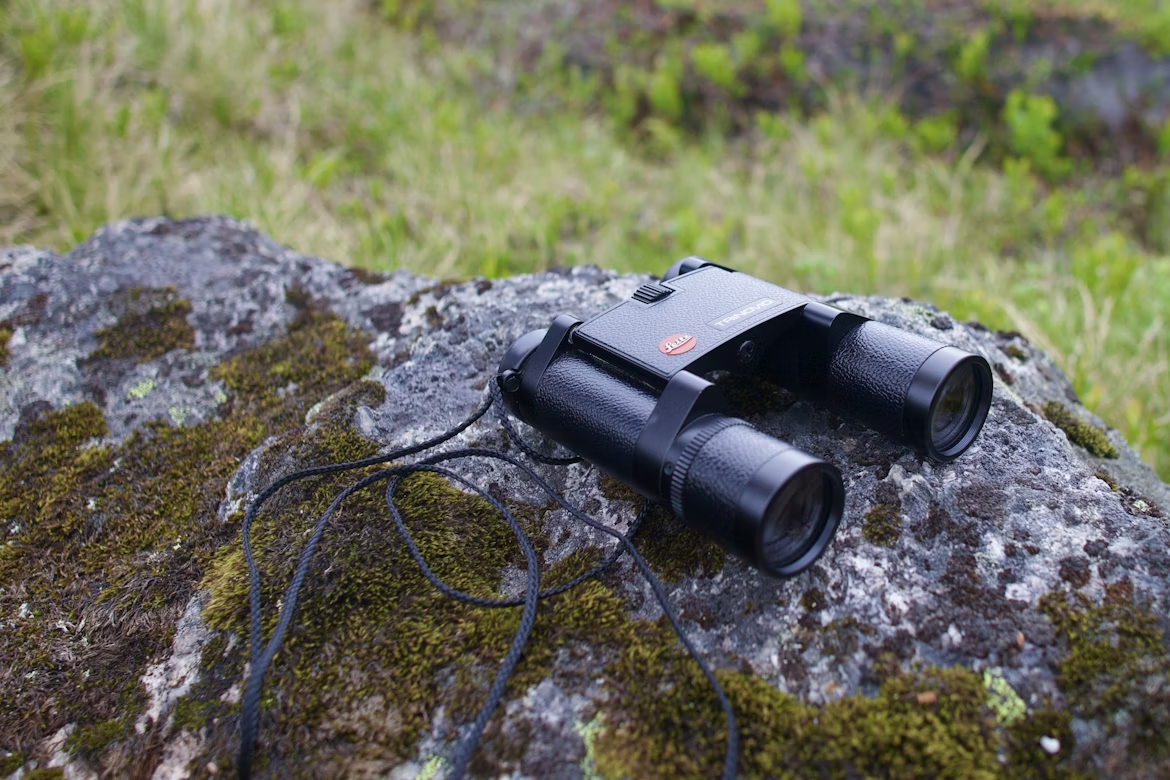
Most lists for the 5 best binoculars with cameras treat this category like it makes perfect sense. It does not. These products are awkward by nature. Some lean toward real optics. Some are basically small digital gadgets shaped like binoculars.
A few are genuinely useful. That is the split that matters. If you care about birding, wildlife, sports, or after-dark viewing, the right pick depends on where you’re willing to compromise.
Magnification helps, but more power usually narrows field of view and makes shake easier to notice, which is exactly why birding guides from Cornell keep stressing that higher magnification is not automatically better.
Related articles
- 9 Best Cameras for Bird Photography (Sony, Nikon, Canon, More)
- 5 Best SD Cards for Photography (By Budget & Niche)
Quick picks
| Product | Best for | Magnification | Camera highlights |
|---|---|---|---|
| Swarovski AX Visio 10×32 | Best overall | 10×32 | Built-in photo/video, smart identification features |
| Camonity 12×32 Digital Binoculars | Best starter pick | 12×32 | Video/photo capture, LCD display |
| Minolta 12×32 Digital Binoculars | Best for better video specs | 12×32 | 4K UHD video, 48MP photo, anti-glare screen |
| Bell + Howell BH1232HD | Best for simple operation | 12×32 | HD camera, 4x digital zoom |
| RexingUSA B1 Compass Night Vision | Best for night use | 25mm lens | 4K recording, IR night vision, 5x digital zoom |
| Product | Screen | Night vision | Best use case |
|---|---|---|---|
| Swarovski AX Visio 10×32 | App-assisted smart interface | No | Serious birding and premium wildlife use |
| Camonity 12×32 Digital Binoculars | 2-inch LCD | No | Casual birding, travel, events |
| Minolta 12×32 Digital Binoculars | 2.4-inch IPS LCD | No | Better daytime recording |
| Bell + Howell BH1232HD | 2-inch IPS LCD | No | Straightforward, uncomplicated use |
| RexingUSA B1 Compass Night Vision | TFT/IPS display | Yes | Night wildlife, property monitoring, dark environments |
How I picked these
I did not rank these like regular binoculars, because they are not regular binoculars.
I looked for five things: actual binocular usability, useful recording features, reasonable clarity, clear fit for a specific type of buyer, and current retail availability. That last part matters more than people admit. Plenty of “best” roundups are built around products you cannot even buy anymore.
One more thing. I am not pretending every model here plays the same game. The Swarovski is in a different universe. The others are here because they solve narrower problems well enough to deserve a place.
1. Minolta 12×32 Digital Binoculars
Best for better video specs
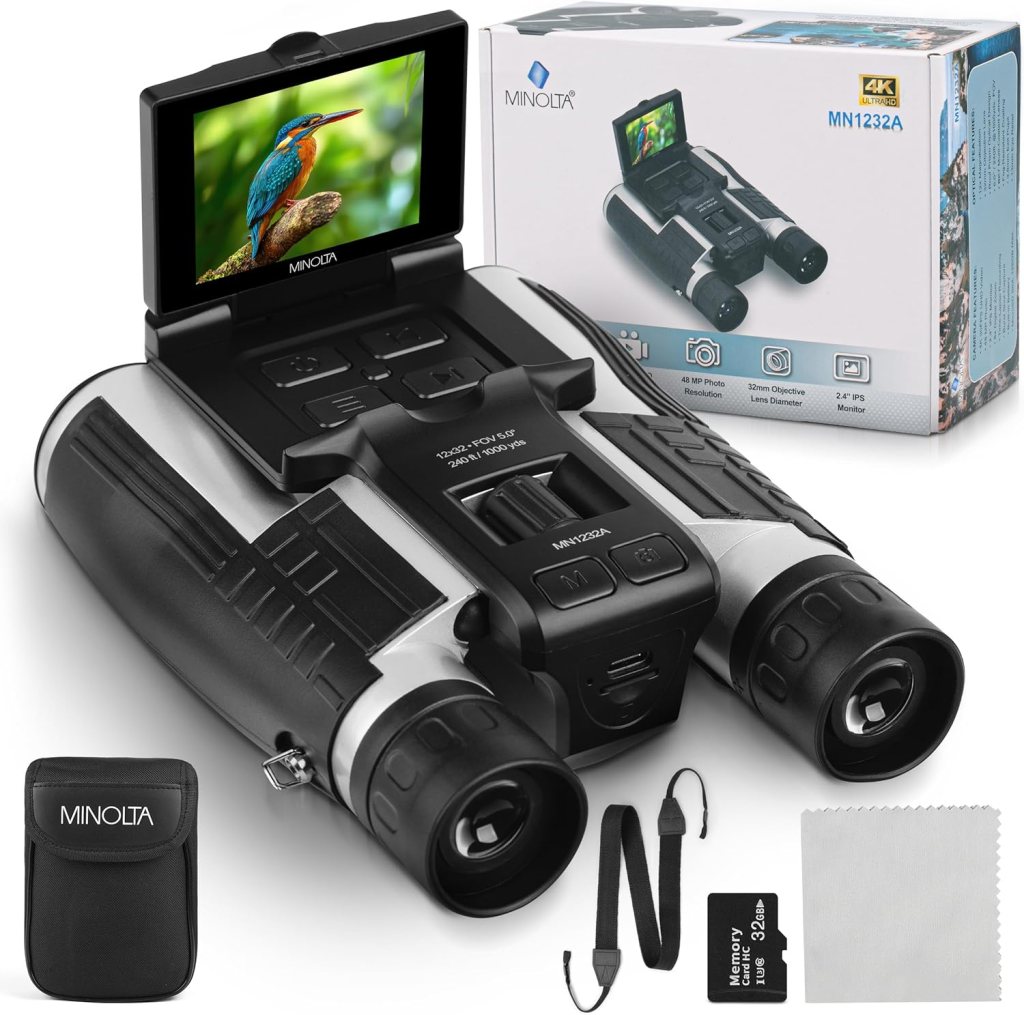
Minolta’s 12×32 digital binoculars make a stronger case for themselves on paper than most of the midrange field.
The current listing highlights 12x optical magnification, built-in 4K UHD recording, 48MP photo capture, a 2.4-inch IPS anti-glare screen, and fog-resistant optics. That is a cleaner, more modern feature package than the usual bargain-bin camera-binocular stuff.
I would not pretend 4K here means “cinematic.” It does not. But it does signal a model built for people who care a bit more about what comes home on the card.
That makes this one a smart fit for wildlife watchers, travelers, and outdoor users who want better capture specs without leaping all the way into the Swarovski bracket.
Review summary:
The Minolta feels like the more ambitious middle-ground pick. It is still a compromise product, but at least it is aiming at useful video, not just novelty recording.
Pros
- 4K UHD video and 48MP photo capture
- Anti-glare IPS screen is a nice practical touch
- 12×32 format suits travel and wildlife use
- Fog-resistant optics help outdoors
Cons
- Still not in the same class as a dedicated camera or premium binocular
- More spec-heavy than optics-heavy
- Likely best for daylight and fair weather use
Real Testimonial
The Camonity feels like the easiest entry into the category. It offers 12×32 binocular viewing, a built-in camera/recorder setup, and a small LCD display in a format that makes sense for bird watching, games, concerts, and casual outdoor use. This is not the refined choice, but it is a very understandable one. That matters. It looks like the kind of product people will actually take outside and use instead of endlessly “testing.”
2. Camonity 12×32 Digital Binoculars
Best starter pick
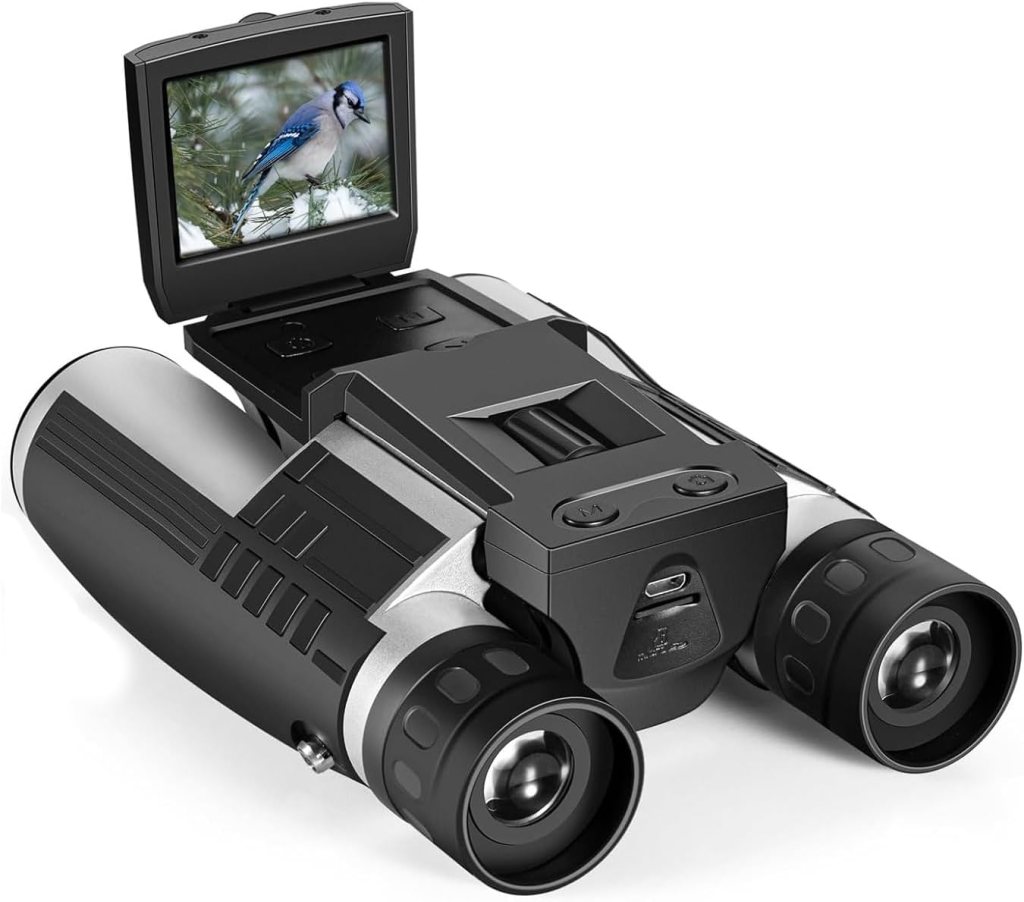
The Camonity 12×32 is the one I would hand to a curious beginner who wants to try this category without stumbling into total junk.
It is a straightforward 12×32 digital binocular with video and photo recording, a 2-inch LCD, and a built-in camcorder-style approach that makes sense for daytime birding, sightseeing, concerts, and casual outdoor use. Amazon’s current listing also notes 12x magnification and support for photo and video recording.
This is not refined. It is not elegant. But it has the kind of layout that makes immediate sense. You look, frame, record, move on.
That simplicity matters more than spec-sheet drama in this tier. Some buyers do not need “the best image quality possible.” They need a unit they will actually use instead of returning after two weekends.
Review summary:
The Camonity works because it keeps the concept readable. It does enough, the controls make sense, and it is easy to imagine using it on a real trip rather than just testing it indoors once.
Pros
- Easy entry point into the category
- Useful LCD display
- Good fit for casual birding, travel, and events
- Light enough for relaxed day use
Cons
- Not a premium optical experience
- Better for daylight than difficult lighting
- Recording quality is functional, not special
Real Testimonial
The Camonity feels like the easiest entry into the category. It offers 12×32 binocular viewing, a built-in camera/recorder setup, and a small LCD display in a format that makes sense for bird watching, games, concerts, and casual outdoor use. This is not the refined choice, but it is a very understandable one. That matters. It looks like the kind of product people will actually take outside and use instead of endlessly “testing.”
3. Swarovski AX Visio 10×32 Smart Binocular
Best overall
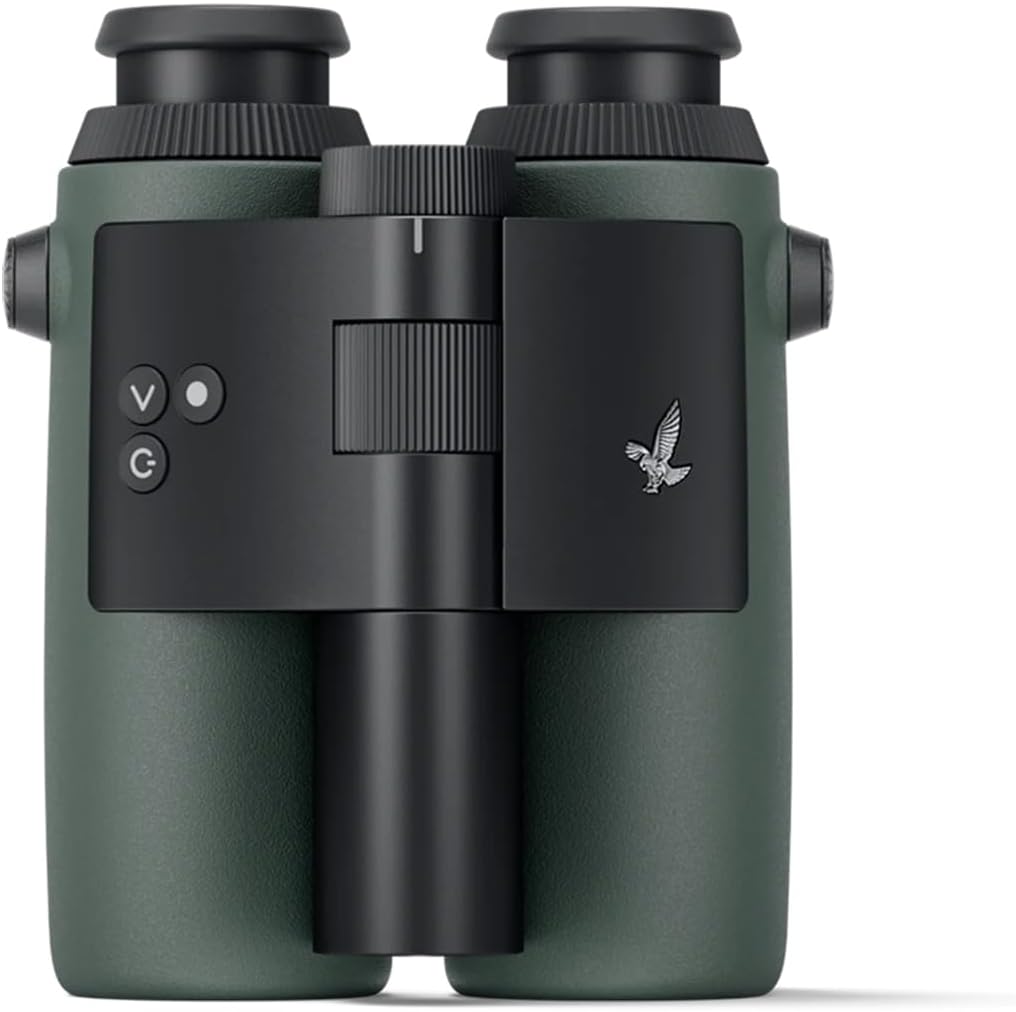
The Swarovski AX Visio 10×32 is the one I would actually want to own if money were not part of the conversation.
It is a real premium binocular first, which is rare in this category. Swarovski positions it as a 10×32 smart binocular with built-in photo and video capture, plus identification and “share discoveries” functions. That combination is why it sits at the top. It is not just a gadget with lenses attached.
For birding and wildlife, that matters. A lot. You can forgive a camera binocular for average video if the glass is strong and the handling feels right. You cannot forgive bad optics when the whole point is seeing something clearly before you record it.
The only real catch is obvious. This is a premium tool with premium pricing. That is not a flaw. It just narrows the audience fast.
Review summary:
This is the only pick here that feels like a serious binocular with extra intelligence layered on top. If you want one product that makes the most sense for demanding wildlife use, this is it.
Pros
- Excellent 10×32 binocular platform
- Built-in photo and video capture
- Smart bird and wildlife identification features
- Feels purpose-built, not novelty-driven
Cons
- Far more expensive than the rest
- Overkill for casual use
- Not the simplest option for someone who wants pure point-and-shoot ease
Real Testimonial
This is the clear top-tier pick. It stands out because it is built on a serious 10×32 binocular platform and adds built-in photo/video capture, AI-assisted identification, and app support instead of feeling like a toy with a screen. I would treat it as the best option for people who care first about the viewing experience and second about the smart features. The downside is obvious: it is a very expensive, specialized buy.
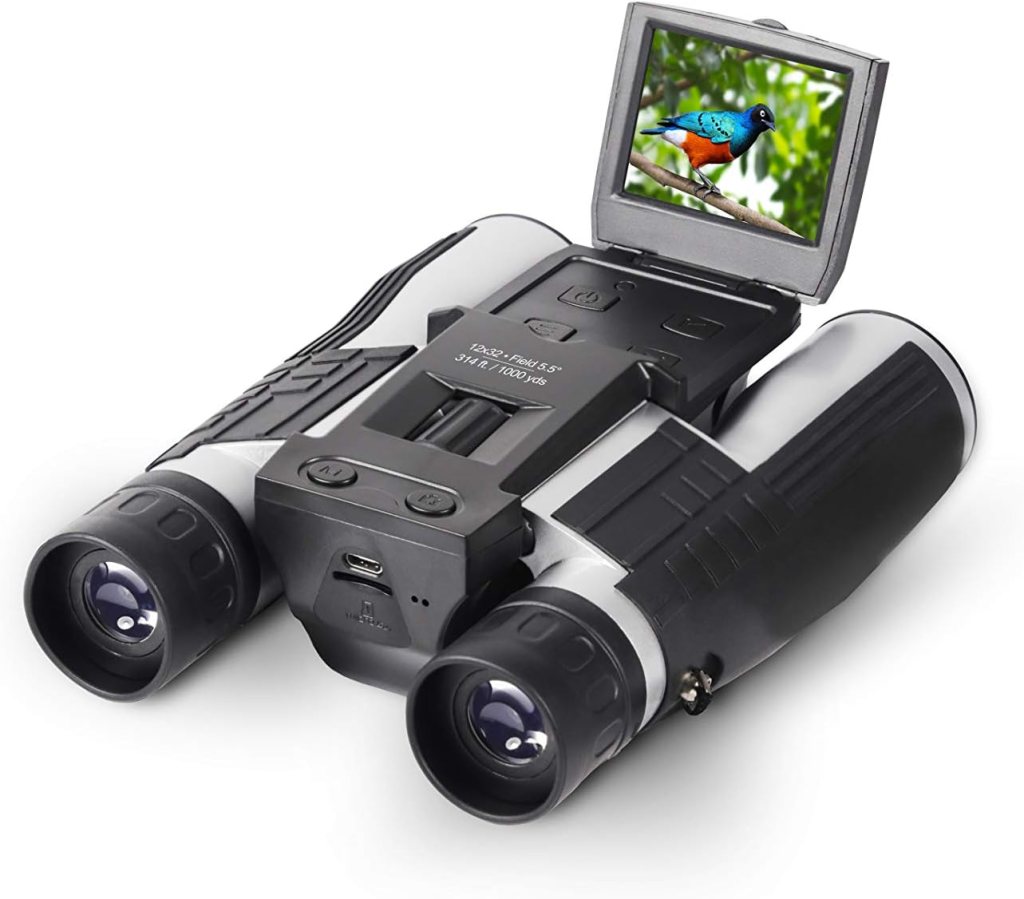
4. Bell + Howell BH1232HD
Best for simple operation
Some people do not want smart features. They do not want app logic. They do not want a menu maze.
They want to pick the thing up and use it.
That is why the Bell + Howell BH1232HD made the list. Its current listing focuses on 12x magnification, HD camera functionality, 4x digital zoom, and a very direct control scheme built around uncomplicated use.
The 2-inch IPS display and 5MP photo / Full HD 1080p video language show exactly what kind of product this is.
No mystery here. It is not trying to be luxurious. It is not trying to be smart. It is trying to be usable.
That honesty counts for something.
Review summary:
This is the least intimidating pick in the lineup. You buy it because you want the format, not because you want to tinker with features all afternoon.
Pros
- Straightforward controls
- Clear use case for events, sightseeing, and casual outdoor viewing
- HD capture is enough for basic use
- Easier learning curve than smart or spec-heavy models
Cons
- Digital zoom is never as appealing as it sounds
- Modest photo and video expectations are necessary
- Not the strongest choice for demanding wildlife observation
Real Testimonial
Minolta’s model is the strongest middle-ground option if you care more about recorded output. The current listing leans on 4K UHD video, 48MP photo capture, an IPS anti-glare screen, and fog-resistant optics, which gives it a more modern and more ambitious feature set than a lot of generic digital binoculars. I would not confuse that with premium glass, but I would say it makes the most sense for someone who wants better-looking files without jumping into Swarovski territory.
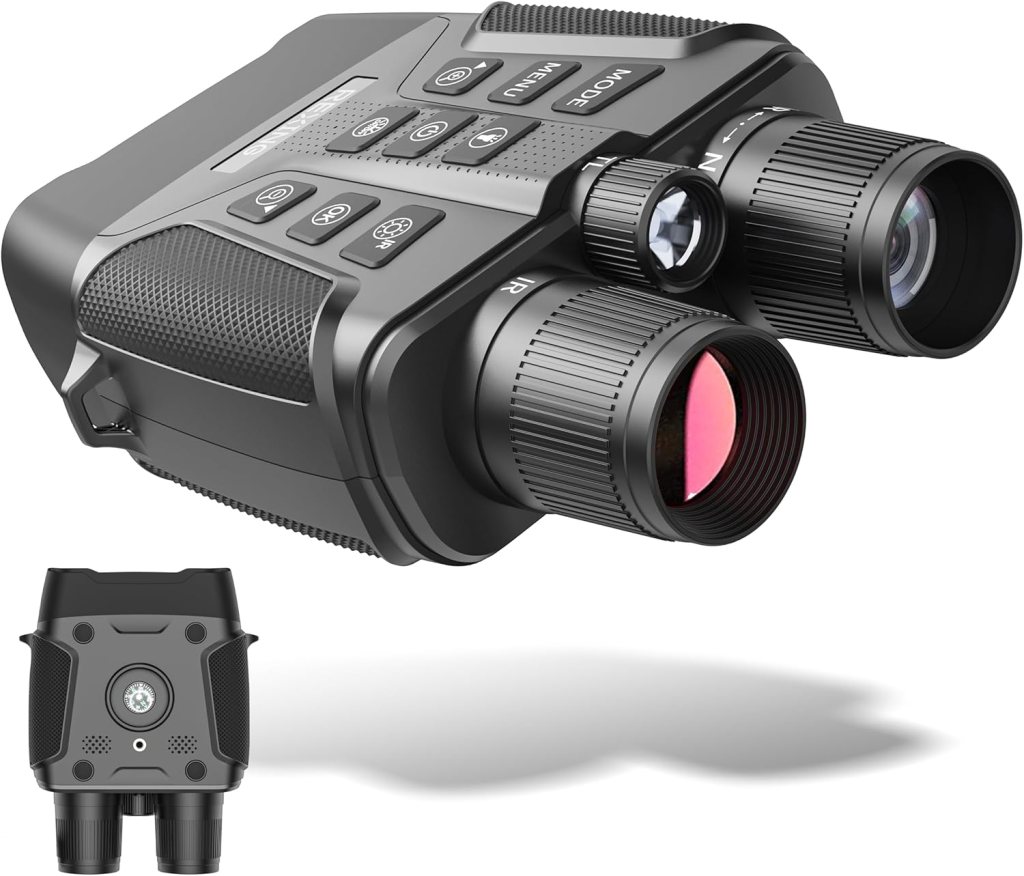
5. RexingUSA B1 Compass Night Vision Binoculars
Best for night use
Night vision changes the conversation.
You are no longer choosing the best all-around binocular. You are choosing the right tool for darkness, which comes with its own tradeoffs. The RexingUSA B1 Compass is built around that reality. Its current listing highlights 4K video, IR night vision, a 25mm lens, 5x digital zoom, and night viewing up to 1,968 feet.
Would I buy this for daytime birding? No.
Would I buy it for nighttime wildlife watching, campsite observation, rural property checks, or just curiosity after sunset? That makes more sense.
This is the specialist in the group. It earns its slot because the use case is real, not because it is the most universally appealing.
Review summary:
The Rexing is here for one reason: it works in conditions where the others are simply the wrong tool. That is enough.
Pros
- Built for dark conditions
- 4K recording is welcome in this category
- IR night vision makes it genuinely different from the daytime models
- Useful for property, camping, and nighttime wildlife use
Cons
- Not the right buy for normal daytime birding
- Digital night products always involve image tradeoffs
- More niche than the rest of this list
Real Testimonial
This is the specialist pick. It is here because it does a different job than the others. The B1 Compass is built around 4K capture, infrared night vision, a 25mm lens, 5x digital zoom, an integrated compass, and weather-resistant construction, so it makes more sense for dark conditions, rural property use, nighttime wildlife observation, or camping than for normal daytime birding.
Which one should you actually buy?
If you want the best overall, buy the Swarovski AX Visio 10×32.
If you want a friendlier starting point, buy the Camonity.
If recording specs matter more to you than brand prestige, the Minolta is the sharper play.
If you hate complicated gear, the Bell + Howell makes more sense than the fancier alternatives.
If your real use starts after sunset, skip the daytime models and go straight to the Rexing.
That is the whole thing. Five products. Five different buyers. Much cleaner than pretending one answer fits everybody.
What matters most in binoculars with cameras
Magnification matters, but not in the lazy way people think. Cornell and REI both make the same broader point in different language: more magnification helps at distance, but it narrows field of view and can make the image harder to hold steady.
Compact 32mm formats are easier to carry, while larger lenses usually help with light gathering but add bulk.
That is why I do not obsess over the biggest number on the box.
I care more about this:
- Whether the binocular part is actually pleasant to use
- Whether the screen is readable outdoors
- Whether the recording feature feels like a tool instead of a gimmick
- Whether the product fits a real use case
- Whether the extra tech gets in the way
A lot of these models live or die on that last point.
FAQ
Are binoculars with built-in cameras worth buying?
They can be. The good ones make sense for birding, travel, sports, or night viewing when you want one device instead of juggling binoculars and a separate camera. The bad ones feel like toys. This category rewards selectivity.
What is the best binocular camera for bird watching?
For serious birding, the Swarovski AX Visio 10×32 is the best pick in this group because it combines premium binocular quality with built-in capture and smart identification features.
Are binoculars with cameras better than regular binoculars?
Not usually for pure optical performance. A dedicated binocular is often the better viewing tool. A binocular with a camera makes sense when recording matters enough to justify the compromise.
What magnification is best for binoculars with cameras?
For general use, 8x and 10x are usually the practical zone. Higher magnification narrows field of view and makes shake easier to see, which is why many birding guides still favor 8x for easier tracking and steadier viewing.
Do binoculars with cameras take real photos or just snapshots?
They take real photos, but quality varies a lot. Premium models and better digital models can produce genuinely usable images. Lower-end models are often better for documentation than for beautiful photography.
Can binoculars with cameras replace a real telephoto camera?
No. Not for anyone serious about image quality. They can replace the need to carry a second casual device, but they do not replace a good long-lens camera setup.
Are digital binoculars good for sports and concerts?
Yes, some are. The Camonity and Bell + Howell models make decent sense for casual sports and event use because they are easy to operate and built around simple daytime recording.
Are night vision binoculars good in daylight?
They can work in daylight, but that is not really the point. Night vision models earn their place because they handle darkness. For normal daytime birding or sightseeing, a standard optical model usually makes more sense.
Why do some binocular cameras look sharper through the lenses than in the recorded video?
Because optical viewing and digital capture are different pipelines. You may be seeing a decent image through the binocular optics while the sensor, processor, and compression system produce weaker recorded footage.
Do binoculars with cameras need a memory card?
Most do if you want to save photos and video regularly. Some ship with storage accessories, but long-term use usually means managing your own cards and file transfer routine.
Are smart binoculars worth the extra money?
Only if you will actually use the added features. On something like the Swarovski AX Visio, smart identification and capture are part of a serious field tool. On a casual buy, extra features can just mean extra friction.
What is the best binocular with camera for travel?
The Minolta 12×32 and Camonity 12×32 both make sense for travel because the 32mm format stays relatively compact while still giving useful reach. REI also notes that 32mm binoculars are a good midsize option when you want something more compact than a 42mm model.
How long do binocular cameras last on one charge?
That varies a lot by screen use, recording time, and whether the device uses night vision. In practice, digital features drain power much faster than plain binocular viewing, so battery habits matter more here than with ordinary binoculars.
What should I avoid when buying binoculars with cameras?
Avoid buying based only on huge zoom claims, inflated resolution numbers, or vague marketing language. Good handling, useful optics, and a believable use case matter more than flashy numbers.
Final verdict
The category is messy. Still, there is a clear winner.
The Swarovski AX Visio 10×32 is the best overall pick because it starts with serious optics and adds genuinely interesting smart features on top.
The Camonity is the best starter option because it keeps the whole idea approachable.
Minolta is the one I would watch if you care more about recorded output.
Bell + Howell keeps things simple.
Rexing owns the night-use lane.
If you are still undecided, think less about specs and more about distance, light, and steadiness. REI’s binocular guide gets that part right: 10x can make sense when subjects are farther away, while 32mm binoculars stay more compact and easier to carry than larger formats.
Affiliate Disclaimer
This article contains affiliate links. We may earn a small commission if you purchase through these links, at no extra cost to you.




Leave a Reply